

Generated content is ready to publish only when its important claims are verified and its language matches your brand. Start by comparing the draft with approved writing examples, checking claims against authoritative sources, and recording unresolved issues. A detector score cannot replace those checks.

Voice and accuracy need separate attention. A draft might sound confident but exaggerate a product benefit. Another might get the facts right while sounding dismissive toward readers. Neither a favorable nor an unfavorable detector result tells you whether those problems exist.
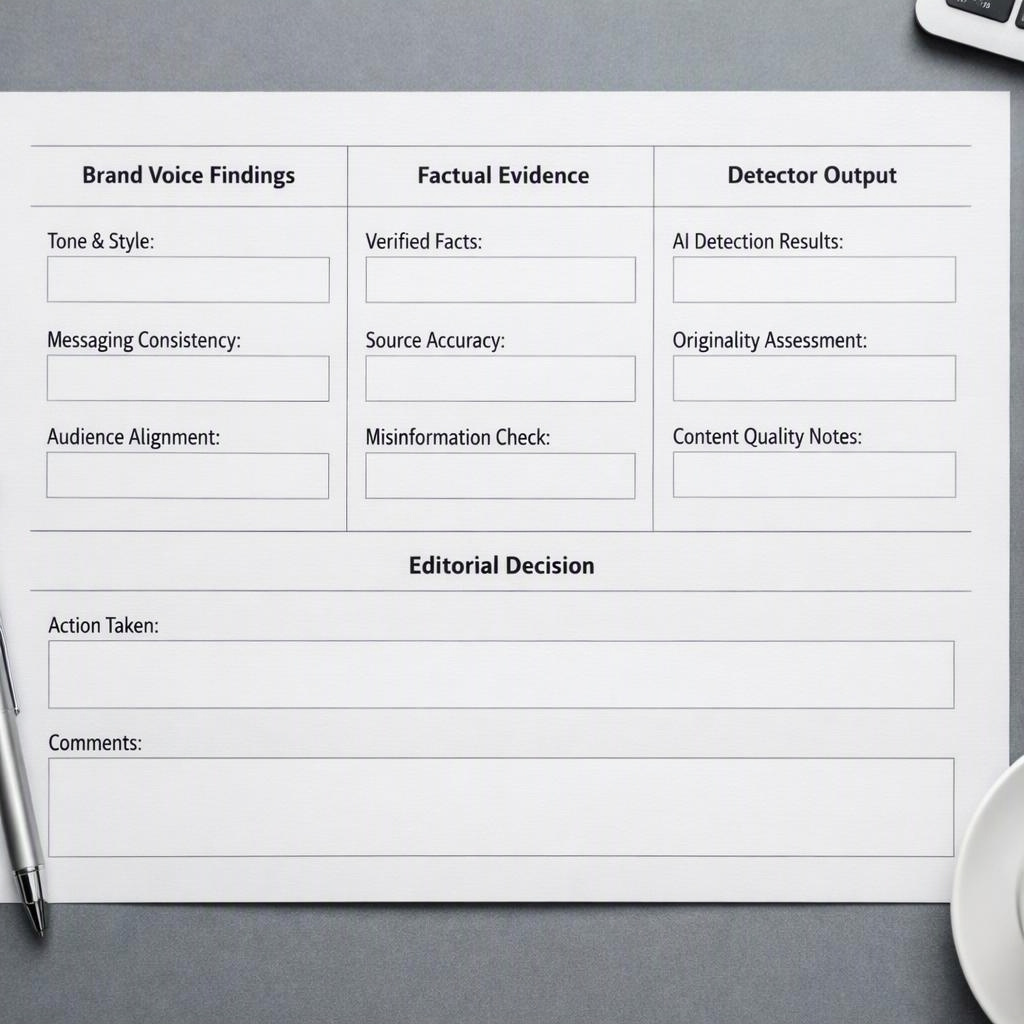
Use this workflow to turn a broad search such as “content brand accuracy smart” into a repeatable editorial review. Keep voice findings, evidence checks, and optional detector results separate. Attach each record to a specific draft version. The editing-case template below is intentionally blank because no permission-cleared example was provided; it shows what to document without inventing results.
Separate Detector Results From Publication Readiness
Treat detection as an optional record, not a publication gate. The content detector for SEO review guidance is worth comparing with your current checklist if your team needs a separate detection step. Check whether that step answers a defined workflow question before adding it. Do not assume it verifies facts, measures brand fit, or predicts search performance.
Preserve the detector’s original label and any stated limitations. Do not relabel its output as “accurate,” “on-brand,” or “ready.” Record the draft identifier so a result from an earlier revision is not mistaken for a review of the final copy.
Record Voice, Evidence, and Detector Findings Separately
- Brand voice column: Approved example: ____; passage reviewed: ____; mismatch: ____; required edit: ____.
- Factual evidence column: Claim: ____; authoritative source and location: ____; relevant date, market, or version: ____; verification status: ____.
- Detector output column: Tool: ____; version, if available: ____; review date: ____; draft identifier: ____; output and limitations: ____.
- Separate editorial decision: Publish, revise, escalate, or hold: ____; rationale: ____; owner: ____; unresolved blockers: ____.
Use these fields as a three-column worksheet with a separate decision field. Never average them into one quality score. Strong writing cannot compensate for an unsupported claim, and verified facts do not excuse inappropriate language.
Check Brand Voice and Claims Against Approved Evidence
Review specific passages rather than leaving broad comments such as “make this sound more like us.” Identify the wording, explain the mismatch, and point to an approved example. Then verify the underlying claim independently. For readers outside the United States, confirm whether US prices, terminology, availability, and promises apply in their market.
- Voice: Check formality, confidence, terminology, sentence length, and respectful audience language. Tie corrections to approved references rather than personal preferences.
- Facts: Verify names, dates, numbers, product statements, quotations, and references. Open each source and confirm that it supports the exact claim, not merely the general topic.
- Scope: Check eligibility, units, time periods, geographic limits, and product versions. A correct number can still mislead when its conditions are missing.
- Disposition: Mark claims supported, contradicted, or unverified. Correct or remove unsupported assertions. Add qualifications only when the evidence supports the narrower wording.
Use a Verified Editing Case to Show What Changed and Why
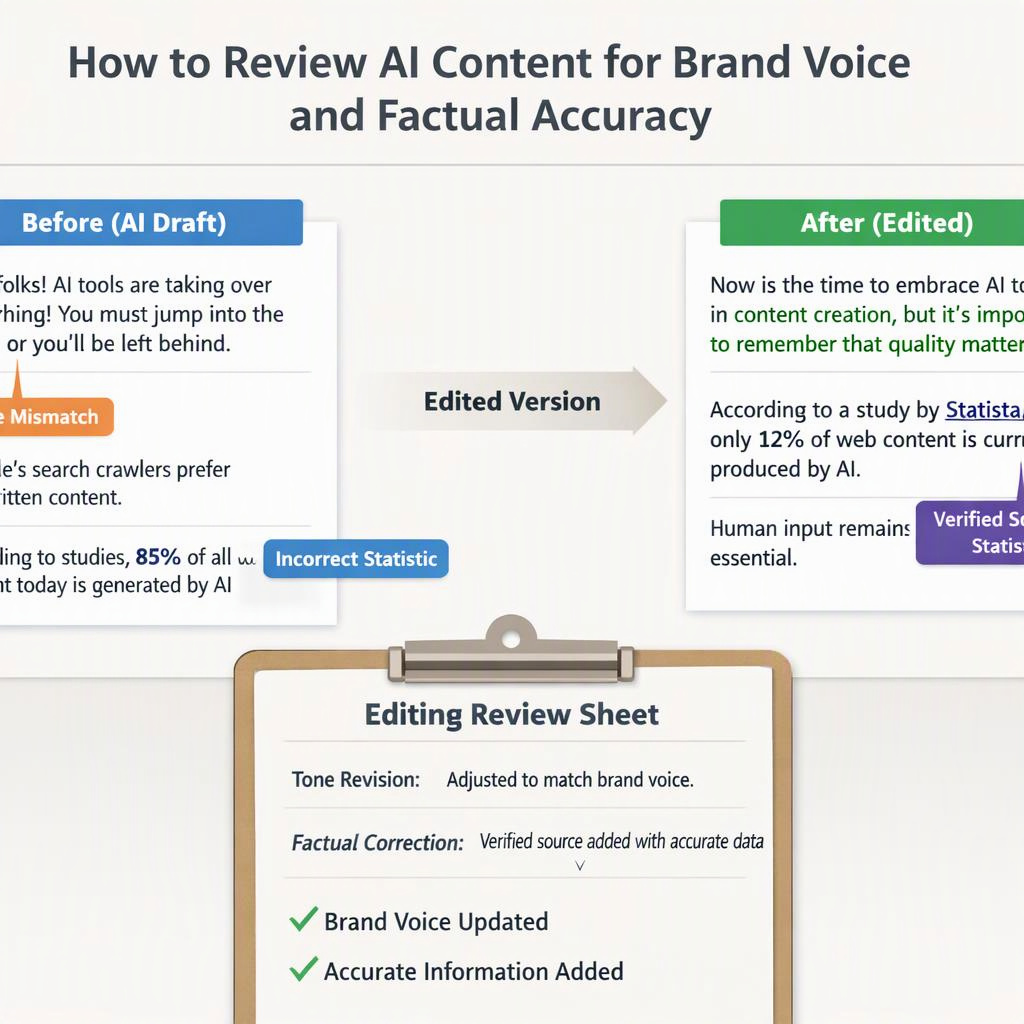
A useful editing case connects each change to a documented reason. It requires permission-cleared original and final excerpts, reviewer notes, and source records. Those materials were not supplied here, so leave this template blank until a real example is available.
- Original passage and problem: ____.
- Revised passage: ____.
- Voice correction and approved reference: ____.
- Factual correction, supporting source, and verification date: ____.
- Detector record, if used: ____; include the tool, version when available, and review date. Do not attribute better editing to a changed score.
Choose What to Publish, Revise, or Escalate
Decide based on unresolved issues and their consequences, not the draft’s polish. Before reviewing, agree on acceptance criteria: approved terminology, evidence for material claims, visible limitations, and any required specialist approval. Assign each blocker to someone who can resolve it.
- Publish: Material claims are supported, language matches approved voice references, relevant limitations are visible, and required approvals are recorded.
- Revise: Routine editing can resolve the issue. Examples include exaggerated adjectives, inconsistent terminology, or an outdated statement with a verified replacement.
- Escalate: Sources conflict, product commitments are uncertain, or consequential medical, legal, or financial statements need a qualified reviewer.
- Hold: Missing evidence prevents a responsible decision. Record what is needed and who should provide it instead of filling the gap with plausible wording.
After editing, recheck the affected claims and nearby text. A factual correction may weaken the headline’s promise; a tone adjustment may accidentally remove an essential qualification. Review the title and meta description against the final article so they answer the reader’s question without promising more than the evidence supports.
Confirm that approvals cover the final draft, not an earlier version. If you rerun a detector, log the new output separately. The documented edits and supporting sources—not a score change—must explain whether accuracy or brand fit improved.

Conclusion
Generated content is publishable only when its material claims are verified and its language follows approved brand standards. Detector output cannot establish either condition. Separate records make the decision easier to explain, hand off, and audit.
For a draft awaiting approval, compare its claims with current authoritative sources and its wording with approved brand examples. Check dates, market restrictions, product versions, and headline promises; assign an owner to every blocker. If your team needs detection, use the detector review guidance to compare intended use, documented limitations, and data-handling terms before adding that step. Finish by confirming that the final draft has the required evidence and approvals.
FAQ
Can a favorable detector result confirm that content is accurate and on-brand?
No. It does not establish factual correctness, authorship, or brand alignment. Check claims against authoritative evidence and compare language with approved examples. A reassuring result can coexist with unsupported promises or inappropriate wording.
How can editors check brand voice without a formal style guide?
Collect several approved pieces written for the same audience and purpose. Draft provisional rules for terminology, formality, confidence, and tone, then ask the brand owner to approve them. Document exceptions so individual preferences do not become unwritten requirements.
When is a content detector a logical addition to the workflow?
When your team has a defined need for a separate detection record. It is not a substitute for fact-checking or specialist review. Compare its intended use, documented limitations, and data-handling terms with your requirements before submitting a draft.
What should an editor do when a claim cannot be verified?
Mark it unverified and request evidence from the responsible owner. Remove it or narrow it to what available sources support. Escalate consequential claims, and hold publication when uncertainty affects the article’s central promise. Before approval, verify the replacement wording against the source.