
The winston smart detector may be worth comparing for routine document screening, but its usefulness depends on your documents, languages, reporting needs, and tolerance for errors. A score alone cannot establish how a passage was written. Educators, editors, and publishers need results they can interpret, record, and question before acting on them.

Review status: untested evaluation. No hands-on tests or current official-source checks were completed for this article. It provides an evaluation method, not measured accuracy, confirmed features, or a purchase recommendation. Detection languages, export options, account restrictions, and document-handling policies remain unverified.
The practical question is whether screening helps your team review documents without turning uncertain classifications into accusations. For recurring checks, Winston is worth evaluating against output clarity, recordkeeping, and review effort. You can check a nonconfidential sample of known origin and save an unchanged copy for comparison with Winston. This comparison route does not imply equivalent features or better accuracy.
Same-Sample Tests: What the Results Can Actually Establish
Start with passages whose origins you can document, rather than examples chosen for dramatic results. Include human-written material shared with permission, machine-generated passages, and clearly labeled edited versions. Use document types your team actually handles, such as student essays, articles, or publication drafts. Exclude confidential text and establish provenance before testing.
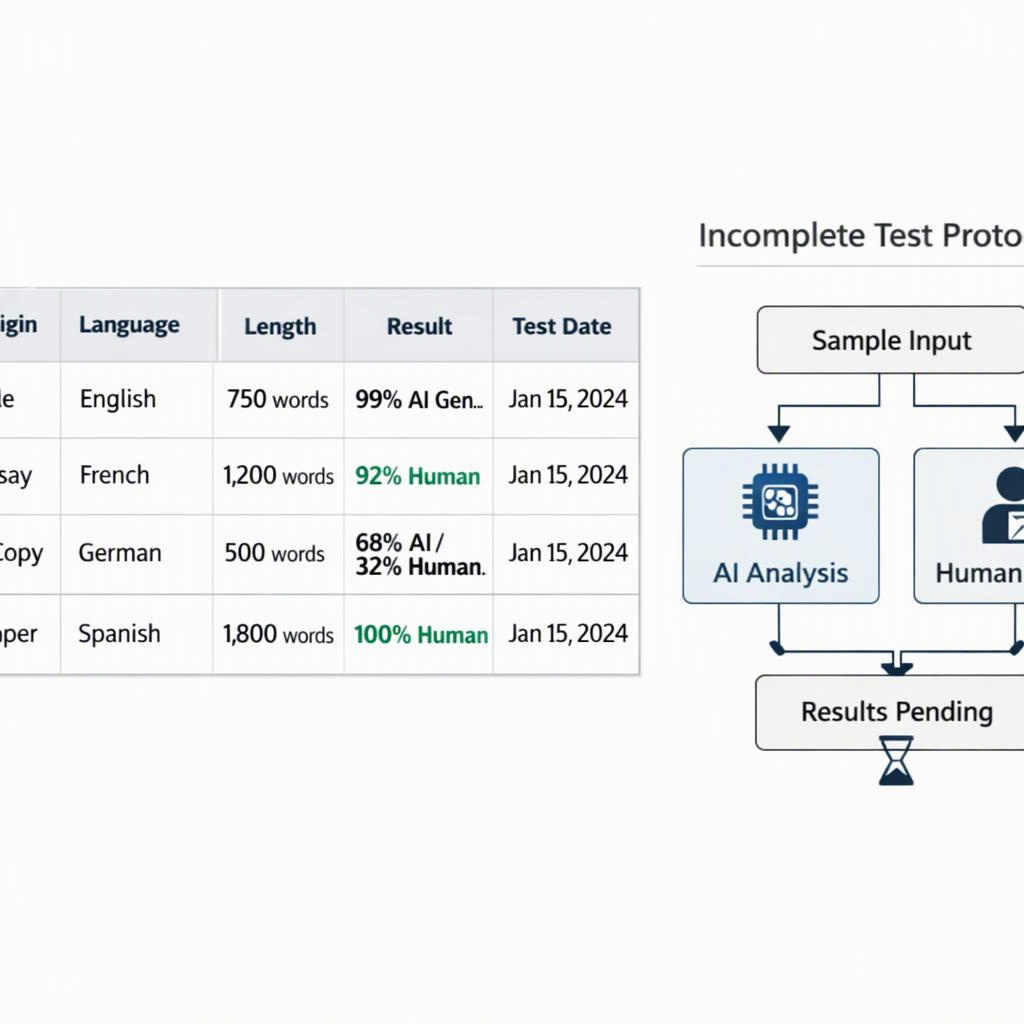
- Prepare: Give each passage an identifier. Record its origin, language, word count, document type, and preparation steps. Keep edited versions separate so their results do not become confused with the originals.
- Run: Submit identical text to each candidate. Record the date, account tier, settings, and input method, plus any rejection or length restriction. Do not quietly shorten a passage for one service.
- Capture: Save the exact displayed result, including explanatory labels. Log repeat runs separately instead of replacing earlier outputs. Note anything that makes the result difficult to interpret.
- Summarize: Group results by origin and document type. Give the numerator and denominator for every calculated rate, and report ambiguous or incomplete results rather than excluding them without explanation.
Protocol only; no results are reported here. False positives, missed detections, and repeatability measure different things. A displayed score is not necessarily a validated probability of authorship. Consistent results show repeatability under the recorded conditions, not correctness. A small test set can reveal workflow problems, but it cannot establish accuracy across all writers, genres, or languages.
Supported Languages and Report Formats: Verify Your Requirements
Which languages does Winston currently support for detection? This review does not establish a current list. No official language documentation was supplied or verified. Interface translations and language support for other features do not prove detection coverage. Even confirmed coverage does not establish reliable performance on your genre, dialect, or mixed-language documents.
- Detection coverage: Check every required language against current official documentation. Save the source, access date, and stated restrictions. Then test representative passages rather than assuming that listed support guarantees useful results.
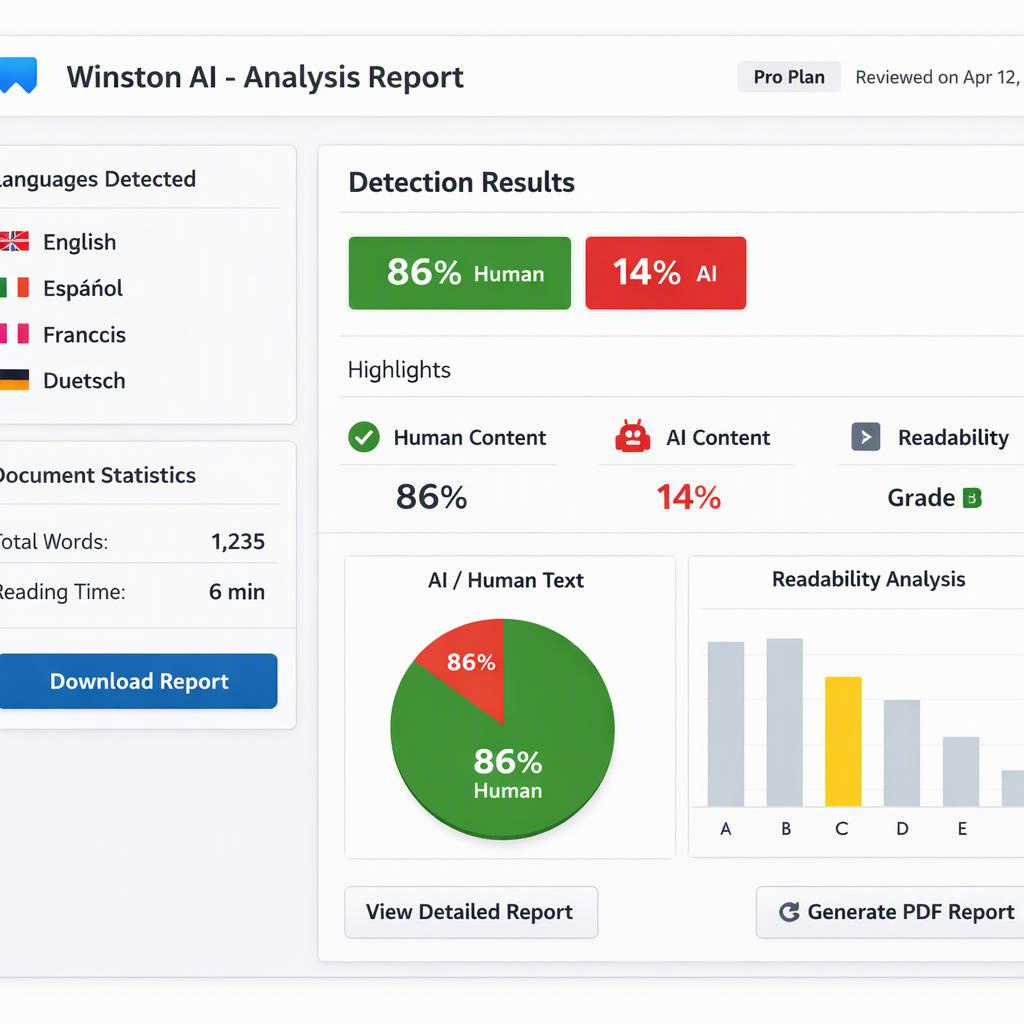
- On-screen results: Inspect the scores, labels, explanations, and any passage-level indicators available in the relevant account. Their presence and meaning are unverified here. Check whether another reviewer can understand the output without extra explanation.
- Downloadable reports: Confirm whether downloads are available, which formats they use, what fields they contain, and whether account restrictions apply. A visible result does not necessarily mean an exportable report exists.
- Sharing: Verify whether results can be shared, who can open them, and what access controls apply. Check whether sharing exposes the submitted text as well as its classification.
Keep vendor claims separate from your observations. Date each observation and identify the account tier used. If you retain screenshots, remove personal information and confirm permission. No report was inspected for this article, so neither report contents nor export formats can be recommended as verified capabilities.
Where Winston Fits—and When Additional Review Is Necessary
Winston is worth comparing when your team needs repeatable screening and can send uncertain results to a reviewer. The relevant question is whether its verified outputs help prioritize checks, preserve useful records, and limit unnecessary escalations. Those are evaluation criteria, not confirmed product benefits.
- Routine editorial screening: A potential fit after checking language coverage, reporting, and error patterns. Compare the time needed to interpret and investigate results; an unexplained flag can add work rather than reduce it.
- Multilingual review: Consider only after verifying detection coverage and testing representative samples in each language. English-language results do not establish performance on another language or on submissions that switch between languages.
- Consequential authorship disputes: Unsuitable as standalone evidence. Review drafts, revision history, assignment context, and the writer’s explanation through the applicable process. A classification should not replace that investigation.
- Confidential documents: Wait until authorized staff verify handling, retention, deletion, and access terms against organizational requirements. A document being easy to upload does not mean your team has permission to submit it.
No current Winston privacy or retention policy is asserted here. Check official policies and record access dates before approving sensitive submissions. Educators should also confirm institutional rules. If uploading is inappropriate, revision history and a direct discussion offer another review path without sending the document to an external service.

Conclusion
Winston remains a candidate to evaluate, not a validated recommendation on the evidence available here. It may suit routine screening if verified language coverage, reporting options, and observed results match your documents. This article cannot confirm those conditions because no tests or current official-source checks were completed.
Before adoption, decide what a result should change: who reviews a flag, which independent evidence they consult, and how the writer can respond. Agree on those steps before seeing scores. This keeps an unexpected classification from becoming an improvised accusation and preserves human judgment in consequential decisions.
For recurring editorial or educational checks, verify detection languages, report formats, account restrictions, and document-handling terms first. Then compare the same known-origin passage with Winston under documented conditions. Compare false positives, missed detections, output clarity, traceability, and review time—not just headline scores—to judge whether either option improves your workflow.
FAQ
- When is Winston detector a logical option? It is a candidate for routine screening when a person reviews uncertain results and repeatable checks serve a clear purpose. Verify language coverage, reporting needs, confidentiality terms, and behavior on representative samples first. Do not use it alone to decide misconduct cases.
- Which languages does Winston currently support for detection? This article does not verify a current list. Consult official detection documentation and record the access date. Check your exact language and document type; interface localization or another feature’s language list is not sufficient evidence of detection support.
- Can I download or share a Winston report? Availability, formats, and account restrictions remain unverified here. Check official documentation, then inspect the relevant account. Confirm that saved or shared results retain enough context for later review without exposing personal information or confidential material.
- What should I do if human-written text is flagged? Preserve the original text, displayed result, and test conditions. Check provenance and revision history, and invite the writer’s explanation where appropriate. Treat the result as a possible false positive to investigate, not proof of wrongdoing. Repeated flags alone do not resolve authorship.