

If you’re comparing smart humanizer tools for essays, they may help with wording—but only when edits preserve your meaning, evidence, and permitted level of assistance. A smoother sentence is not better if it overstates your claim, separates it from its citation, or breaks assignment rules. Start by identifying what needs work: awkward sentences, unclear transitions, or gaps in reasoning. Wording tools cannot reliably solve all three.
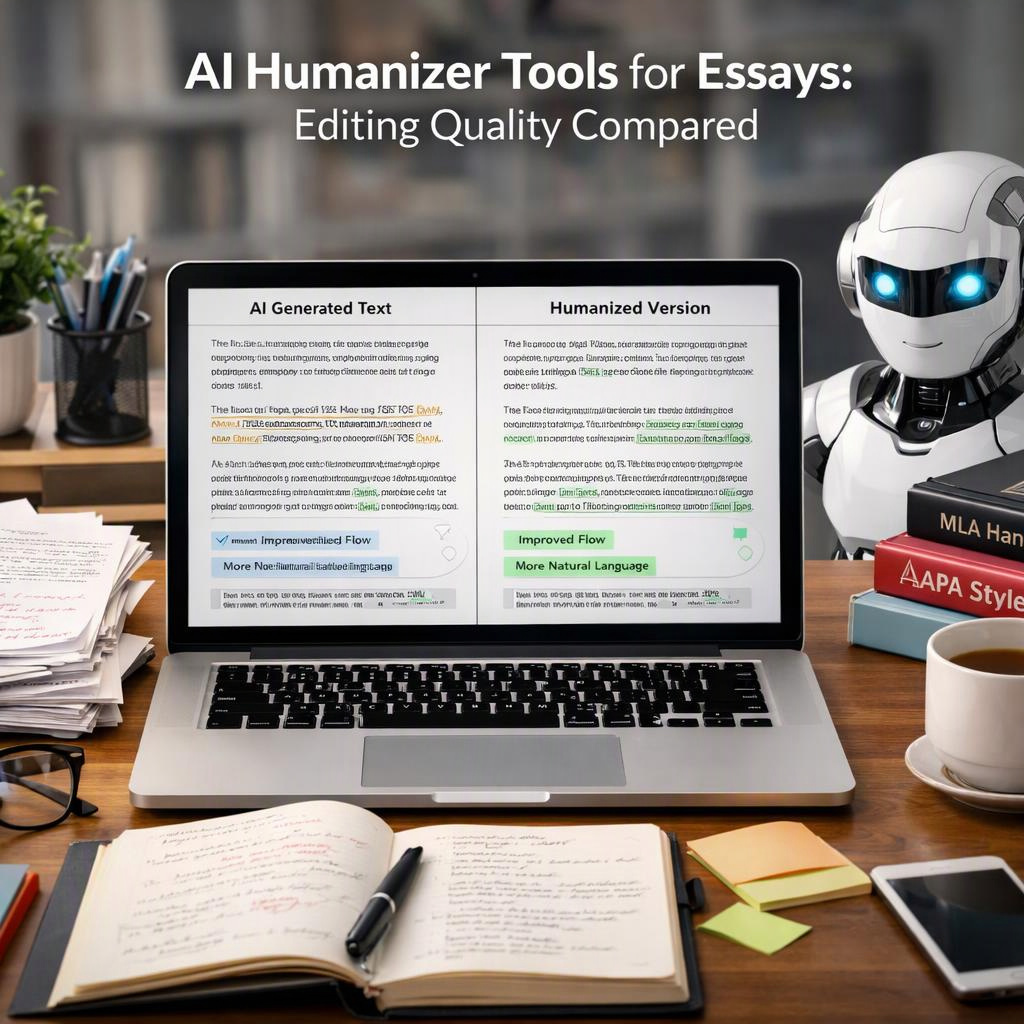
You can compare an essay humanizer as a candidate for sentence-level revision, not as a tested winner. It is relevant when your argument is complete but the prose needs attention; suitability still depends on documented features, privacy terms, and your course rules. No comparative results or verified product specifications were provided for this article, so the criteria below offer a review method rather than a ranking.
Compare Editing Quality: Clarity, Structure, and Argument
Choose a short passage containing a claim, supporting explanation, and transition. Give each candidate the same permitted text and equivalent instructions: improve clarity without adding claims, changing qualifications, or rearranging the reasoning. Keep the original beside each revision so you can judge specific changes rather than the overall impression of polish.
- Sentence clarity: Are subjects, actions, and references easier to follow without losing necessary detail?
- Paragraph order: Does the sequence of claim, evidence, and analysis still make sense?
- Transitions: Do connecting words reflect real relationships rather than inventing a contrast or causal link?
- Thesis consistency: Are the position, scope, and qualifications still aligned with your introduction and conclusion?
- Argument progression: Does each sentence advance the reasoning instead of repeating it in different words?
- Writer’s voice: Does the revision retain your terminology and tone rather than replacing them with generic academic phrasing?
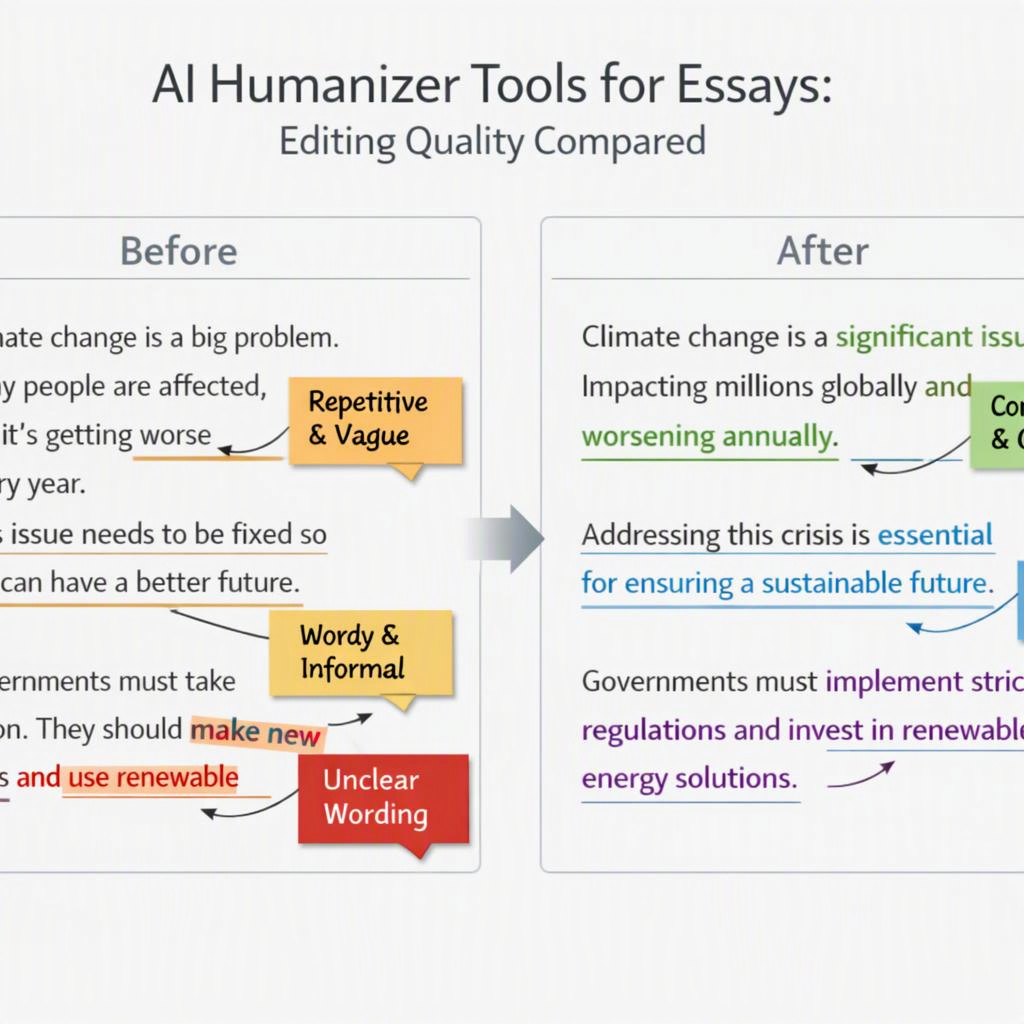
Illustrative example—not tool output: Before: “Because some students work evenings, which makes attendance difficult, the college should consider additional daytime workshops.” After: “The college should consider additional daytime workshops because evening work makes attendance difficult for some students.” The revision puts the recommendation first while preserving “some” and “should consider.” It does not turn a qualified proposal into a requirement. That distinction matters more than whether the new sentence sounds more formal.
Check Citation Integrity and Meaning Before Accepting Edits
Preserving citations means more than leaving reference markers visible. A source must still support the statement beside its citation. Compare the original sentence, revised sentence, and source passage together. Watch for stronger verbs, broader populations, missing conditions, and wording that changes an association into a cause.
- Changed claims: Check who, what, when, where, and how much. Evidence from one group cannot automatically support a conclusion about everyone.
- Missing qualifications: Retain limits such as “may,” “in this sample,” and “under these conditions” when they affect meaning.
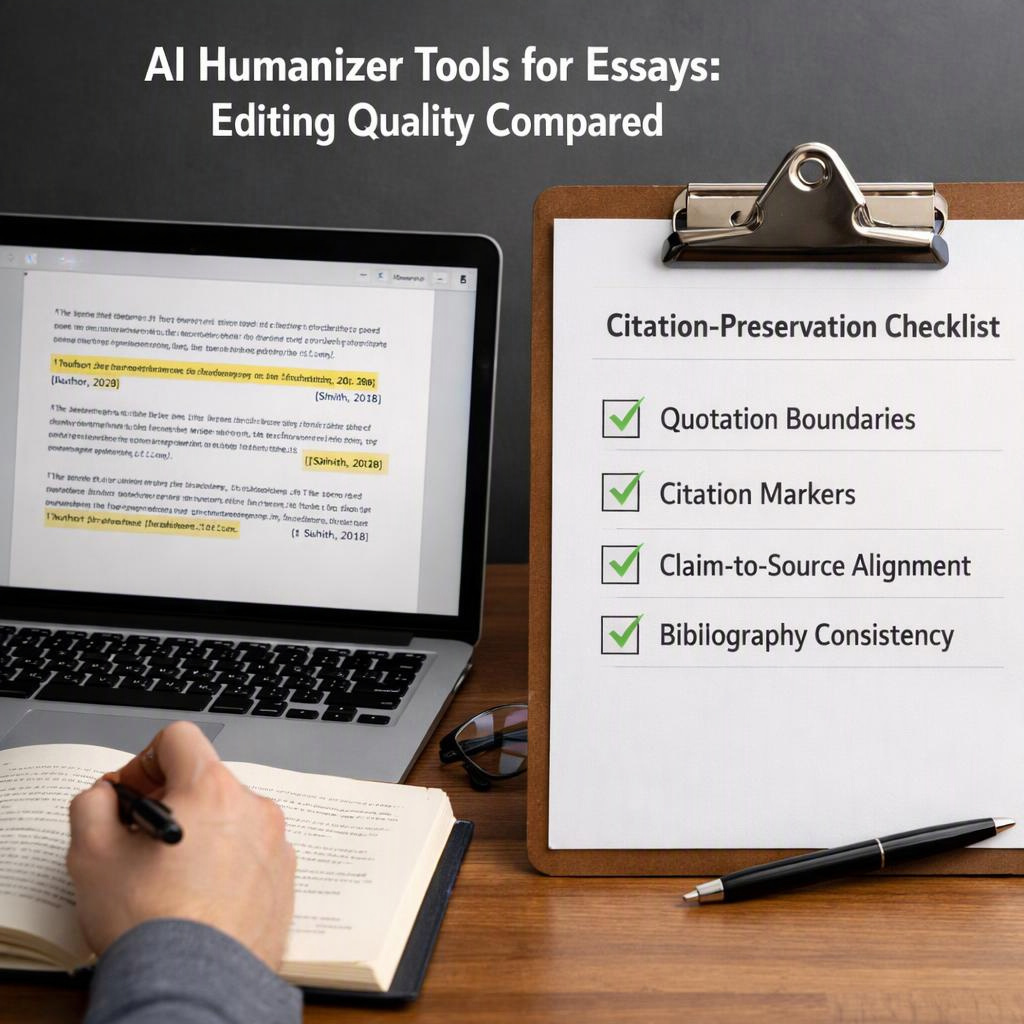
- Quotation boundaries: Match quoted wording to the source. Rephrased text must not remain inside unchanged quotation marks.
- Citation markers: Keep each marker attached to the statement it supports, not a neighboring claim.
- Claim-to-source alignment: Identify the source supporting each factual assertion. Simple labels such as [Claim A] and [Source A] can help during review.
- Bibliography consistency: Confirm that in-text references match bibliography entries and that publication details remain unchanged.
Reject unsupported additions, even when they sound plausible. If a revision introduces a statistic, example, or explanation, remove it or verify it independently before using it. A useful check is to ask: “Could I point to the evidence for this exact wording?” If not, the passage needs more work. Polished language is not evidence.
Match the Editing Approach to Your Essay and Course Rules
Choose an approach based on the problem you need to solve. Before uploading text, check the assignment instructions and current instructor or institutional guidance. Permission to receive proofreading feedback does not necessarily include permission to rewrite passages. Ask your instructor when the boundary is unclear.
- Permitted wording edits: A limited passage review may fit when your reasoning is complete. The main risk is meaning drift. A manual sentence edit and read-aloud check are alternatives.
- Argument-development needs: Rewriting is insufficient when evidence or reasoning is missing. Fluent prose can conceal those gaps. Rebuild the outline or consult a writing center instead.
- Quotation-heavy passages: Manual editing around quotations may be preferable. Rewriting risks altered quotations or displaced citations. Verify each quotation directly against its source.
- Assignments restricting rewriting: Stay within the permitted scope. The risk is unauthorized assistance, regardless of how small the changes look. Use only explicitly allowed feedback or revision methods.
For any candidate, check official documentation for upload limits, supported formats, data retention, and citation-handling claims. Do not submit sensitive or unpublished material until you have reviewed the applicable privacy terms. Features described on a product page still need checking against your actual editing task.
If you record a comparison, note the sample, instructions, review criteria, and tool version or access date. One successful paragraph does not establish reliability across a full essay, especially when later sections contain technical terms or complex citations.

Conclusion
Essay humanizer tools can be useful for permitted wording edits, but clarity matters only when meaning and evidence survive. The best revision is one you can explain and defend: it states your intended claim, preserves the paragraph’s purpose, and keeps each source attached to the right statement. Detector scores and marketing promises do not establish those qualities. Without comparable evidence, leave candidates unranked.
If your argument is complete and rewriting is allowed, review the essay humanizer for your editing task. It is worth comparing for that narrow use case, not as a substitute for research or argument development. Verify its documented editing scope, privacy terms, and citation-handling features before sharing text. Then compare one permitted, non-sensitive passage for thesis meaning, paragraph logic, quotation accuracy, and citation alignment. This small test helps you spot damaging changes before applying the workflow to your whole essay.
FAQ
Can an essay humanizer improve readability without changing my argument?
Yes, potentially, when edits stay at the wording level and preserve scope, qualifications, and reasoning. Compare the versions sentence by sentence. Reject changes that strengthen conclusions, remove exceptions, or replace precise terms with inaccurate synonyms. Easier reading does not automatically mean a stronger argument.
How do I check whether rewritten passages still support their citations?
Open the source and compare its evidence with the revised claim. Check the population, timeframe, conditions, and degree of certainty. Then inspect quotation wording and citation placement. Correct formatting cannot fix a mismatch between a source and a statement.
How can I humanize an essay without changing meaning?
Start manually: clarify subjects, split overloaded sentences, and remove repetition. Keep technical terms and meaningful qualifications. Read the passage aloud, then summarize the original and revision separately. If those summaries differ, investigate before accepting the edit. Save the original throughout the process.
When is the linked essay humanizer a logical option?
It is a candidate when you need permitted wording edits rather than new arguments. Avoid it when rewriting is prohibited or privacy requirements cannot be met. For your draft, verify documented features and data handling, then compare a permitted sample for clarity, meaning, and citation accuracy before proceeding.