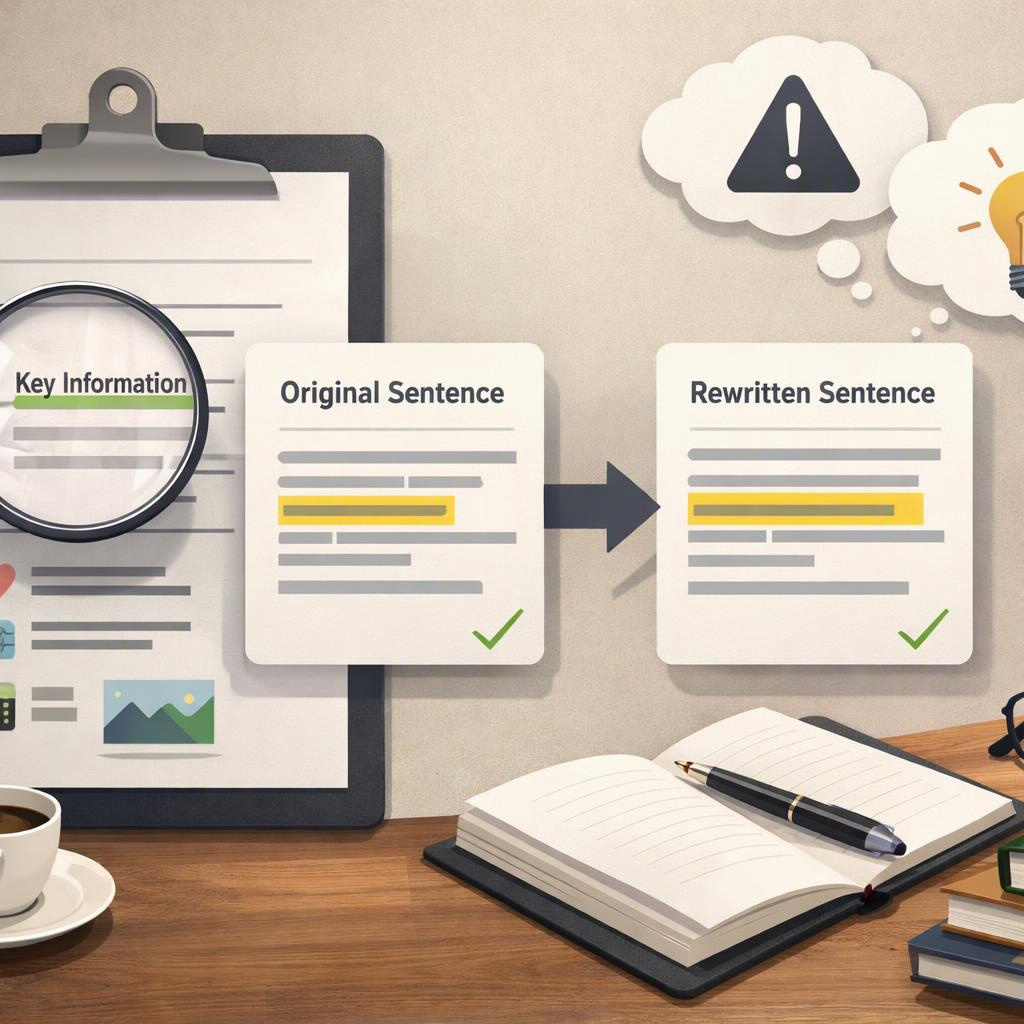

To rewrite a sentence without changing its meaning, identify the main message, revise the wording or structure, and compare both versions. Preserve the facts, conditions, timing, and level of certainty. A sentence that sounds smoother but makes a different claim is not an accurate rewrite.

If you’re asking someone to “rewrite this sentence,” explain what needs improving: awkward phrasing, unnecessary length, unclear references, or tone. Focus on that problem rather than replacing every word. Read the surrounding paragraph, too. Context may explain who “they” refers to or why a detail needs emphasis.
Start by marking what must stay, then draft one alternative. If you’re stuck, a sentence rewriter can offer wording options to evaluate alongside your own edit. The linked paraphrasing tool is worth comparing for this purpose if its stated features support your task. Treat any suggestion as a draft, not a verified correction.
Identify the Meaning Your Rewrite Must Keep
Before editing, note exactly what the sentence says. You don’t need a detailed analysis for every line, but a quick inventory helps prevent accidental changes. Protect each of these elements when it appears:
- Actor, action, and recipient: Who does what, and who or what receives the action?
- Timing and quantities: Preserve dates, sequence, duration, amounts, units, and limits.
- Conditions and negation: Keep the meaning of “if,” “unless,” “only,” and “not.”
- Certainty: Respect the differences among “may,” “likely,” “will,” and “must.”
Meaning also includes tone and emphasis. “Please send the report today” and “Send the report today” request the same action, but they differ in politeness. Similarly, moving a condition to the beginning can give it more prominence without changing the facts.
- Original: “The coordinator may send the three revised forms to applicants on Friday if approval arrives.”
- Rewrite: “If approval arrives, the coordinator may send applicants the three revised forms on Friday.”
- Details preserved: The coordinator sends; applicants receive; there are three revised forms; Friday is the possible sending date; approval remains a condition.
- Emphasis check: The rewrite leads with the condition. Use the original order if the paragraph should focus first on the coordinator’s action.
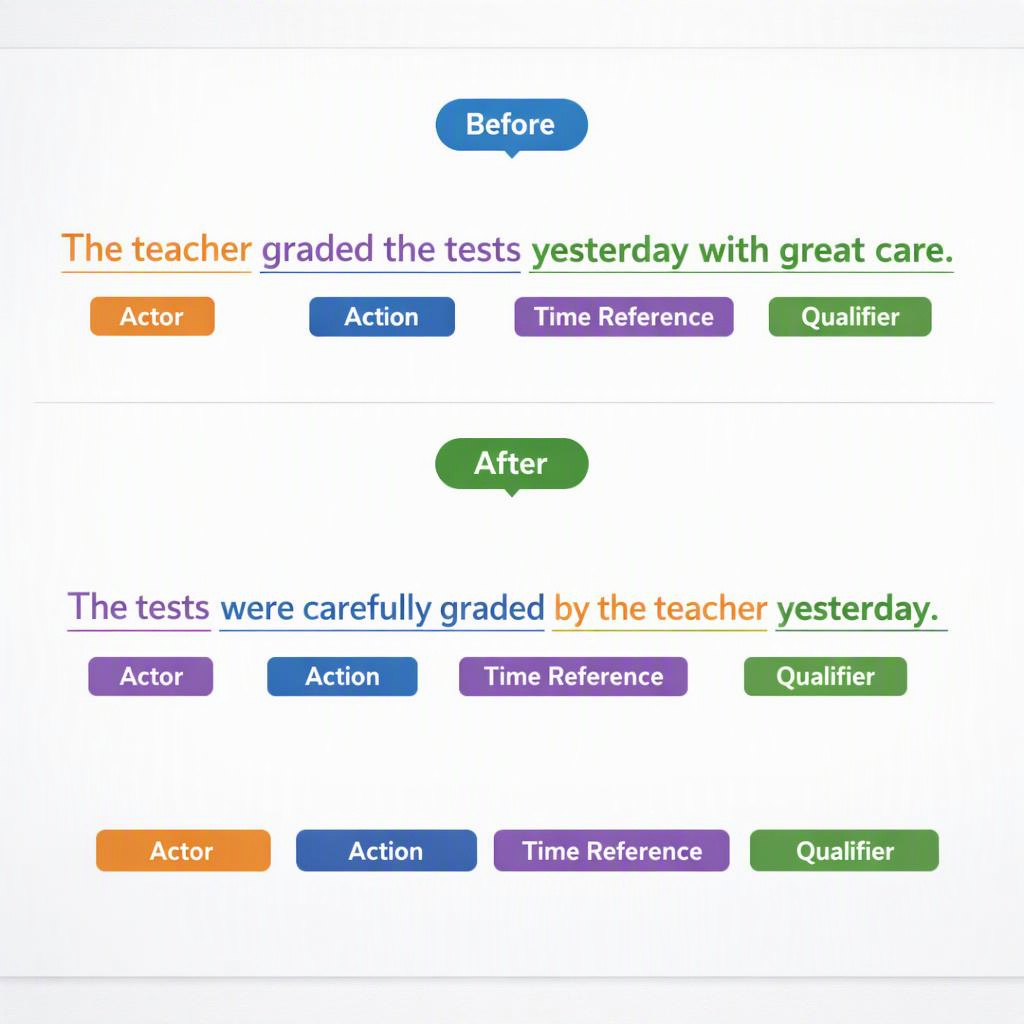
Change Voice, Sentence Length, and Information Order
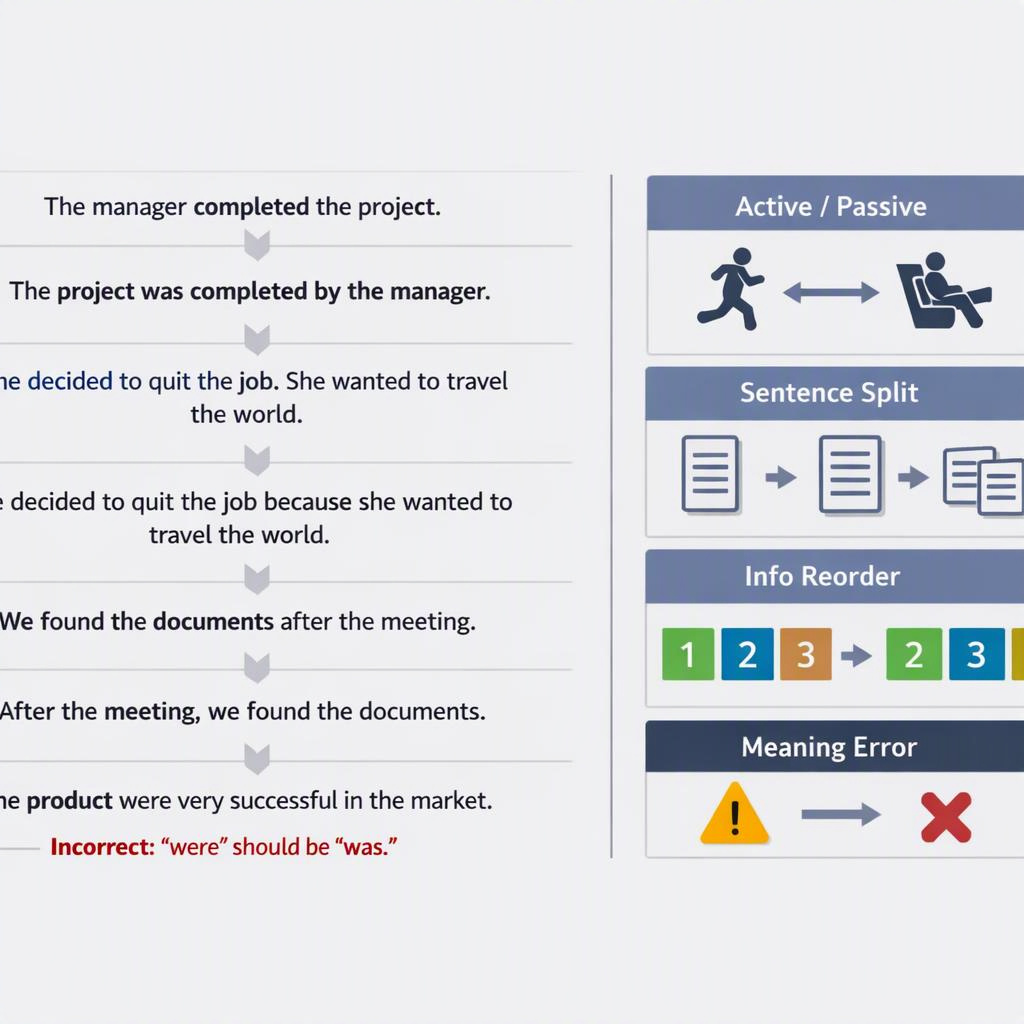
Try one structural change at a time so you can see its effect. Active voice, shorter sentences, and reordered information can improve readability, but none automatically makes a sentence better. These examples show where each approach helps—and where it changes the message.
- Active and passive voice. Original: “The editor approved the draft.” Accurate rewrite: “The draft was approved by the editor.” Inaccurate rewrite: “The draft approved the editor.” The accurate version changes the grammatical subject while preserving who performed the action.
- Sentence splitting. Original: “If payment arrives today, we will ship tomorrow and send tracking details.” Accurate rewrite: “If payment arrives today, we will ship tomorrow. Under that condition, we will also send tracking details.” Inaccurate rewrite: “We will ship tomorrow. We will send tracking details.” The inaccurate version removes the condition.
- Information order. Original: “The analyst reviewed only the revised figures on Monday.” Accurate rewrite: “On Monday, the analyst reviewed only the revised figures.” Inaccurate rewrite: “Only the analyst reviewed the revised figures on Monday.” Moving “only” changes what it limits.
Don’t invent an actor to make a sentence active. “The file was deleted” does not tell you who deleted it. Likewise, don’t add “because” when the original merely lists two events. Keep modifiers beside the words they describe, and preserve connections when splitting sentences. If repeating a condition makes the result clumsy, one sentence may be the clearer choice.
Check for Meaning Changes Before Accepting a Rewrite
Read both versions side by side. Could a reader reasonably draw a different conclusion or take a different action after reading the revision? If so, inspect the changed wording. Fluency can hide a missing restriction, and a familiar synonym can carry a different meaning.
- Facts: Match names, actors, recipients, dates, amounts, and units. Look for added or missing information.
- Qualifiers: Preserve conditions, exceptions, limits, negation, and uncertainty. Simpler wording must not create a stronger claim.
- Pronoun references: Confirm that “it,” “this,” and “they” still refer to the intended person or thing.
- Logical relationships: Retain cause, contrast, sequence, and dependency. Two events happening together do not necessarily establish causation.
- Tone and emphasis: Check politeness, urgency, responsibility, and which information receives the most attention.
- Word choice: “Required” does not mean “recommended,” and “eligible” does not mean “approved.” Preserve specialized terms when substitutes would be less precise.
Certainty check: “The treatment may help” cannot become “The treatment will help.” That changes a possibility into a prediction. Deleting “for eligible applicants” similarly broadens a claim. If you’re unsure whether two versions match, explain each in plain language. Different explanations signal that you need another revision—or clarification of the original.
Conclusion: Improve the Wording, Preserve the Message
A successful rewrite improves expression without changing the underlying message. When you ask someone to “rewrite this sentence,” name the problem and identify any details that must stay. Preserve qualifications and relationships, not just the general topic.
For an awkward or lengthy sentence, mark the essentials, make one change, and check the result in context. Keeping the original is a valid choice when the revision loses accuracy. Shorter is not always clearer, especially when readers need a condition or explanation to understand the point.
If you want alternative phrasing, review the paraphrasing tool and compare its stated editing options with your clarity or tone goal. Then check any suggested wording against the original for factual accuracy, conditions, certainty, and emphasis before using it.
FAQ
How can I rewrite my sentence without changing its meaning?
Identify its essential facts and qualifiers, then fix one specific clarity problem. Compare the revision detail by detail. Preserve conditions, negation, and certainty. If the original is ambiguous, clarify the intended meaning first rather than silently choosing one interpretation.
Does changing passive voice to active voice always preserve meaning?
No. It usually preserves the basic event when the actor is known and retained, but it can shift emphasis. If the actor is unknown, making the sentence active may introduce unsupported information. Passive voice is appropriate when responsibility is unknown or deliberately unstated.
How do I rewrite sentences more clearly without making them shorter?
Place related words together, replace vague references with specific nouns, and arrange information logically. Adding necessary context can make a sentence easier to understand. Judge the result by how easily readers can follow the message, not by word count alone.
When is the linked paraphrasing tool a logical option?
It is worth evaluating when you need alternative wording for routine edits. Manual editing remains an option; legal, medical, and technical text may require qualified review. For your sentence, compare the tool’s stated features with your editing goal, then verify names, numbers, specialized terms, conditions, and tone before accepting a revision.