

Choose a humanizing approach for stiff wording and a paraphrasing approach for sentence restructuring—but verify that either preserves your meaning. If you are searching for “quillbot smart humanizer,” the practical question is whether your draft needs a more natural voice, a different structure, or both.

Humanizing focuses on wording that feels repetitive, impersonal, or wrong for the audience. Paraphrasing expresses an existing idea differently. These goals overlap, and neither permits changing facts. No documented product tests were supplied or performed for this article. The examples below are editor-written illustrations, not QuillBot outputs or performance results.
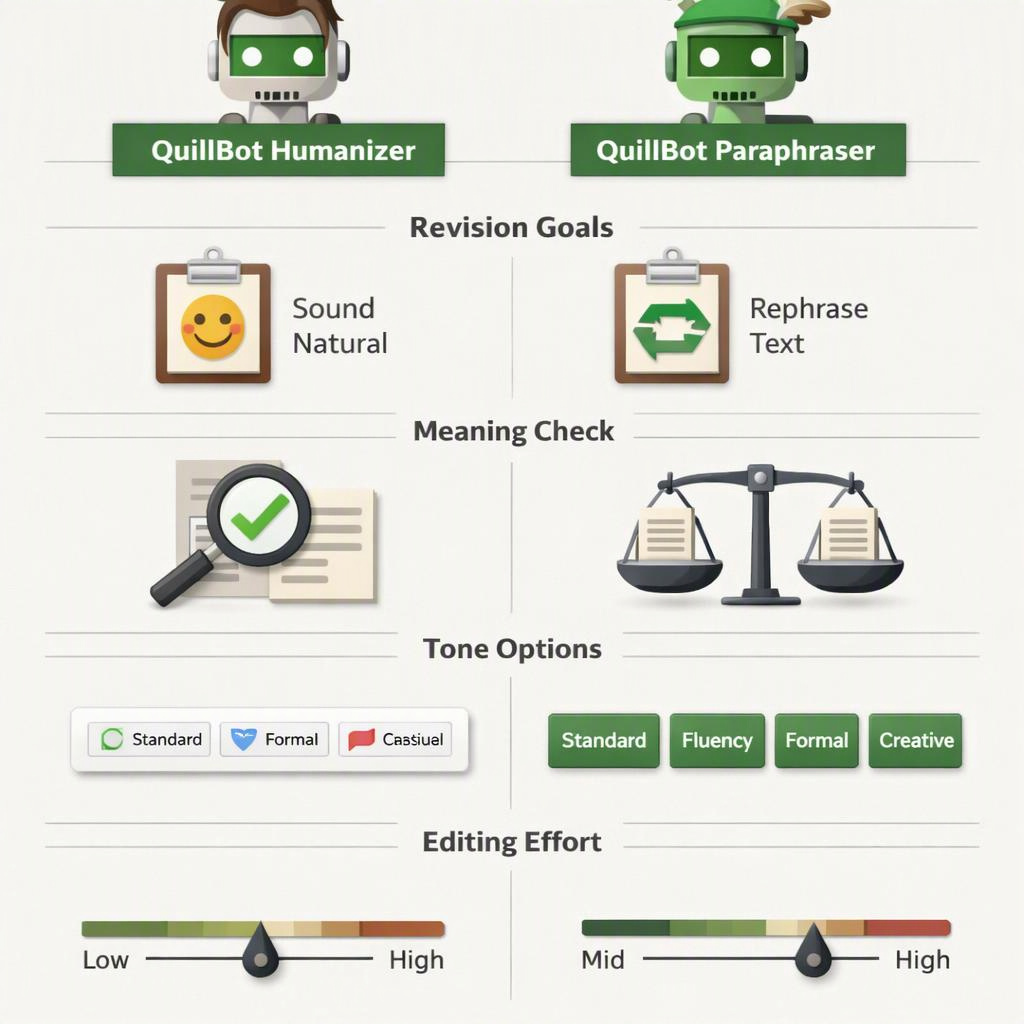
Humanizing vs. Paraphrasing: Compare the Revision Goals
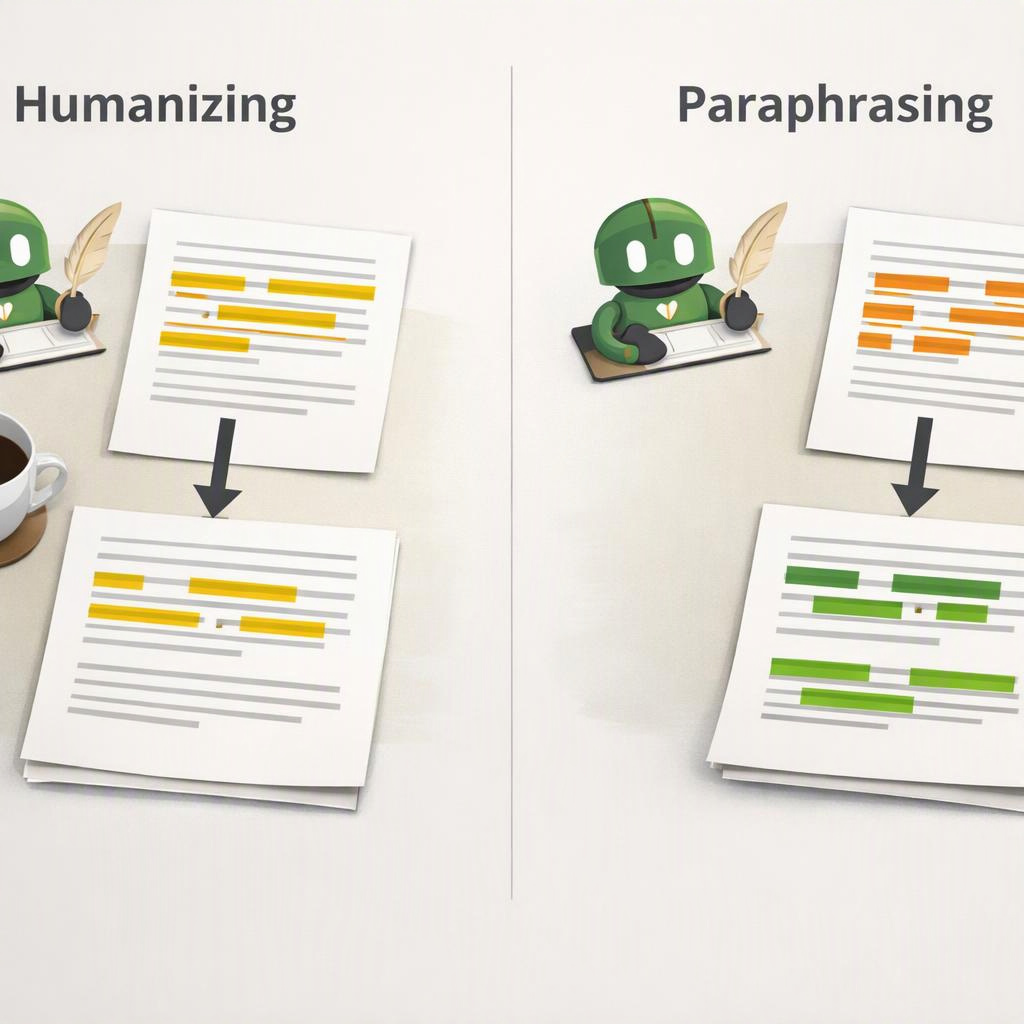
Think of humanizing as an audience-and-voice task and paraphrasing as a re-expression task. Replacing “at this point in time” with “now” can serve both goals. These are useful editing distinctions, not verified boundaries between the products.
QuillBot Humanizer is worth comparing when accurate writing sounds mechanical or distant. QuillBot Paraphraser is worth comparing when repetition or clause order makes a passage harder to follow. Verify current features, settings, and access limits rather than assuming either offers a specific control.
- Meaning: Preserve who did what, under which conditions, and with what degree of certainty. Check quantities and deadlines.
- Tone: Match the reader and setting. A friendly email and a technical report need different levels of formality.
- Structure: Look for clearer relationships between ideas, not different wording for its own sake.
- Editing effort: Count necessary corrections, including terminology, grammar, and citation placement.
- Another option: If you also need to shorten a passage, review the option at /reducer to see whether its stated purpose fits. Its functionality was not inspected for this article.
Before-and-After Evaluation: Compare the Same Drafts
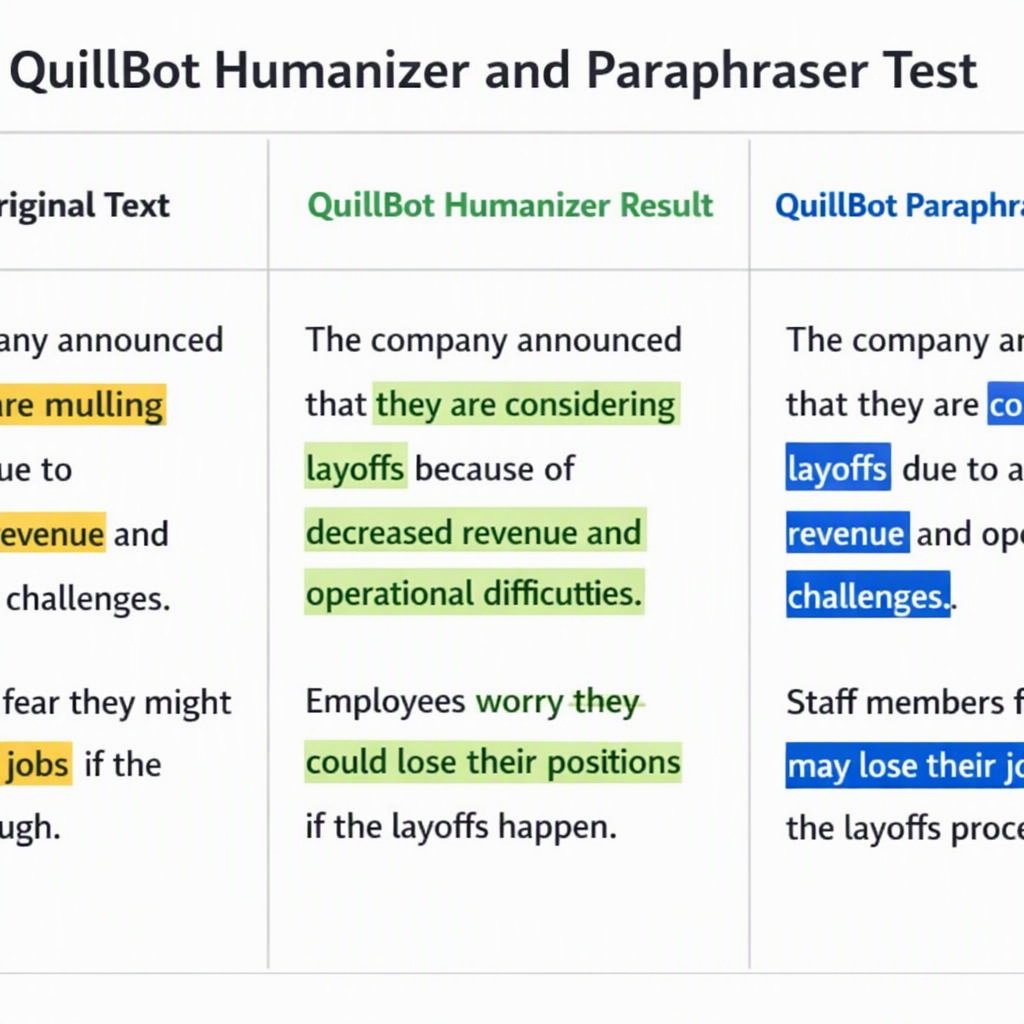
Start with three short, non-sensitive excerpts: an informational paragraph, a professional message, and a fact-sensitive explanation. Submit the same original to both tools. Editing one input first makes the results harder to compare fairly.
Evidence boundary: These samples show editorial choices, not what either QuillBot product would produce. Use them to identify what to check in your own results.
- Record the conditions: Note the date, account tier, settings, input length, and number of runs.
- Save every output: Keep results unchanged. If you discuss a repeated run, explain which result you selected and why.
- Use one rubric: Review preserved claims, grammar, clarity, audience fit, and required manual edits.
- Limit the conclusion: A few excerpts can inform your workflow, not establish a universal winner.
Illustrative Samples: Informational Writing and Professional Messages
Informational original: “The library offers evening workshops for residents. Registration is required because each session has limited seating.”
- Humanizing-oriented revision: “Residents can attend evening workshops at the library. Register beforehand because each session has limited seating.”
- Paraphrasing-oriented revision: “Because each session has limited seating, residents must register for the library’s evening workshops.”
- Meaning check: Both preserve the audience, evening schedule, and registration requirement. The first addresses readers directly; the second combines the information into one sentence.
Professional message original: “Please provide your comments on the attached proposal by Thursday so we can prepare the final version on Friday.”
- Humanizing-oriented revision: “Please send your feedback on the attached proposal by Thursday so we can get the final version ready on Friday.”
- Paraphrasing-oriented revision: “To prepare the final version on Friday, we need your feedback on the attached proposal by Thursday.”
- Meaning check: Both retain the attachment, deadline, and purpose. “Feedback” may suit the team’s usual language, but that preference does not prove greater accuracy or a measurable readability improvement.
Separate Verbatim Outputs From Editorial Judgments
Fact-sensitive original: “In this fictional survey, 42 of 60 respondents preferred the revised layout. The survey did not measure whether the layout improved task completion.”
- Humanizing-oriented revision: “In this fictional survey, 42 of the 60 respondents preferred the revised layout. The survey did not check whether it helped people complete tasks.”
- Paraphrasing-oriented revision: “The revised layout was preferred by 42 of 60 respondents in this fictional survey, which did not assess improvements in task completion.”
- Meaning check: Both retain the counts, fictional context, preference finding, and measurement limitation. Simpler wording must not turn a preference into evidence of better performance.
- Reject this shift: “The revised layout helped most users complete tasks.” It invents a performance finding and changes respondents to users.
Keep each untouched output beside a separate editorial note. “The number changed” describes an observable error; “this sounds friendlier” depends on the audience. Separate required repairs from optional style changes. Never silently fix an output and present the edited version as the tool’s result.
Choose the Better Fit for Your Draft and Its Constraints
A smoother sentence is useful only if it still does its job. The examples show how tone and structure can change independently, but they do not establish which product performs better.
- Stiff wording: Try a humanizing-oriented revision when the message is accurate but impersonal. Reject invented personality or unnecessary informality.
- Awkward structure: Try paraphrasing when repetition or clause order obstructs comprehension. Preserve emphasis and logical connections.
- Fact-sensitive writing: Verify either option line by line. Manual editing may be preferable when one changed qualifier could mislead readers.
- Policy-governed submissions: Check the organization’s official rules before using either tool. This article does not establish permission.
For a short draft, targeted manual edits may be enough. For recurring work, a style guide helps keep tone consistent. Before submitting confidential material, verify the service’s current official data-handling terms and your organization’s requirements.
Conclusion
The better choice depends on your revision goal and how reliably the result preserves meaning. Compare QuillBot Humanizer for voice-related problems and QuillBot Paraphraser for restructuring needs, without treating product names or these illustrations as performance evidence.
For your next draft, compare one representative, non-sensitive excerpt in both tools. Check factual accuracy, audience fit, sentence clarity, and required corrections; then verify current access limits, privacy terms, and submission rules. Those checks give you a practical basis for choosing a workflow.
FAQ
- When is QuillBot Humanizer a logical option instead of the Paraphraser? When stiff or audience-inappropriate wording is the main concern. This is a goal-based starting point, not a tested recommendation. Avoid changing fixed wording or quotations, and review high-stakes material carefully.
- Can either tool change facts, citations, or intended meaning? Treat every generated revision as fallible. Check names, numbers, dates, negation, qualifications, and causal claims. Keep citations attached to supported claims; different wording does not remove attribution duties.
- Which option requires fewer manual edits? No documented comparative results are available here. Count required corrections on your own samples, separately from stylistic preferences. A polished paragraph with the wrong deadline still needs repair.
- Can I use revised text for school or work? Check the official policy for the assignment or document. Permission may depend on disclosure and context. Preserve required attribution and ask for clarification when the rule is unclear.