

GPTZero can serve as a screening tool, but its results should not be treated as proof of authorship. Whether it is accurate enough depends on the writing being checked, the evaluation behind its claims, and what happens if the result is wrong. Flagging a draft for review requires less certainty than rejecting someone’s work.

If you are asking “is gptzero accurate,” the practical answer is: potentially useful for preliminary review, but not sufficient for a consequential decision on its own. Any accuracy claim needs context, including the samples tested, classification thresholds, and errors in both human-written and generated text.
This article explains how to assess that evidence; it is not a hands-on benchmark. No documented test results were supplied, and current official policies were not verified. It therefore offers neither a numerical accuracy verdict nor a confirmed free-plan allowance.
For a flagged essay or draft, start with the writing record. Our detector page is an optional comparison destination if you want to compare outputs on the same sample. Check its suitability first: another classification adds a comparison point, not proof of how the document was written.
Evaluate GPTZero Results by Test Date and Sample Quality
A useful GPTZero evaluation should describe a dated, reproducible test. Older findings may not reflect the version you use today. More importantly, a strong result on one collection of documents does not establish reliability for every assignment or publication. The evidence available for this article has these boundaries:
- Source and findings: No benchmark was supplied, so neither vendor-reported nor independent performance findings are established here.
- Evaluation date and version: Not available; no original testing was performed for this review.
- Sample composition and counts: Not available, including the balance of documented human-written, generated, and mixed or edited samples.
- Text length and languages: Not available; this record cannot establish reliability for a particular document type or readership.
- Thresholds and access tier: Not available; classification settings and account conditions cannot be compared.
- Limitations: These gaps support a cautious evaluation process, not a product accuracy estimate.
When assessing a published test, look for false-positive and false-negative counts with their denominators. “Five human-written essays flagged out of 100” is more informative than an error count alone. Overall accuracy can conceal uneven performance when a test contains far more samples from one category than another.
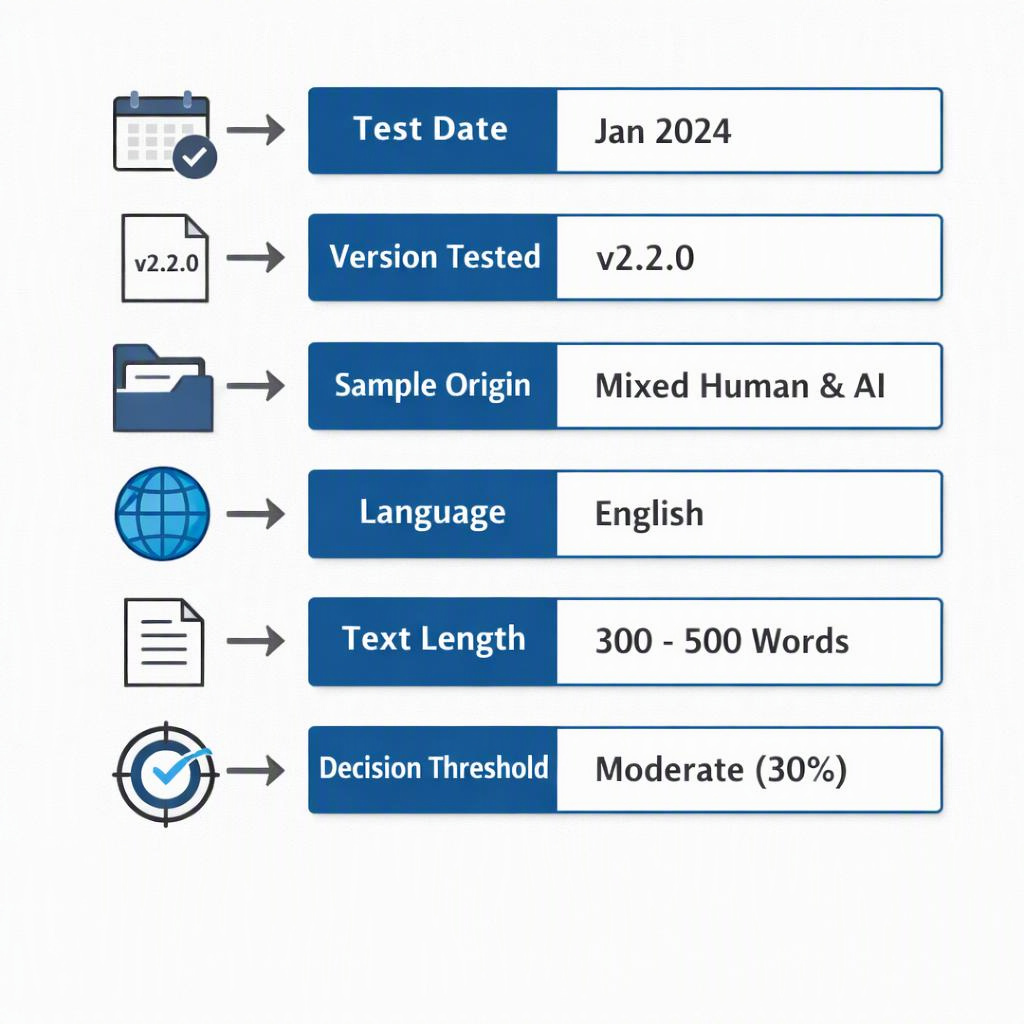
Evaluation checklist: Record the test date, version when documented, sample origin, language, text length, and decision threshold. For student essays, seek documented samples resembling the assignment. Keep evidence of sample authorship separate from detector labels; otherwise, the evaluation risks assuming what it is meant to test.
Interpret False Positives Without Mistaking Scores for Proof
A false positive means human-written text was incorrectly labeled as generated. A false negative means generated text was incorrectly labeled as human-written. Both matter, but the costs differ: an unfair accusation can damage trust, while missed generated text can weaken a review process. Neither possibility should be ignored.
Read a displayed score using the current official explanation for that specific output. Do not assume it means the probability of misconduct, the percentage of generated words, or certainty about authorship. This review does not verify GPTZero’s current score definitions. Even a correctly interpreted result cannot establish whether a writer broke an assignment or editorial rule.
- Preliminary screening: Use a flag to choose what deserves closer inspection. Check references and context before approaching the writer with a concern.
- Self-review: Compare highlighted passages with your notes and drafts. Rewriting only to change a detector label does not establish authorship or improve the underlying evidence.
- Consequential judgments: Review draft history, verify references, discuss the writing process, and apply the relevant policy. Agreement between detectors is not definitive confirmation.
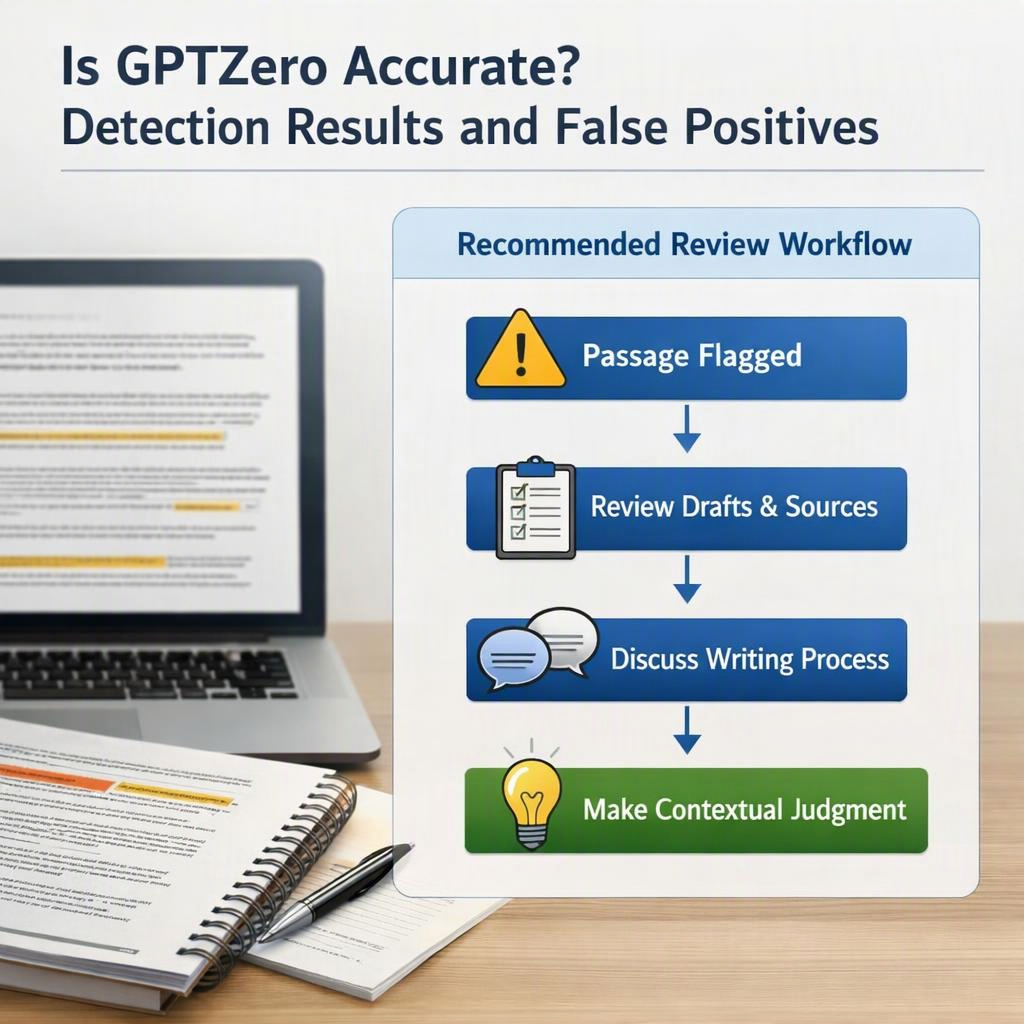
Recommended review workflow: Inspect the flagged passage → review drafts and references → discuss the writing process → make a contextual judgment. Ask neutral questions about how the argument developed. Missing drafts do not automatically establish wrongdoing, just as a favorable detector label does not establish compliance.
Check Free-Plan Limits and Decide Whether GPTZero Fits
Verify GPTZero’s free-plan limits before building a workload around them. This article does not confirm current allowances, registration requirements, submission limits, or feature restrictions. Consult the official pricing and help documentation, and record the date you checked: a remembered allowance or an older review may not describe current access.
- Usage allowance: Confirm the counting unit, reset period, and whether limits apply per submission, account, or billing period.
- Account requirements: Check whether registration is required and whether trial conditions affect your intended workflow.
- Input restrictions: Verify minimum and maximum text lengths, accepted submission methods, and applicable language guidance.
- Feature access: Confirm which outputs your tier includes rather than assuming every advertised function is free.
- Policy versus observation: Save the official source and checked date separately from what happened during your own submission.
GPTZero is worth comparing for low-stakes screening when you need to prioritize documents for closer inspection, provided its verified limits and documented behavior fit your material. That potential value is workflow triage, not authorship verification. For a disputed essay, draft history and a discussion with the writer are more directly relevant alternatives to collecting additional labels. Before uploading confidential student or client work, check data-handling terms and your organization’s rules.
Conclusion: Match Your Confidence to the Evidence
GPTZero may help direct attention, but the evidence available here does not establish a numerical accuracy level or justify detector-only authorship judgments. Your confidence should reflect the quality of the evaluation, how closely its samples resemble your text, and the consequences of a mistake.
For a flagged document, compare the highlighted passages with dated drafts, references, and the writer’s explanation before acting. Check current score definitions and access limits in official documentation. Keep any additional detector output separate from evidence about the writing process.
The goal is an explainable decision, not enough matching labels to create certainty. If the evidence remains ambiguous, acknowledge that limitation and follow the applicable review or appeal process.
FAQ
Can GPTZero flag text that a person wrote?
Yes. That is a false positive, although this review does not establish how often it occurs. Examine the passage alongside drafts, notes, references, and relevant evaluation evidence before drawing conclusions about the writer.
Does a high GPTZero score prove how a document was written?
No. Use the score’s official definition rather than treating it as a misconduct probability. A classification does not document the writing process, distinguish permitted assistance, or establish that a rule was broken.
How reliable are GPTZero detection results for short passages?
This review cannot establish reliability for short passages. Look for tests using comparable lengths, documented sample origins, and separate error counts. Findings from full essays should not automatically be applied to isolated sentences.
When is GPTZero a logical option for a writing review?
It may fit preliminary screening, but not as the sole basis for consequential judgments. For your next essay or draft review, verify supported lengths, score definitions, usage limits, and privacy terms. If comparing outputs through our detector page, use the same sample and record disagreements to guide contextual review—not an authorship verdict.