

Humbot is worth considering only if its rewrites improve readability without changing important facts—and its subscription limits fit your workload. Neither point is verified here: this article includes no recorded Humbot outputs or confirmed current pricing. If you searched for “humbot smart” to see whether it makes writing sound more natural, the honest answer is that a representative test is still needed.

This is an evaluation guide, not a hands-on endorsement. The passages below are test inputs, not completed before-and-after comparisons. A useful comparison needs the original text, unchanged output, settings, and test date. The question is whether clearer wording saves more effort than checking and repairing the rewrite takes. Before subscribing, test a non-sensitive passage and review the billing terms. Smoother sentences are not necessarily more accurate sentences.
Before-and-After Samples: Does Humbot Improve Readability?
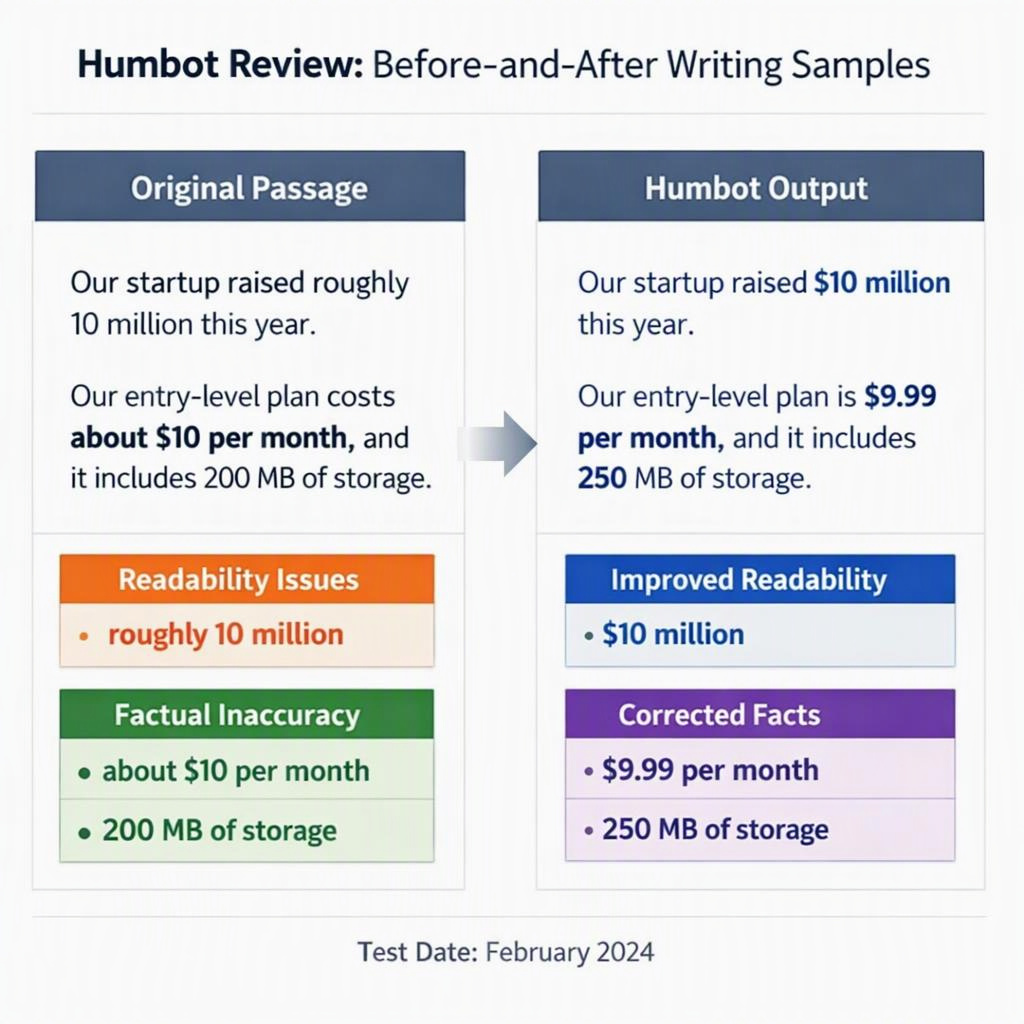
A credible review should place the actual rewrite beside its input. Without recorded outputs, Humbot’s readability improvements remain unassessed. These original passages give you two starting points: one tests editorial tone, while the other tests numerical meaning and qualifications.
- Sample one: general prose. “The introduction takes too long to reach its main point. I would move the recommendation into the opening paragraph and remove the sentences that repeat it. That would leave more room for an example.”
- Recorded output: Unavailable; this passage has not been run through Humbot.
- Sample two: numerical meaning. “One US dollar equals 100 cents. Reducing a one-dollar price by 25 cents leaves a price of 75 cents before any taxes or additional charges. The final amount may therefore be higher.”
- Recorded output: Unavailable; this passage has not been run through Humbot.
Check Whether Names, Numbers, Caveats, and Meaning Survive
Save the test date, visible settings, every attempt, and each unchanged output. Keep your later edits separate so the comparison shows what Humbot produced, not what you fixed.
Assess readability and accuracy separately. For readability, look for clearer phrasing, less repetition, and a tone that suits your audience. In sample one, check whether personal suggestions become instructions. In sample two, verify the arithmetic and the caveat about taxes and additional charges. For your own drafts, also check names, dates, units, and attribution. Treat each result as evidence about that passage, not proof of consistent performance across every writing task.
Pricing and Usage Limits: Verify What Your Workload Requires
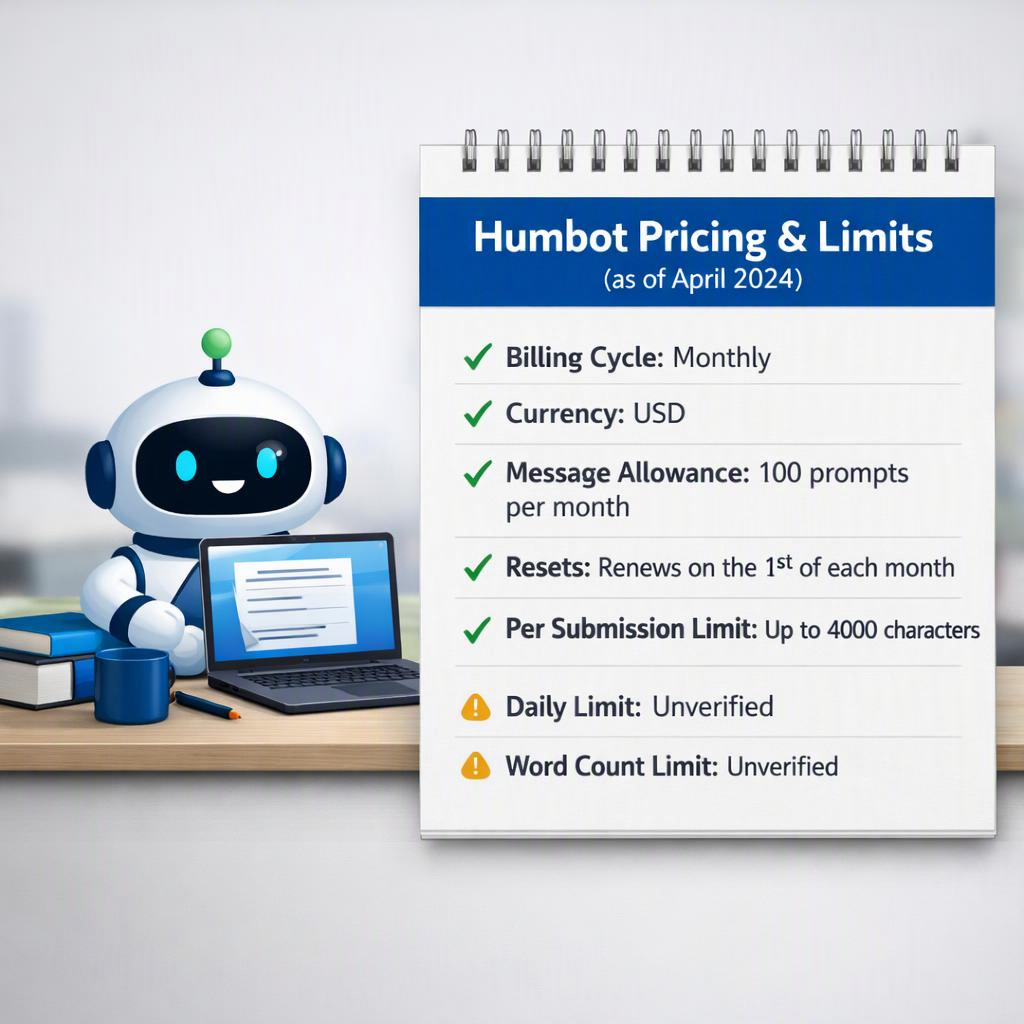
Current Humbot prices and usage limits are unverified here. No official pricing, billing, or help pages were accessed for this article, so there is no confirmed subscription amount or access date to report. Check current official pages and the checkout summary for these details:
- Price and currency: Confirm the displayed currency, applicable taxes, and total charge—not just the advertised amount.
- Billing period: Distinguish a monthly subscription from an annual commitment presented as a monthly equivalent.
- Included allowance: Check whether usage is counted in words, characters, credits, requests, or another unit.
- Reset timing: Verify when the allowance renews and whether unused capacity expires or carries over.
- Submission limits: Look for a separate maximum per request. A sufficient monthly allowance may still be inconvenient for long drafts.
- Retries: Establish whether repeat attempts, unsuccessful requests, or different settings use additional allowance.
- Cancellation and refunds: Read the renewal schedule, cancellation procedure, and refund eligibility conditions before paying.
Estimate demand from drafts you actually handle, including likely repeat attempts. Once you know the charging unit, compare that workload with the documented allowance. Include review time: a low subscription price may offer little value if you regularly need several rewrites or substantial repairs. None of the plan details above should be treated as confirmed product features.
When Humbot Fits—and When Manual Review Matters More
Humbot is a candidate to test, not a supported recommendation based on the evidence available here. It is worth comparing when awkward wording is your main problem and you can reliably judge the result. The best starting point depends on the consequences of an unnoticed change.
- Routine, non-sensitive prose: A reasonable testing scenario. Compare clarity, voice, and editing time; proceed only if the observed improvement and verified cost justify the effort.
- Fact-heavy business content: Check figures, names, promises, and qualifications sentence by sentence. Manual editing may be preferable when a small wording change could alter a commitment.
- Student or publication submissions: Review the institution’s or publisher’s current official rules first. This article establishes no permission or acceptance claim.
- Confidential drafts: Do not upload sensitive material before reviewing current official privacy and retention terms. No confidentiality protection has been verified here.
- High-volume editorial work: Test representative documents and measure cleanup time before comparing verified capacity with recurring demand.
Use manual editing or your existing editorial workflow as the baseline. These alternatives are worth comparing because they show whether Humbot reduces total effort, rather than merely producing different wording. For another on-site destination, you can review the /reducer page; its purpose is unverified here, so check what it offers before treating it as an alternative.
Conclusion
Humbot merits consideration only when observed rewrites improve expression without unacceptable changes to meaning, and verified pricing fits your workload. Without authentic outputs or current plan information, a stronger verdict would go beyond the evidence.
Start with one non-sensitive passage that resembles your everyday work. Save the input, unchanged output, settings, and date. Then judge readability and factual retention separately, counting the edits needed to make the result usable. That gives you a more useful benchmark than a polished first impression.
Before committing, compare the documented allowance, retry rules, billing period, and cancellation terms with your expected usage and review time. This small test can help you decide whether further evaluation is worthwhile without assuming a free tier exists or that one successful rewrite predicts future results.
FAQ
When is Humbot a logical option?
It is a candidate when you want smoother wording in non-sensitive prose and can review every change. It is less suitable as an unchecked step for consequential or confidential material. Test your own passage and verify relevant submission rules, privacy terms, and costs first.
How can I check whether Humbot changed facts or meaning?
Compare input and output sentence by sentence. Check names, quantities, dates, units, negations, attribution, and caveats. Watch for “may” becoming “will,” or a suggestion becoming a requirement. Finally, read the whole passage for shifts in emphasis; correct numbers alone do not establish preserved meaning.
Where are the authentic before-and-after results?
None are available here. Both passages are original test inputs with outputs marked unavailable. A defensible comparison would include unchanged recorded results, dates, settings, and attempt history. Any later human edits should be shown separately, not presented as Humbot’s output.
How should I compare subscription value?
For your typical drafting workload, compare a representative Humbot rewrite with a manual edit. Record factual changes, cleanup time, and repeat attempts, then verify official pricing, usage allowances, and renewal terms. Those checks help show whether a subscription would improve your workflow rather than add another review step.