

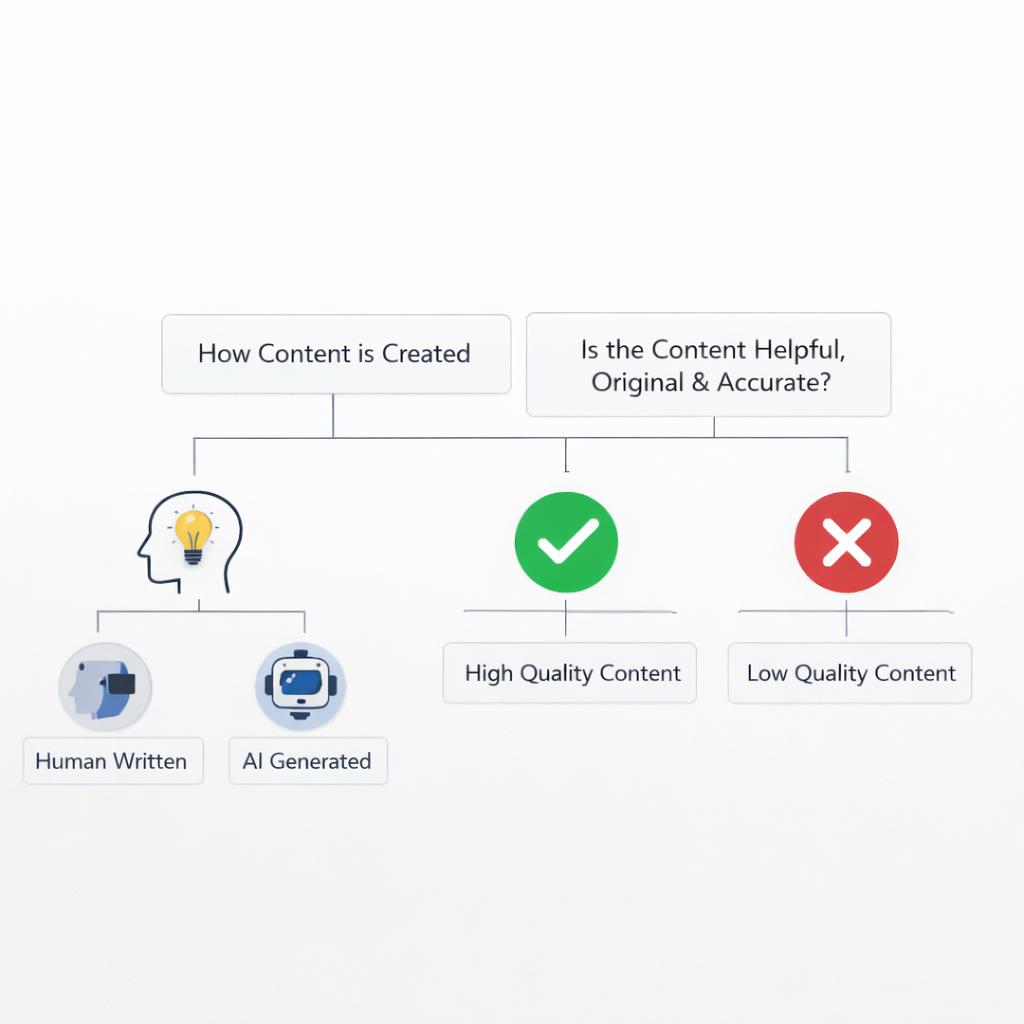
Google can often spot patterns that show up in machine-assisted writing, but detection alone is not what usually affects rankings. The bigger issue is whether a post is useful, accurate, original, and worth a reader’s time. For most site owners, the practical question is not only can google detect smart content on blog posts, but whether the final page shows real expertise, clear purpose, and trustworthy information.

That is why machine-assisted drafts should be treated as raw material, not publish-ready copy. Strong editing, better examples, and careful fact-checking usually matter far more than how the first version was produced. If you want better results, review your content quality checklist before publishing so each article meets search intent and avoids the common weaknesses that make low-value pages easier to recognize.
What Google actually evaluates in blog content
Google’s systems are designed to reward content that helps people complete a task, answer a question, or make a decision. In practice, that means a blog post can still perform well if it is clear, useful, and reliable, even when software helped create the first draft. Search visibility is usually tied more closely to quality signals such as originality, completeness, accuracy, and credibility than to the drafting method itself.
Many publishers ask whether Google can tell if blog content is machine written. In many cases, yes, both search systems and human reviewers can notice familiar patterns. But the stronger ranking signal is often the page’s overall value. If an article feels thin, generic, or poorly sourced, it is more likely to struggle. If it is specific, well organized, and genuinely helpful, it has a much better chance to compete.
Why quality matters more than how the draft was produced
Search results exist to satisfy users, so usefulness remains the main standard. A post that repeats obvious points, gives vague advice, or rephrases information already found everywhere else is less likely to stand out. On the other hand, a page that explains the topic clearly, includes relevant details, and answers the searcher’s real question is far more valuable.
This is also why measured claims matter. No one can promise rankings simply because content was edited by a person or because a certain workflow was used. What matters is the final result. Blog owners should ask simple questions before publishing: Does this page answer the query directly? Does it include current facts? Does it add anything beyond a surface summary? Posts with sound judgment, clear examples, and careful review are usually safer than content published at scale with little oversight.
Common signals that make machine-written posts easier to spot
Low-value posts often share patterns that readers notice quickly. Common signs include repetitive phrasing, broad claims without support, shallow explanations, and polished language that says very little. Another warning sign is weak sourcing. If an article mentions facts, statistics, or best practices without showing where that information came from, trust drops fast.
These signals matter because they make a page feel mass-produced. Google does not automatically demote every machine-assisted article, but pages with filler, factual slips, and poor alignment with search intent are easier to classify as unhelpful. Readers often spot these weaknesses first. If they do not find the page satisfying, that lack of value becomes a much bigger problem than the draft method.
Patterns like repetition, weak sourcing, and generic claims
Repetition is one of the easiest issues to identify. Instead of developing an idea, weak posts often restate the same point with slightly different wording. Generic claims are another problem, especially when an article says something is “important” or “effective” without explaining why. Advice should be tied to a reason, an example, or a practical outcome.
Weak sourcing is just as damaging. If a post includes no references, no verified details, and no sign of editorial review, it can feel unreliable even when the writing is smooth. Other common problems include awkward topic jumps, made-up examples, and language that sounds like a template. A strong article should feel grounded in the topic, not interchangeable with dozens of other pages.

How to publish machine-assisted posts that readers trust
The safest way to publish machine-assisted content is to build a real editorial process around every draft. Start by checking facts, removing repeated phrases, and replacing bland statements with specific details. Add examples that reflect actual experience, explain tradeoffs, and make the advice more concrete. If the topic changes often, verify dates, terminology, and sources before anything goes live.
It also helps to improve clarity inside the article itself. Answer the main question early, keep paragraphs easy to scan, and support key points with examples or evidence. Before publishing, put the draft through your editorial review process so another reviewer can catch weak logic, unsupported claims, and outdated details. When can google detect smart content on blog posts is the concern, the most practical answer is to create pages that earn trust on their own merits.
Editing steps for originality, accuracy, and first-hand value
A strong edit should improve substance, not just polish the wording. Add observations from real use, clarify what the reader should do next, and explain why one option may be better than another. If a claim appears in the draft, ask what supports it. If a section sounds generic, rewrite it with a concrete example or a more precise explanation.
After publishing, review the page again over time. Update outdated references, expand sections that feel thin, and add answers to new user questions. Useful content is rarely a one-and-done task. Regular updates help a blog stay relevant and reduce the risk of pages that look rushed, stale, or interchangeable.

Conclusion
So, can google detect smart content on blog posts? In many situations, Google and human readers can notice patterns linked to machine-written text. Still, rankings depend much more on whether the page is genuinely helpful, accurate, original, and trustworthy. Chasing perfect invisibility is less useful than improving the article itself.
If you use automated writing tools, use them for outlining or rough drafts, then rely on editing, sourcing, and judgment to make the post worth reading. Pages that meet intent clearly, include verified information, and add distinct value are in a stronger position than generic content published with minimal review. That is the standard worth optimizing for.
FAQ
Does Google penalize every machine-written blog post?
No. Google does not treat every machine-assisted post the same way. What matters more is whether the page is useful, reliable, and satisfying for the searcher. Low-value pages are more likely to struggle than well-edited posts that offer clear, accurate help.
Can detection tools reliably tell whether a post was machine-written?
Not consistently. Detection tools may catch patterns, but they can also mislabel content. They are best used as a rough check, not as proof. Editorial review, fact-checking, and clear sourcing are more reliable than depending on any detector alone.
Can Google tell if blog content is machine written when a human edits it?
Sometimes it may still notice certain patterns, but strong editing removes many of the most obvious weaknesses. The key question is whether the final article is specific, accurate, and genuinely useful. A well-reviewed page is usually in a better position than a lightly edited draft.
What is the safest way to use automated writing tools for SEO content?
Use them for brainstorming, outlines, or rough drafts, then improve the result with careful editing. Check facts, add original examples, strengthen sources, and remove repetitive language. That workflow is typically safer than publishing large volumes of lightly reviewed content.