
When ChatGPT Tsunami Hits: How Phrasly AI Checker Fortifies the Great Wall of Originality
As ChatGPT-generated content floods academia and social media (Oxford reports 76% AI-assisted essays...
If you’ve just run a scan on AIGCChecker and received a high AI percentage, your first reaction might be confusion—or even frustration. You might think, "But I wrote this myself!" or "I only used AI for the outline!"
To an AI detector, "AI-like" doesn't necessarily mean "written by a robot." It means your text follows mathematical patterns of high predictability. As an AI strategist and copywriter, I’ve analyzed millions of tokens to understand why certain phrases trigger the "red zone." Here are the four primary reasons your text feels synthetic to an algorithm.
AI models like ChatGPT are built on a "Next Token Predictor" architecture. They are trained to choose the most statistically likely word to follow the previous one.
When a detector analyzes your text, it calculates Perplexity.
The Fix: Swap generic adjectives for specific, sensory language. Instead of saying "The results were very good," try "The results shattered our initial projections."
Humans write with a pulse. We use a mix of short, punchy sentences and long, winding, complex ones. This variation is called Burstiness.
AI, however, tends to be very "flat." It produces sentences of similar lengths and structures (Subject-Verb-Object). When every sentence in a paragraph is roughly 15 to 20 words long, the detector sees a "robotic" steady-state signal rather than a "human" erratic signal.
There is a specific dialect I call "AI-ese." It is characterized by an over-reliance on formal, logical transitions that humans rarely use in casual or even professional creative writing.
If your text is littered with these phrases, your AI score will skyrocket:
While grammatically perfect, these are "filler" tokens that AI uses to maintain structure. Humans usually jump straight to the point or use more nuanced transitions.
AI is designed to be a neutral, objective aggregator of information. It avoids taking "hot takes," sharing personal anecdotes, or using "I" in a way that feels lived-in.
Detectors look for "Grey Content"—text that provides information without providing a soul. If your writing lacks a specific stance, a unique opinion, or a reference to a personal experience, it falls into the statistical average of the entire internet—which is exactly what AI models are trained on.
Understanding the "Why" is only the first step. To truly bypass detection and maintain your SEO ranking or academic integrity, you need to break these mathematical patterns.
Stop writing like a machine. Start writing like a master. ---
As ChatGPT-generated content floods academia and social media (Oxford reports 76% AI-assisted essays...

Blackboard SafeAssign, a widely used plagiarism detection tool in academic settings, plays a pivotal...
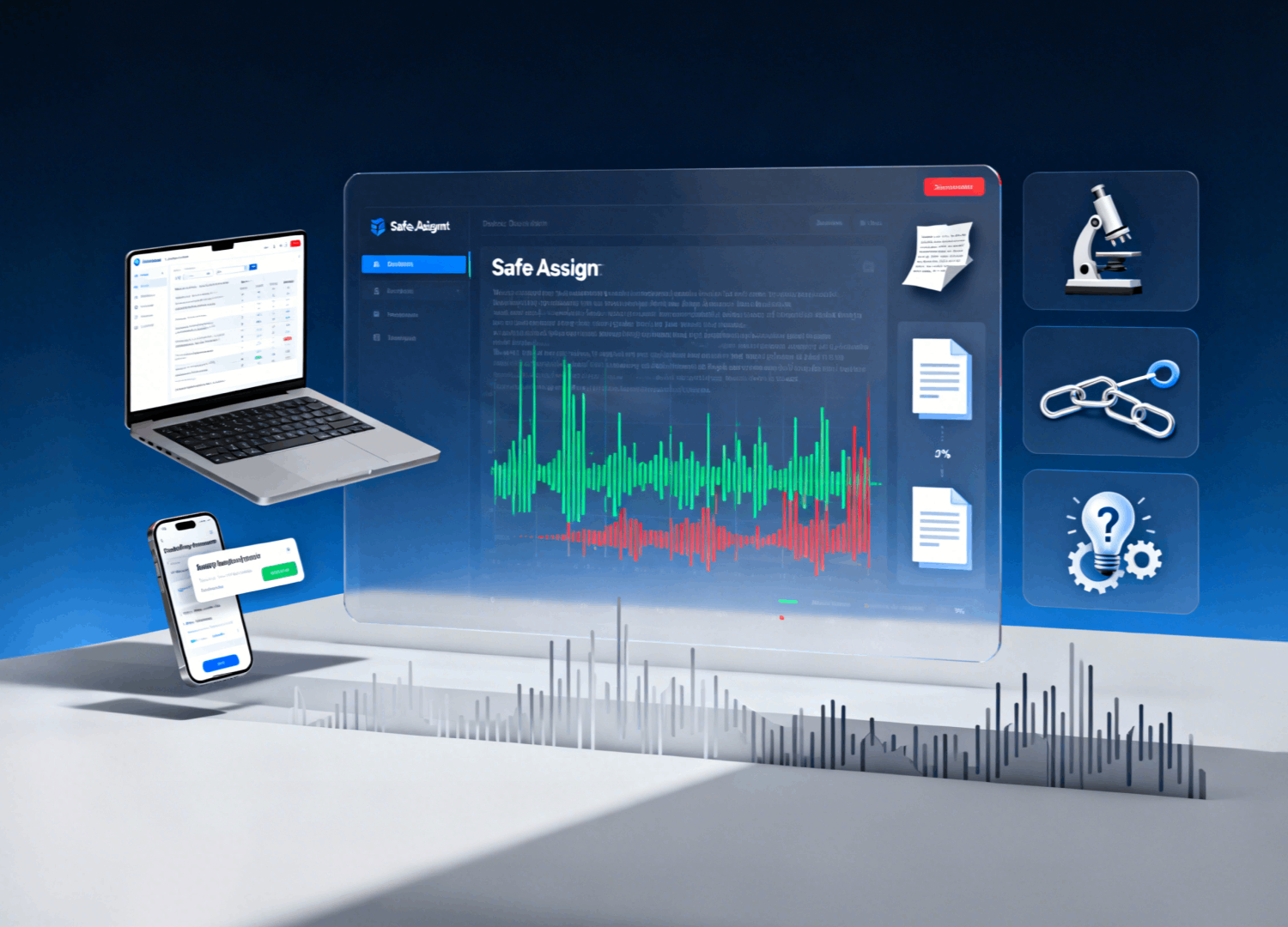
In today's era of widespread AI writing tools, academic content creation has become more efficient a...

In modern academic settings, AI-based plagiarism detection tools have become commonplace, promising...

In today's competitive software development landscape, protecting your original code has never been...