

If you are wondering how to humanize smart text for college essays, the goal is not to make a draft sound fancy. It is to make it sound real. A rough generated draft can help you organize ideas, but college essays only work when the voice, details, and reflection clearly belong to you. For a broader foundation, see the complete guide to humanizing generated writing.

Admissions readers want writing that feels personal, specific, and honest. That usually means doing more than changing a few words. You need to add lived details, cut generic lines, and shape each paragraph around what you actually experienced and learned. When you do that well, the essay becomes more readable, more believable, and much more memorable.
What makes a college essay sound human and believable
A strong college essay sounds like one student thinking clearly on the page. It has a point of view, a natural rhythm, and details that feel lived-in rather than borrowed. Readers notice when an essay relies on broad statements like “I learned the value of perseverance” without showing the moment that led to that insight. They also notice when the tone feels too polished, too formal, or too detached for a real high school writer.
Believable essays usually balance story and reflection. The reader needs to see what happened, but also why it mattered to you. If a draft feels smooth but empty, it often needs simpler wording, sharper examples, and more honest thinking. This is the heart of how to humanize smart text for college essays: reduce abstraction, keep the tone age-appropriate, and let the writing sound like a person instead of a template.
Traits admissions readers notice: voice, specificity, and reflection
Voice is the feeling that a real student is speaking. Specificity means using details that could only come from your life: the cracked violin case you carried to rehearsal, the silence after a hard conversation, the note a teacher wrote in the margin of your paper. Reflection is what turns those details into meaning. Instead of claiming an event changed you, explain what you misunderstood before, what you see differently now, and how that shift affected what you did next.
These three traits work together. Voice makes the essay sound genuine, specificity makes it memorable, and reflection gives it depth. If a sentence could fit almost any applicant, it is probably too general. Revise until it sounds unmistakably yours.
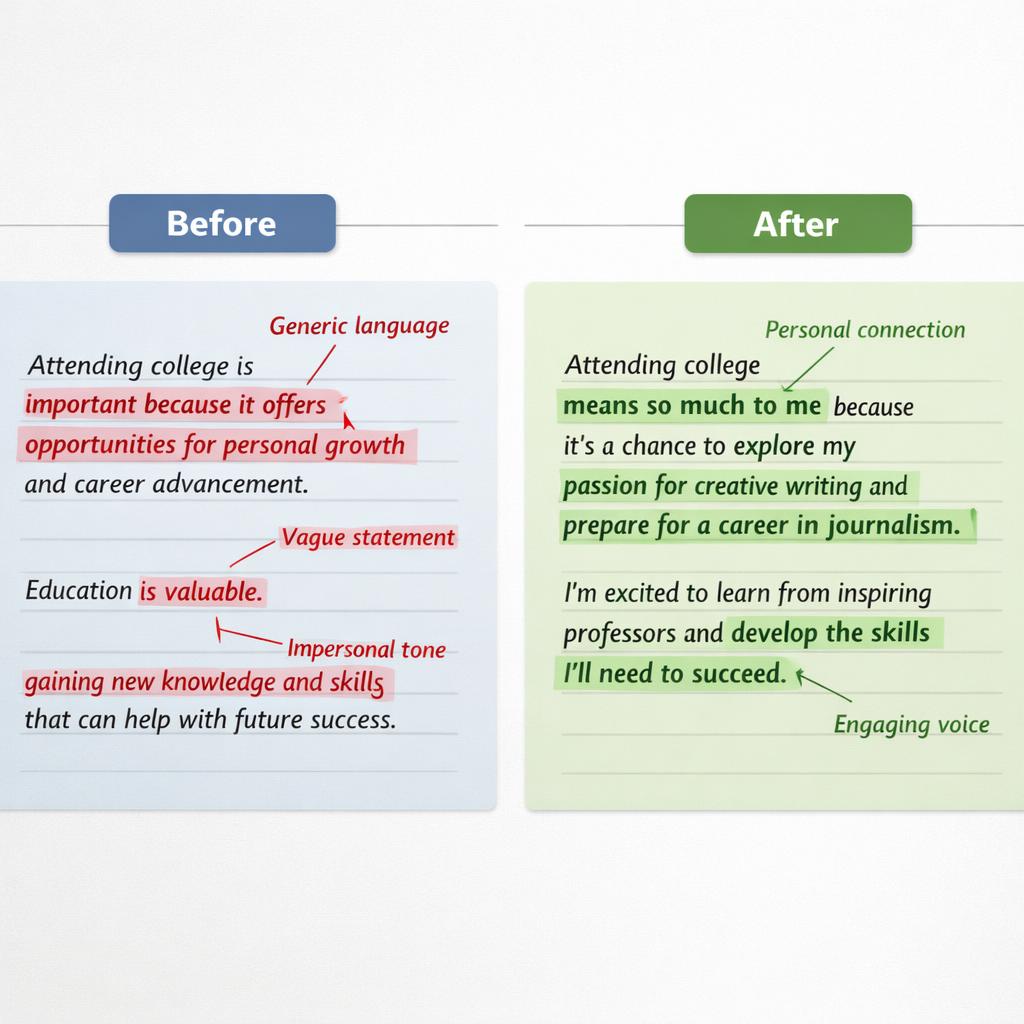
How to revise generated text into your own essay voice
The easiest way to revise a generated draft is to edit in layers. First, keep only the parts that match your real story and delete anything exaggerated, inaccurate, or generic. Next, rewrite sentence openings and transitions so they sound closer to your natural speech. Then trim inflated wording. A college essay usually gets stronger when the language gets clearer. If you want help spotting weak sections, review how to spot text that sounds too generic while you revise.
After that, test every paragraph with two questions: did I actually experience this, and would I ever say it this way? If the answer is no, rewrite it. A writing tool can help you brainstorm or outline, but your examples, values, and judgments should come from you. That is how to make a draft useful without losing authenticity.
Replace generic claims with lived details and real examples
Generic line: “My leadership journey taught me resilience and collaboration.” Stronger version: “When two volunteers quit the week before our food drive, I spent lunch in the school office calling local churches for extra boxes and realized leadership sometimes means asking for help before you feel ready.” The second version works because it shows action, pressure, and a real realization instead of announcing a lesson.
Use that same approach throughout the essay. Circle broad claims and attach them to a memory, a decision, or a sensory detail. Replace “I am passionate about science” with a scene from tutoring, lab, or home. Replace “I overcame challenges” with what the challenge looked like on an ordinary day. This is one of the most reliable ways to make college essays sound more personal and natural.

Common mistakes that make edited essays still feel robotic
One common mistake is overediting. Students remove every plain sentence and replace it with polished, abstract language. The result may sound impressive at first, but it often feels distant. Another problem is forcing insight with lines that sound profound but are not supported by the story. Repetition can also make a draft feel mechanical: the same sentence length, the same transition words, and the same pattern of claim followed by a vague moral.
A final issue is mismatched voice. If your essay uses vocabulary you never use in class or conversation, readers may doubt that it reflects you. Keep the tone thoughtful and clear, not theatrical. Reading aloud is one of the best final tests because stiffness becomes obvious when you hear it. If you still find yourself asking how to humanize smart text for college essays, the answer is usually simple: cut more, simplify more, and return to real experience.
Quick self-check before you submit
Before you submit, review the essay with a short checklist. Does the opening sound like a real person instead of a stock introduction? Does each paragraph include at least one concrete detail? Have you explained why the experience mattered instead of only describing it? Are there lines that could apply to thousands of students? If so, make them more precise and personal.
- Voice: Does it sound like how you actually think and speak?
- Specificity: Did you include real scenes, actions, or brief dialogue?
- Reflection: Did you show what changed in your thinking or behavior?
- Readability: Do the sentences sound natural aloud?
- Honesty: Is every claim accurate and consistent with school expectations?

Conclusion
Learning how to humanize smart text for college essays is really about taking ownership of the draft. Keep what helps you think, but replace generic language with your memories, your phrasing, and your reflection. The best essays are not the ones trying hardest to sound impressive. They are the ones that feel credible, specific, and emotionally true.
Focus on voice, detail, and honesty. Read the essay aloud, trim anything inflated, and make sure the final version could only belong to you. That approach leads to writing that feels natural, useful, and ready for admissions readers.
FAQ
How can I make generated text sound more like my own voice?
Read the draft aloud and rewrite any sentence you would not naturally say. Swap formal wording for language you actually use, add details from your life, and vary sentence length so the rhythm feels less flat.
Is it okay to use generated drafts for college essays if I rewrite them?
Check the school or application rules first. In general, your final essay should be truthful, personally written, and clearly shaped by your own experiences, judgment, and voice.
What is the fastest way to make a draft feel less robotic?
Cut generic claims, remove filler transitions, and add one real example to each paragraph. Specific moments and honest reflection usually improve tone faster than swapping random words.
How do I know if my essay still sounds too generic?
Ask whether a sentence could fit many applicants with only minor changes. If it could, revise it with a concrete scene, a precise detail, or a clearer explanation of what you learned.


