
To humanize essay drafts, revise one paragraph at a time, record meaningful changes, and check the result against your argument and sources. The goal is clearer, more specific writing that still sounds like you. An essay humanizer may offer alternative wording for a generic passage, but it cannot replace your authorship, source checks, or editorial judgment.

Start with what you meant to say, not what sounds most polished. A smoother sentence is not better if it overstates the evidence, drops a qualification, or uses language you would struggle to explain. Keep the original draft beside your revision so you can see what each edit changes.
This process is about responsible revision, not hiding assistance or bypassing detection. Your finished essay should contain reasoning you understand and citations you have checked. Before using outside help, read the assignment instructions, course policy, and disclosure requirements. If permission is unclear, ask your instructor before sharing your draft or accepting suggested wording.
Define Your Voice and Protect the Essay's Core
Choose a paragraph from your earlier writing that matches the assignment’s formality. Look at your vocabulary, sentence length, and approach to evidence. Use it as a voice baseline, not a template: you can improve awkward habits without replacing your usual way of explaining ideas.
Separate wording you can revise freely from meaning that needs protection. Keep your thesis, supporting claims, source references, quotations, and citations visible. Protection does not mean preserving mistakes. It means reviewing suspected errors deliberately rather than silently changing them. If a claim seems inconsistent with its source, reopen the source before revising either.
- Voice: Note three preferences, such as direct verbs, moderate formality, and explanations before examples.
- Argument: Summarize your thesis and each paragraph’s contribution in one sentence.
- Evidence: Mark source-dependent claims, qualifications, dates, and numbers for careful checking.
- Quotations: Leave quoted wording unchanged during stylistic editing; verify it separately against the original.
- Boundaries: Record required terminology, word limits, citation style, and restrictions on assistance.
- Version history: Save an untouched draft so you can reverse edits without reconstructing your reasoning.
Edit Each Paragraph and Record Why It Changed
Identify a paragraph’s purpose before editing individual sentences. Does it introduce a claim, present evidence, or explain a connection? Make changes that serve that purpose. For substantive edits, use these five fields to record your decision:
- Purpose: State a claim. Change: Replace vague wording. Reason: Precision. Protected: Scope. Manual check: Does the source support the more specific claim?
- Purpose: Introduce evidence. Change: Vary repetitive openings. Reason: Rhythm. Protected: Attribution. Manual check: Is the source still clearly identified?
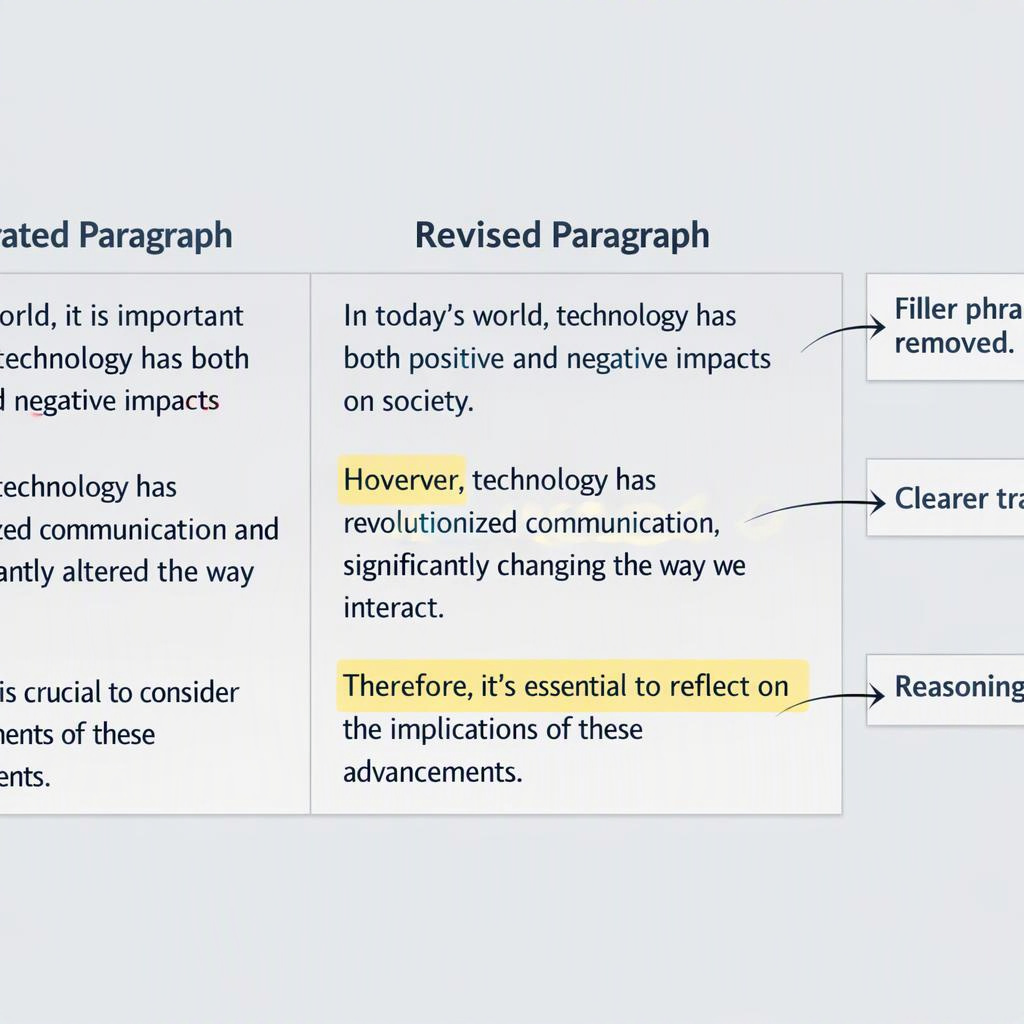
- Purpose: Connect ideas. Change: Remove unsupported “therefore.” Reason: Avoid false causation. Protected: Reasoning. Manual check: Does the transition describe the relationship accurately?
- Purpose: Explain significance. Change: Delete filler. Reason: Clarity. Protected: Qualification. Manual check: Did an important limitation disappear?
Illustrative example—not a quotation or product output: “It is important to note that longer library hours may help students with evening jobs. Therefore, staffing costs also matter.” Revision: “Longer library hours may help students with evening jobs. However, staffing costs also matter.” Notes: Removing filler puts the claim first. “However” signals a competing consideration rather than suggesting that one statement causes the other. Keeping “may” preserves uncertainty. Both points remain, but their relationship is clearer. In a sourced paragraph, retain the reference and citation, then check that the revised wording still matches the evidence. Do not add details simply to make the sentence sound more convincing.

Choose Editing Help and Manually Verify the Result
Compare editing options by how much control they give you, how they handle context and sources, their privacy terms, and assignment permission. Promises of natural writing are not enough. An essay humanizer may provide wording alternatives; do not assume it tracks changes, preserves citations, or verifies facts without checking its documentation.
- Manual revision: A strong starting point when meaning is delicate because you retain control and context. Keep sources open while editing. Familiarity can make weaknesses harder to notice, so take a break before rereading.
- Writing-center feedback: Useful when organization or reasoning needs discussion rather than sentence replacement. Ask for explanations you can apply yourself. Confirm permitted assistance and how drafts are handled; feedback does not replace source verification.
- Essay humanizers: Worth comparing when a specific wording problem remains and assistance is permitted. Avoid them when uploading is prohibited or essential nuance cannot be preserved. Check documented functionality, text-retention terms, restrictions, and options for reviewing changes before sharing text.
Compare each revised paragraph with its original, then read the full essay aloud. Listen for abrupt transitions, repetitive openings, and sentences that no longer sound like you. Complete these checks yourself rather than assuming they happen automatically:
- Thesis consistency: Are the position, scope, and qualifications unchanged?
- Evidence fidelity: Do the sources still support each claim?
- Quotation accuracy: Does quoted wording match the originals?
- Citation placement: Is attribution clear and formatting consistent with the required style?
- Voice: Are the vocabulary and rhythm recognizable?
- Assignment rules: Is assistance permitted, with required disclosure included?
Conclusion: Keep Only Changes You Can Defend
Natural editing works when it clarifies your thinking without changing what the essay can support. Keep ownership of every decision. Preserve your argument, source references, quotations, and citations, and accept only revisions you can explain and verify.
If your reasoning is sound but one paragraph feels generic, review the essay humanizer page to compare its documented editing scope, text-handling terms, restrictions, and review options with your needs. If it fits your assignment rules, test one non-sensitive paragraph. Compare clarity, voice, claim strength, and citation placement against the original before deciding whether to use it more broadly.
Keep your edit log through the final read-through. If a change remains difficult to justify, restore the original or revise the sentence yourself.

FAQ
How can I make my essay sound more natural without making it too informal?
Use specific nouns, direct verbs, and varied sentence lengths. Remove empty introductions while retaining necessary academic terms and qualifications. Compare the result with your voice baseline. Natural writing does not require slang, contractions, personal anecdotes, or a conversational tone.
How do I check that an edit has not changed my argument or citation meaning?
Compare certainty, scope, causation, and attribution in both versions. Then reread the cited passage. Does it support the exact revised claim? Is the citation still attached clearly to the statement it supports? If either answer is unclear, revise again.
When is the linked essay humanizer a logical option?
It is worth comparing for a permitted, non-sensitive paragraph that needs wording alternatives you can assess yourself. It is unsuitable when assistance or uploading is prohibited. Verify its documented features, privacy terms, restrictions, and review process before sharing any text.
Should I accept every edit that sounds better?
No. Reject edits that exaggerate evidence, remove uncertainty, blur attribution, or introduce language you would not normally use. If an edit changes meaning, treat it as an argument revision requiring source review—not a harmless stylistic improvement.


