
An smart detector and humanizer can support editing, but only when you treat detection as a tentative review signal and check every revision yourself. A changed score does not prove authorship, accuracy, or compliance. If you need both passage review and rewriting support, the detector and humanizer overview is a starting point for comparing a combined workflow with manual editing.

The process should answer three questions: What needs attention? What would make it clearer? Did the changes preserve the facts and meet the publication or assignment requirements? The goal is a better draft, not a preferred score. For marketing copy, articles, or permitted coursework, keep editorial judgment at the center.
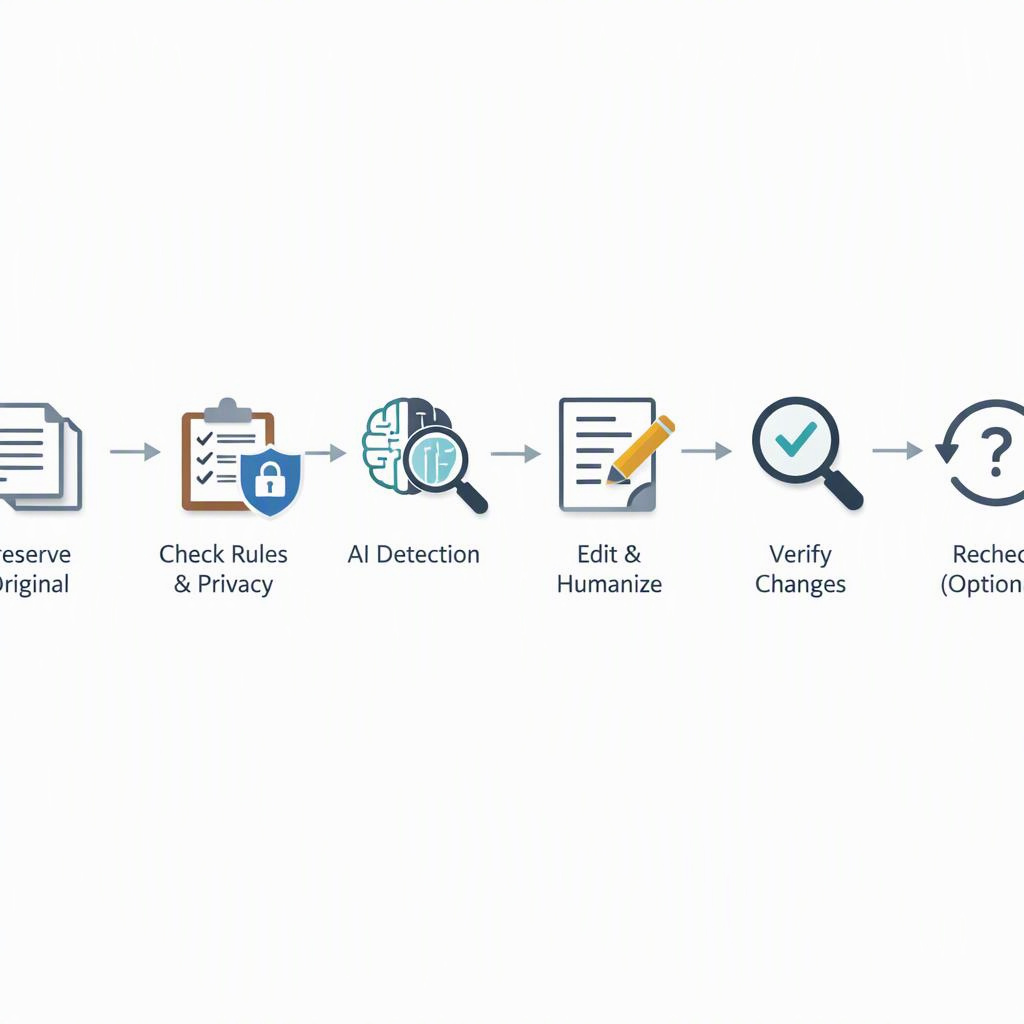
- Preserve: Save the original draft and its supporting sources.
- Check: Confirm submission rules and permitted data handling.
- Detect: Use the result to guide review, not establish authorship.
- Edit: Improve clarity without changing the intended meaning.
- Verify: Check facts, citations, voice, and requirements.
- Optionally recheck: Repeat detection only for a clear review purpose.
Detect: Treat the Result as a Review Signal, Not a Verdict
Before uploading anything, save an unchanged copy with source notes and available drafting history. Confirm that external processing is allowed. Client documents, student work, unpublished research, and personal information may require special handling. If permission is unclear, pause the upload and use an approved review method.
Check the service’s official documentation for supported languages, minimum text length, and stated limitations. Separately, read the relevant institution’s, publisher’s, or employer’s rules. Note each policy’s scope, URL, and access date so you can explain which requirements guided your review. Permission in one setting does not establish permission elsewhere.
- Document the check: Record the date, settings, text version, and service version when available.
- Read in context: Review flagged passages alongside neighboring sentences. Do not assume an isolated phrase needs rewriting.
- Look for actual problems: Identify vague claims, repetitive structure, missing evidence, or shifts in voice. Edit those issues, not the score.
- Separate accuracy from detection: A result does not confirm that a claim is true or that a citation exists.
- Avoid accusations: A score alone cannot prove who wrote a passage. For authorship concerns, examine drafting records and follow the applicable review procedure.
Edit: Improve Specificity and Voice Without Changing Meaning
Start with the argument, not individual word substitutions. Who is the reader? What should the passage explain? Which evidence supports its main point? A humanizer can suggest alternative wording, but you remain responsible for every accepted change. Natural writing depends on clear, purposeful language—not added slang, intentional mistakes, or invented personal experiences.
- Replace vagueness: Add specifics only when the sources support them. If evidence is missing, flag the gap rather than filling it with a plausible detail.
- Improve structure: Lead with the main point and make the connection between ideas clear.
- Remove repetition: Cut duplicated claims and transitions that do not help the reader.
- Restore voice: Use vocabulary and sentence patterns appropriate to the writer, audience, and document.
- Protect facts: Compare names, numbers, dates, citations, and technical terms with the original and its sources.
- Keep qualifications: Preserve distinctions such as “may” versus “will.” Do not turn a limited finding into a universal claim.
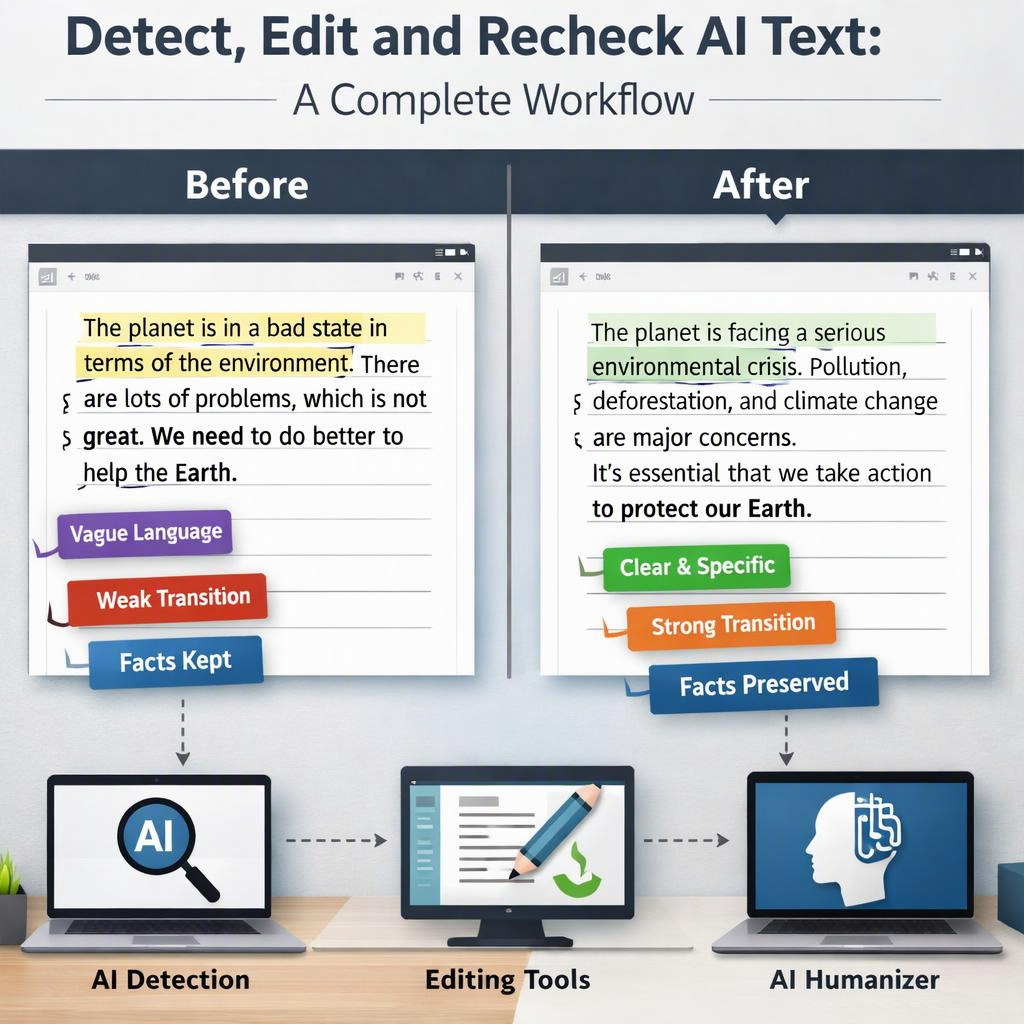
Illustrative before: “It is important to note that the report covers three departments. In addition, it does not include contractors.” After: “The report covers three departments but excludes contractors.” Annotation: The revision drops an empty opening and makes the scope limitation easier to see. Both factual statements remain intact, and no new evidence is introduced. This demonstrates an editorial improvement, not a measured change in detection results.
Recheck: Validate the Revision and Know When to Stop
Rechecking begins with the document, not another score. Compare the revision with the saved original and supporting sources. Open cited references and confirm that they support the nearby claims. Check quotations word for word. Read the draft aloud to catch awkward transitions or changes in voice, then confirm any disclosure and submission requirements.
If another detection check serves a useful purpose, keep the service, settings, and passage boundaries consistent where possible. Record the edits and any changed conditions, including documented service updates. Wording, structure, and input length can affect results; a different score does not establish authorship. Stop when the draft meets factual, editorial, and submission requirements.
- Permitted, low-stakes editing: A combined workflow is worth comparing when you need both passage review and wording suggestions. Manual editing remains an alternative.
- Sensitive documents: Use approved handling only. An authorized editor or internal review process may be more appropriate than an external upload.
- Restricted submissions: External rewriting may not be allowed. Check the governing rules and ask for clarification before proceeding.
- Final handoff: Retain the original, revised copy, source notes, and any required disclosure. These records support accountable review; they do not mean a detector certified the document.

Conclusion
Detection can help focus attention, but it cannot certify authorship or quality. The useful outcome is a clearer, well-supported draft that preserves meaning and meets the relevant requirements. Editing should fix identifiable problems, while rechecking should catch any new problems introduced along the way.
Before sharing the draft, compare it with the original one last time. Can you explain every substantive change? Do the sources support the claims? Does the voice suit the audience? Have you included required disclosures? Another detector run cannot replace those checks.
For permitted drafts needing both review and revision support, compare the detector and humanizer approach with manual editing or editorial review. Before uploading, check documented input requirements, data handling, and compatibility with your submission rules. Choose the process that suits the document’s sensitivity and protects its meaning, rather than one promising a particular score.
FAQ
Can a detector prove who wrote a passage?
No. Its output alone is not proof of authorship. Draft history, source notes, and explanations of writing decisions can provide context. Formal concerns should follow the relevant institution’s or organization’s review process rather than rely on a score.
Why do detector results change after editing?
Editing changes wording, sentence structure, and sometimes passage length. Different settings or service updates may also affect results. A changed score does not establish that the revision is more accurate, more original, or acceptable for submission.
How should I recheck text after rewriting?
Compare the revision with the original and sources. Check facts, citations, qualifications, readability, and voice, then review rules and disclosures. Repeat detection only if it addresses a remaining review question, keeping conditions consistent where possible.
When is a combined detector and humanizer solution a logical choice?
It is worth comparing for permitted, low-stakes drafts that need both review and rewriting support. Restricted or sensitive documents may require another approach. For your next draft, compare input support, data practices, submission permissions, and meaning preservation against manual editing before choosing a workflow.


