
If you are searching for how to lower smart detection score on an essay, focus on revision rather than shortcuts. The safest way to reduce false flags is to make your draft clearer, more specific, and more obviously connected to your own thinking. Detection tools tend to react to flat sentence rhythm, vague claims, repeated wording, and overly neat structure. In most cases, the fix is simple: edit until the essay sounds like a real person making a real argument.

That matters for students, freelance writers, and non-native English speakers alike. A paper can be fully original and still sound stiff if it leans on generic phrasing or formulaic structure. Start with your own ideas, notes, and assigned sources, then revise for flow, clarity, and precision. A practical essay revision checklist can help you spot weak areas before submission and improve both readability and confidence.
Why essays get flagged and what detection tools actually notice
Essays usually get flagged because they sound predictable, not because they contain a single suspicious phrase. These tools often notice uniform sentence length, recycled transitions, broad claims without evidence, and paragraphs that follow the same pattern from start to finish. That is why even honest writing can get flagged if it feels generic or detached from the topic. A paper may look questionable simply because it lacks texture, detail, or a distinct point of view.
Another common issue is abstraction. When a draft stays at the level of general statements, avoids taking a clear stance, or summarizes ideas without explaining their importance, it can read like a template. This happens often when writers choose overly formal wording to sound academic. Instead of sounding thoughtful, the essay starts to feel distant and unnatural.
Common patterns that make writing sound robotic
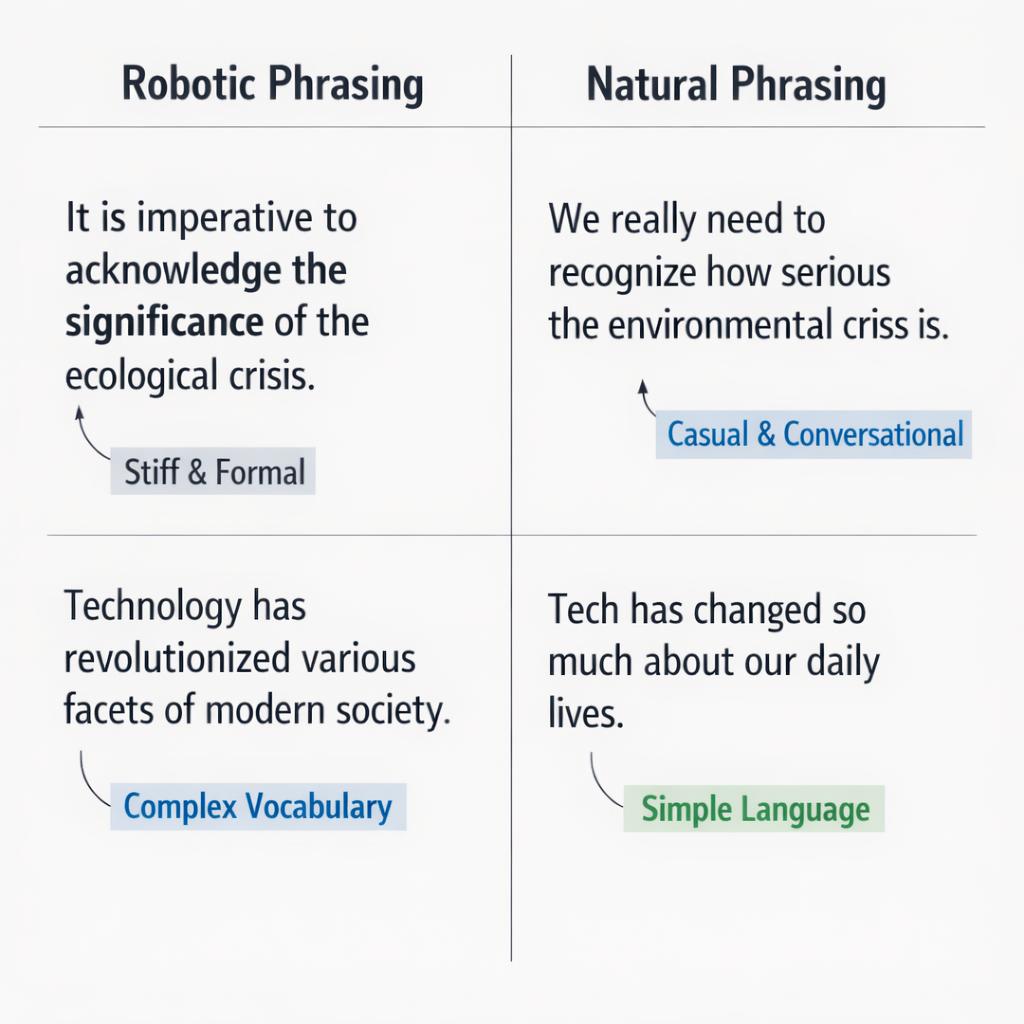
Robotic writing usually shows the same habits again and again. It may repeat sentence openings, rely on stock phrases such as “it is important to note,” or fill space with statements that could fit almost any topic. Sometimes the analysis is technically correct but too safe, with every paragraph built around the same rhythm and the same kind of transition. The result is smooth, but it does not feel personal or fully engaged.
To fix that, look for patterns instead of isolated lines. Mark any sentence that sounds interchangeable or overly formal. Vary sentence length, replace generic transitions with direct links between ideas, and cut lines that do not add meaning. If you are trying to figure out why a draft sounds mechanical, these are usually the first places to revise.

How to revise your essay so it sounds more natural and personal
The most effective way to improve a draft is to revise for ownership. Replace vague claims with details from your reading, class discussion, research notes, or relevant experience when appropriate. Name the exact example, explain why it matters, and show how you reached your conclusion. This makes the writing stronger on its own, and it also helps if you are wondering how to lower smart detection score on an essay without compromising honesty.
Read each paragraph aloud and listen for rhythm. If every sentence moves at the same pace, mix shorter and longer lines. If the tone feels too stiff, swap filler for direct wording. If a point sounds thin, add the reasoning behind it instead of padding the paragraph with repetition. For more help with flow and style, see how to make your writing sound natural.
Add specific examples, varied sentence flow, and your real viewpoint
If you want an essay to sound more human, include details that reflect real engagement with the assignment. That might be a close reading of a quotation, a comparison between two sources, or a short explanation of why one argument is more convincing than another. Specific choices like these make a paper feel grounded instead of generic.
Then revise the flow of your sentences. Combine short related ideas, break up long stretches of similar syntax, and move emphasis around so the rhythm feels less predictable. Just as important, let your viewpoint appear in the analysis. You do not need to sound casual, but you should sound present. Phrases like “the stronger evidence here is” or “this matters because” can make your reasoning easier to follow while keeping an academic tone.
A simple final review checklist before you submit
Before you turn in the essay, do one last review with a clear checklist. Make sure the thesis matches the body paragraphs, each example supports a claim, and every citation is accurate and complete. Remove repeated transitions, cut sentences that restate the obvious, and check whether the introduction promises something the paper actually delivers. These small changes often reduce false flags because the draft becomes more coherent, less repetitive, and more clearly yours.
Next, test for consistency. Keep tone, tense, formatting, and citation style steady from beginning to end. Watch for abrupt shifts that make the paper feel patched together. Read the first and last sentence of each paragraph aloud. If anything sounds stiff, overgeneralized, or unlike your normal writing, revise it. When people ask how to lower smart detection score on an essay, this final pass is often where the biggest improvement happens.
Check citations, transitions, tone shifts, and consistency
A strong final check does not need to be complicated. Verify that quotations are introduced naturally, paraphrases are truly in your own words, and source details are not missing. Then review transitions. They should connect ideas clearly, not just announce them. If you use the same connector too often, replace it or remove it.
Also compare sections side by side. Does one paragraph sound much more formal than the rest? Does one section stay broad while another gives detailed analysis? Uneven tone can make a draft feel unnatural. Smooth those differences by tightening wording, clarifying analysis, and keeping your voice consistent all the way through.

Conclusion
Learning how to lower smart detection score on an essay usually comes down to honest, careful revision. The more your paper reflects your own reasoning, examples, structure, and word choice, the more natural it will read. Instead of chasing tricks, focus on clarity, sentence variety, accurate citations, and analysis that shows real engagement with the topic.
This approach improves more than one thing at once. It strengthens readability, supports originality, and lowers the chance that a tool will misread stiff or generic phrasing. If your draft already contains your own ideas, thoughtful editing is often enough to make it stronger. Write clearly, revise patiently, and submit a paper that genuinely sounds like you.
FAQ
Why do detection tools flag some essays unfairly?
They often react to patterns rather than intent. A fully original essay can still get flagged if it uses repetitive transitions, uniform sentence length, broad claims, or wording that feels too generic for the topic.
Can rewriting an essay in my own words lower the score?
Yes, if the revision is genuine. The goal is not to swap a few words. It is to express the ideas through your own structure, examples, and reasoning so the paper reflects your actual voice.
Does reading the essay aloud really help?
Yes. Reading aloud makes stiff phrasing, repetitive rhythm, and weak transitions much easier to notice. It is one of the fastest ways to improve flow before submission.
What should I fix first in a draft that sounds robotic?
Start with vague claims, repeated sentence patterns, and filler phrases. Then add specific examples, tighten the analysis, and make sure each paragraph clearly supports your main argument.


