
Detection tools do not read intent, authorship, or the writing process itself. They look at the finished draft and estimate whether its wording matches patterns commonly found in machine-written text, even after someone has revised it. In practical terms, how does smart detection work after human editing depends on whether the final version still shows predictable phrasing, repetitive sentence shapes, or an unusually even style from start to finish. Human revisions can change those signals, but they do not guarantee a different outcome. For a broader primer, see how detectors evaluate writing signals.

For marketers, publishers, students, editors, and website owners, the key point is simple: a detector score is a clue, not a verdict. Edited text may score differently because sentence length, vocabulary, factual detail, and structure have changed. At the same time, these systems are probabilistic, so results can vary from one tool to another or even from one draft to the next. That makes careful review more useful than score chasing.
What detection tools look for in edited text
Most detectors evaluate statistical features in the final wording rather than any visible history of who typed what. They may weigh predictability, sentence variety, transition habits, and how evenly ideas move across the page. That is why the question is rarely a clean yes or no. If edits are light, many of the same patterns can remain. If edits are deeper, the overall profile may look less uniform and the result may shift.
Why sentence patterns, predictability, and consistency still matter
Even after revision, detectors can still notice a steady cadence, repeated syntax, low-surprise word choice, or sections that sound polished in the same way throughout. This helps explain why edited text may still get flagged. Many human editors improve grammar and clarity, but if they mainly smooth the wording without changing the structure, much of the underlying predictability can stay in place. These tools do not prove who wrote a piece. They only estimate how closely the final draft matches the signals they are built to measure.
That also means highly generic writing can create issues regardless of authorship. Broad claims, templated transitions, and paragraphs that all follow the same rhythm may appear suspicious simply because they are statistically regular. A strong editor usually breaks that pattern by adding specifics, reshaping the flow, and making the piece sound grounded in a real audience and purpose.
How human editing can change a detection result
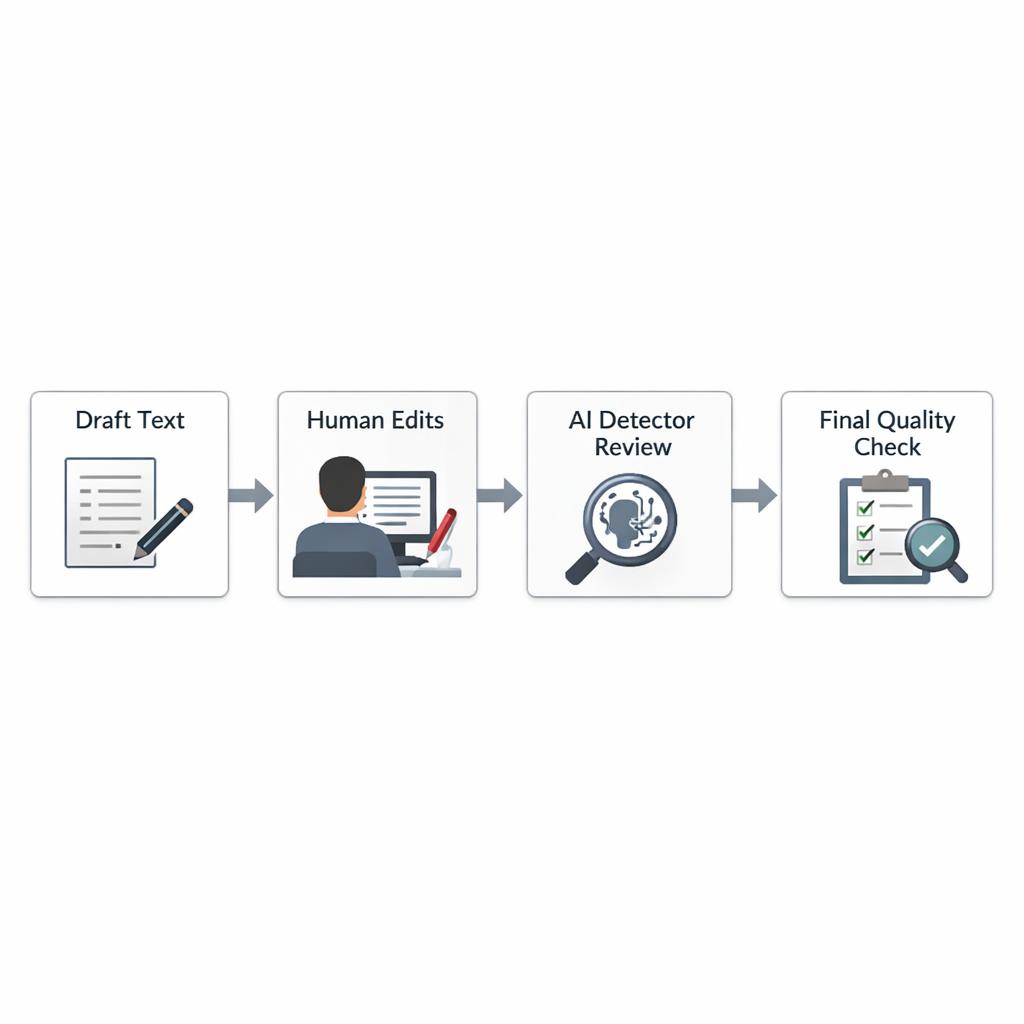
Human editing can influence results most when it changes substance, organization, and evidence instead of just swapping words. Adding firsthand examples, verifying facts, tightening claims, removing filler, and reordering ideas all reshape the text more deeply than surface rewriting. That is often the real answer to how much editing changes detector scores: meaningful revision tends to have more impact than cosmetic cleanup, though no method can promise a specific result.
Edits that help readability versus edits that only reword surface phrasing
Readability edits help real readers, while shallow rewrites mostly try to game a score. Replacing a few adjectives, changing sentence openings, or switching obvious synonyms may not alter the core patterns very much. By contrast, adding sourced detail, trimming vague summaries, varying paragraph logic, and matching the tone to a publication can make the writing more distinct and more useful.
This is also why results after rewriting should be treated cautiously. A revised draft may look different to one detector and almost unchanged to another. Sample length, tool sensitivity, and the quality of the revision all matter. In other words, editing can influence the output, but no detector offers a perfect reading of originality, intent, or authorship.
A practical way to think about it is this: if the revision improves accuracy, specificity, and structure, it is doing real editorial work. If it only hides obvious patterns while leaving the piece generic, the writing may still read as flat to both detectors and human readers.

How to review content responsibly after editing
The safest approach is editorial, not score driven. After revision, review clarity, factual support, originality, citations when needed, and whether the piece sounds natural for the intended audience. If a detector result changes, use it as a prompt to inspect the draft, not as proof of authenticity or misuse. Teams publishing web content should also compare the piece against search intent, brand voice, and quality standards instead of relying on one system reading.
Use detection as one signal alongside fact-checking, originality, and brand voice
A responsible workflow combines detector output with human judgment. That means checking for unsupported claims, duplicate passages, thin summaries, awkward transitions, and tone mismatches before publication. If you need a practical process, review this content originality and editorial review checklist. In this topic area, that balanced view matters most: editing can change measurable signals, but detectors remain limited and should support, not replace, careful editorial review.
For SEO readability, the same rule applies. Content should answer the search clearly, use specific language, and offer information a reader can act on. If a page becomes clearer, more useful, and better organized after editing, that is a stronger outcome than simply trying to move a score in one direction.

Conclusion
How does smart detection work after human editing? It works by analyzing the final text for patterns such as predictability, consistency, and phrasing habits, not by knowing who wrote each sentence. Human edits can affect the result, especially when they add substance, restructure ideas, and improve specificity. But the output is still an estimate, not proof.
The most useful takeaway is to edit for readers first. When a draft becomes clearer, better supported, more original in structure, and more aligned with your voice, its overall quality improves regardless of any single detector score. Use detection tools carefully, understand their limits, and make publication decisions through fact-checking, originality review, and sound editorial judgment.
FAQ
Can human editing make text look fully original to detectors?
Sometimes a score changes after strong revision, but no edit can guarantee that a detector will interpret the text a certain way. These tools evaluate patterns in the final wording, so a lower or different result is not the same as proving originality or authorship with certainty.
Why can heavily revised text still be flagged?
Some underlying signals may remain even after major edits, especially if the structure, pacing, and phrasing habits stay consistent. Tools also vary in sensitivity, so a well-edited draft may trigger a cautious result in one system and not in another.
Do different detectors give different results on the same edited draft?
Yes. Different tools use different thresholds, methods, and assumptions, so the same passage can receive different assessments. That is why comparing scores without broader editorial review can be misleading.
What is the best next step if a detector score seems questionable?
Review the content manually. Check facts, originality, clarity, sourcing, and voice, then revise where needed. A questionable score is most useful as a signal to inspect the draft more closely, not as a final judgment on the writing.


