
Formulaic transitions, repeated ideas, and broad claims without supporting detail can make a passage sound machine-written. But none of these patterns proves how it was created. They also appear in school assignments, business templates, rushed drafts, and heavily edited prose. Treat them as reasons to inspect the writing, not identify its author.
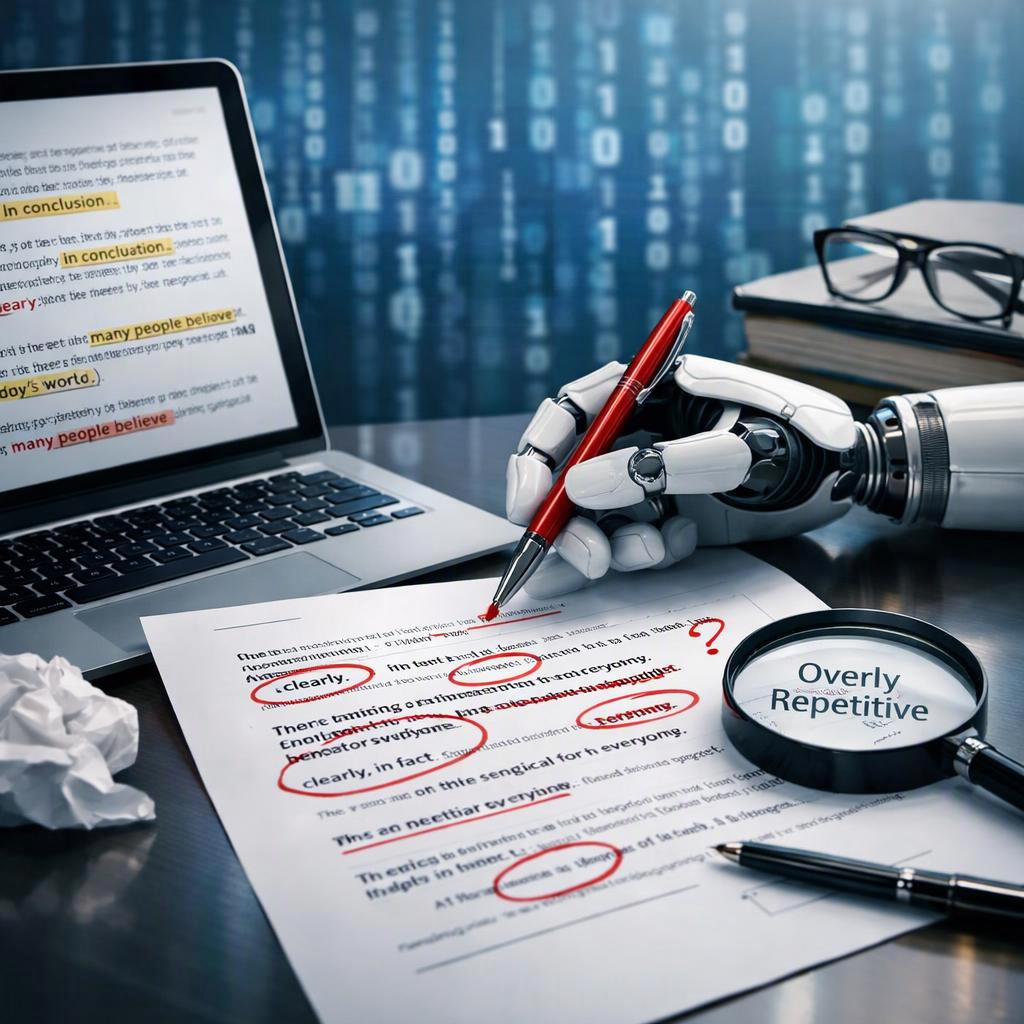
If you are asking, “Does this sound machine-written?” separate two questions: what makes the passage unconvincing, and what evidence exists about its creation? Close reading can help answer the first. The second requires context beyond vocabulary and sentence structure. A paragraph can need substantial editing while its authorship remains unresolved.
Whether you are revising your own work or reviewing someone else’s, start with specific weaknesses rather than labels. You can optionally review a passage with the detector if another review input would be useful. Before submitting text, check the service’s documented purpose, limitations, and data handling. Its output is not independent proof of authorship.
Recognize Mechanical Transitions, Repetition, and Generic Claims
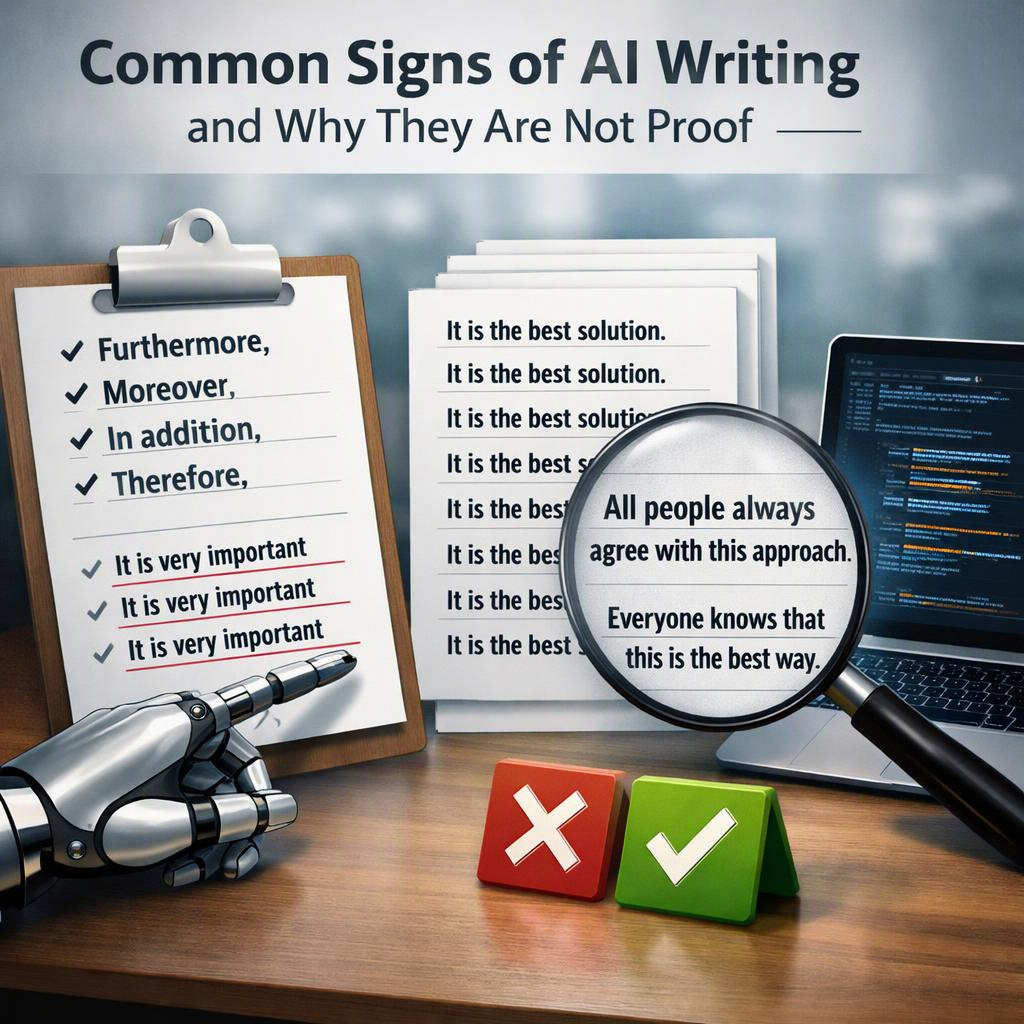
The most useful clues are problems you can point to and explain: a connector that misstates the relationship between sentences, a conclusion repeated without development, or a claim broad enough to fit almost any topic. These are editing concerns, not reliable authorship markers. Ask what each sentence contributes before deciding it feels suspicious.
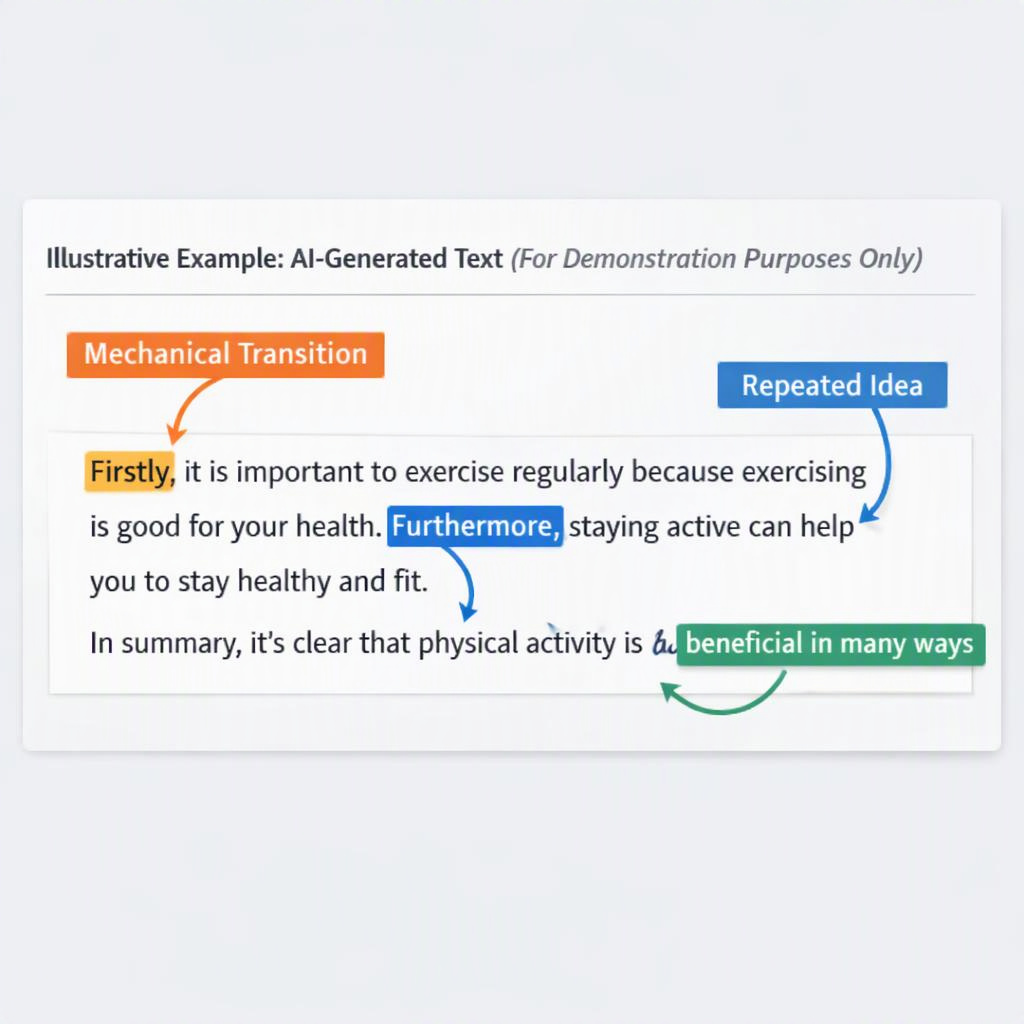
- Mechanical connectors. Example: “The deadline changed. Furthermore, submit by Friday.” The second sentence gives an instruction, not simply additional information. A clearer version might be, “The deadline is now Friday.” A person following a formal template could make the same awkward choice.
- Repetition. Example: “The process saves time. It makes work faster.” The second sentence adds little. Replace it with a supported detail about which step becomes faster, or cut it. Still, repetition can serve a human writer’s purpose, especially for emphasis or clarification.
- Generic claims. Example: “Communication is essential for success.” Look for an explanation of who needs to communicate, about what, and with what result. A beginner may start broadly and add specifics later, so inspect the surrounding paragraph before judging the opening.
Annotated illustrative passage: “Clear communication helps teams succeed. Furthermore [mechanical transition], it supports success [repeated idea] in every organization [generic claim].” This is a constructed example, not a verified sample of generated writing. A useful revision would name the team, the communication problem, and a supported outcome. Do not invent details just to make the passage sound more convincing.
Check Context and Counterexamples Before Judging Authorship
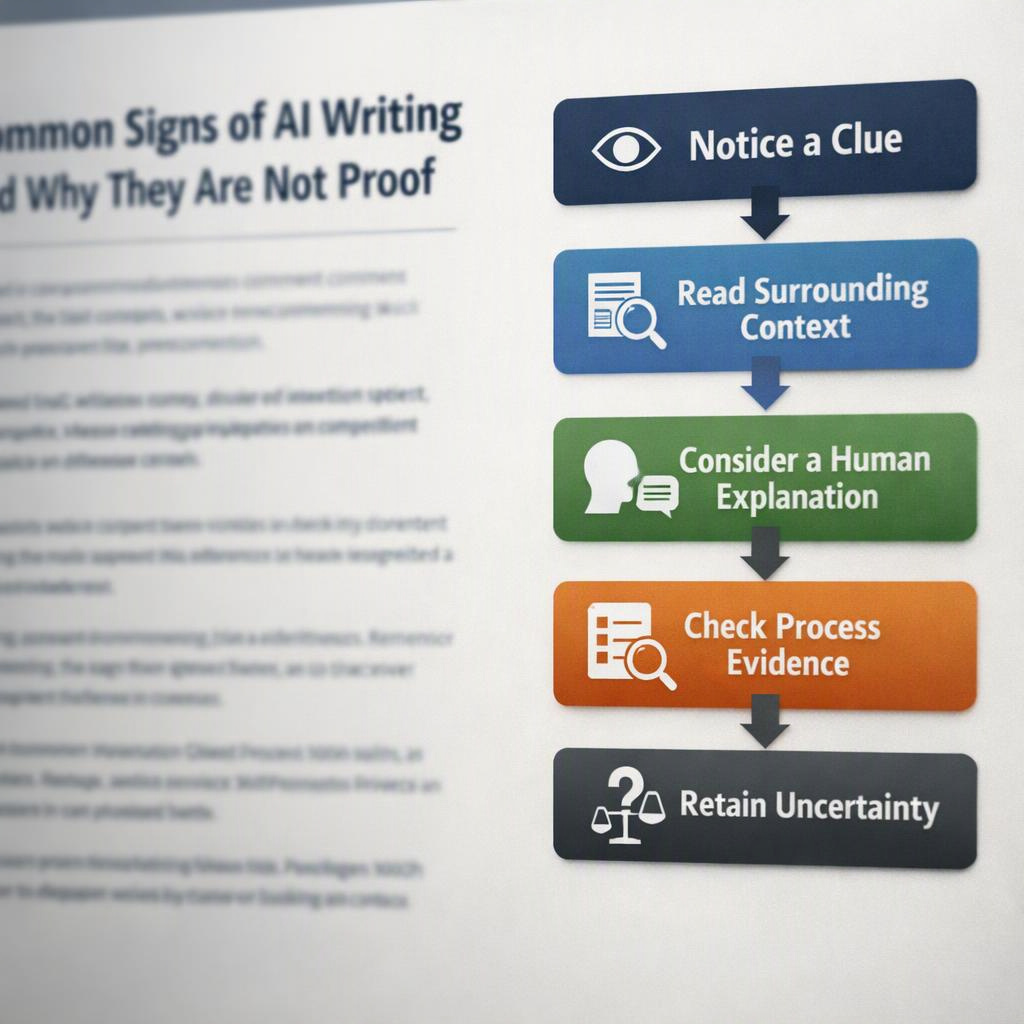
Read the full passage before drawing conclusions from one sentence. Templates can require identical openings, formal genres favor predictable organization, and editing can remove distinctive phrasing. Standardized assignments may also lead different writers toward similar arguments. Even several clues together call for closer review, not certainty. First ask whether the task or format explains the pattern.
- Mark the exact concern: highlight the sentence that repeats an idea or lacks support instead of labeling the entire document.
- Read the surrounding context: check whether nearby examples, qualifications, or source material supply the detail that seems missing.
- Consider an ordinary explanation: account for templates, genre conventions, writing experience, and intentional stylistic choices.
- Review available process evidence: drafts, source notes, and revision history may help explain how the argument developed.
- State what remains unknown: if the evidence does not resolve authorship, preserve that uncertainty in your assessment.
Process records have limits, too. Missing drafts do not prove machine use; someone may write offline or overwrite earlier versions. When appropriate, ask the writer to explain a source choice or revision decision without framing the question as an accusation. “This claim needs support” identifies a concrete problem. “This must be machine-written” makes a different claim that the wording alone cannot establish.
Use a Detector as a Review Prompt, Not a Verdict
A detector’s usefulness depends on your goal and the stakes. For low-stakes self-editing, another review input may be worth comparing with your own reading when deciding what deserves attention. For disciplinary or employment decisions, neither stylistic impressions nor detector results are sufficient grounds for action. A result should raise questions, not replace evidence about the writing process.
- Start with manual review: identify unclear reasoning, unsupported statements, repetitive sentences, and missing context. These findings remain useful regardless of authorship.
- Verify sources: confirm that cited material exists and supports the claim. An incorrect citation is a sourcing problem, not automatic proof of machine authorship.
- Discuss the process: where appropriate, ask how the writer selected evidence, organized the argument, and revised difficult passages.
- Check tool suitability: review intended uses, documented limitations, input requirements, output definitions, and data handling before sharing material.
The detector is worth considering only if its documented capabilities match your question. For example, if you want help identifying passages for closer review, verify whether it offers that level of feedback rather than assuming it does. Do not read a score as the probability that a particular person used a machine unless that interpretation is explicitly supported. When documentation is unclear, manual editing and source verification remain practical alternatives.
Conclusion
Mechanical transitions, repetition, and generic claims reveal possible weaknesses in prose, not proof of authorship. Human writing can contain all three; polished or distinctive writing does not settle the question in the opposite direction. The defensible approach is to name the concern, consider plausible explanations, and review relevant evidence.
For a passage you are editing, decide whether the next step is clearer wording, stronger sourcing, or more context about its creation. Those are different problems with different remedies. If an optional check would help, review the detector’s stated limitations and compare its intended use, output meaning, input requirements, and privacy terms with your situation. This keeps the review focused on useful improvements without turning an impression into an accusation.
FAQ
Can human-written text sound machine-generated?
Yes. Templates, rigid assignments, and rushed drafting can all produce formulaic prose. Repetition may also be deliberate. Evaluate whether the wording serves its purpose, then consider evidence about the writing process separately. A familiar style does not identify its source.
Are words like “moreover” and “furthermore” evidence of machine-written text?
No. Both are legitimate connectors in formal writing. Check whether the word expresses a real relationship between ideas. If it adds nothing or suggests the wrong connection, remove or replace it. That editing decision does not require an authorship judgment.
Are writing detectors proof of authorship?
No. A result requires interpretation and does not directly establish how a document was created. Check what the output means and which limitations are documented. For consequential decisions, review relevant context and process evidence rather than relying on a label.
When is the detector a logical option?
It may suit low-stakes review after close reading, but not a stand-alone accusation or consequential decision. Before checking your draft, compare the service’s intended use and output definitions with your goal, then verify privacy and retention terms before submitting confidential or someone else’s material.


