
A clear student use policy helps universities explain when generative tools are allowed, when disclosure is required, and how student responsibility is evaluated. If you are looking for an smart policy for students example for universities, the most useful model is concise, written in plain language, and flexible enough to work across departments. It should support an existing academic integrity policy framework rather than replace it.

This guide explains what a university student use policy should include, shares sample language institutions can adapt, and outlines practical steps for rollout. The sample language below is for informational purposes only and should be reviewed by university counsel, privacy, accessibility, and academic affairs teams before adoption.
What a university student use policy should cover
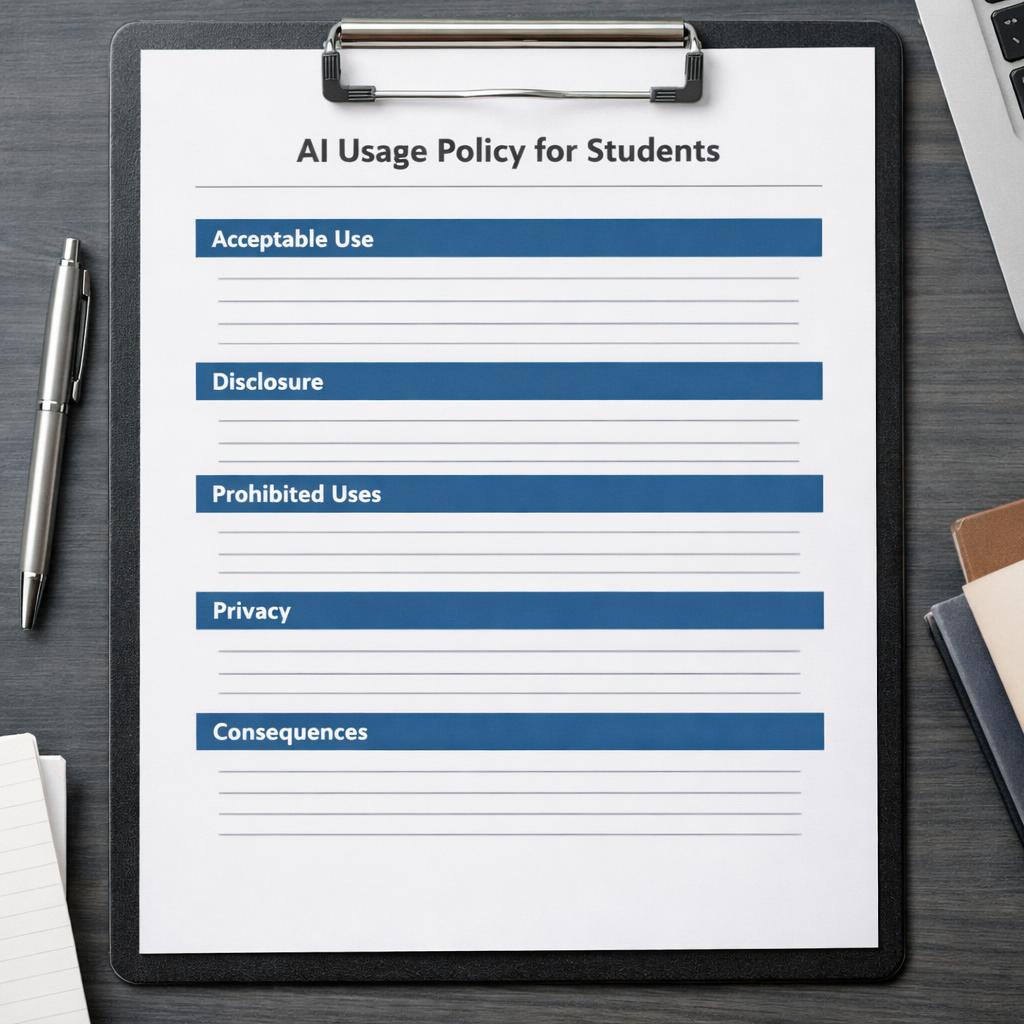
A university student use policy should define scope, permitted uses, restricted uses, disclosure rules, privacy limits, and consequences for misuse. Students should be told whether generative tools may be used for brainstorming, outlining, editing, coding support, translation help, or study preparation. The policy should also make clear when independent student work is required and when outside assistance crosses a line.
For many institutions, the best approach is a campus-wide baseline with room for instructors or departments to set stricter expectations. That is especially important in writing-intensive courses, labs, clinical programs, licensure pathways, and other settings where accuracy, confidentiality, or professional standards matter more. A strong policy gives students one starting point while preserving faculty authority over assignment-specific rules.
Core clauses: acceptable use, disclosure, privacy, and academic integrity
Core clauses should state that students remain responsible for accuracy, citation, originality, and compliance with copyright, data protection, and accessibility requirements. The policy should also explain that confidential, student-record, research, patient, or proprietary information must not be entered into external systems unless specifically approved. This is where a student use policy becomes especially practical: it separates acceptable support from prohibited substitution and connects those boundaries to existing conduct and integrity procedures.
A useful policy also explains disclosure in simple terms. If students use a tool in a meaningful way, they should say so using the method required by the instructor or university. Clear disclosure rules reduce guesswork, improve fairness, and make enforcement more consistent across courses.
Student use policy example for universities
Sample institutional language: “Students may use approved generative tools only as permitted by university policy, course instructions, and applicable law. Unless an instructor states otherwise, students may use such tools for idea generation, study support, grammar review, formatting assistance, and non-confidential drafting help. Students may not submit tool-generated output as wholly original work, misrepresent tool-assisted content as solely their own, or use generative tools during quizzes, exams, or other restricted assessments. Students are responsible for verifying facts, citations, calculations, and references in any submitted work.”
Sample language universities can adapt by course, department, or campus
Additional sample language: “When use is permitted, students must disclose material use in the manner required by the instructor or university, such as a brief statement in the assignment, appendix, or project log. Students must not upload confidential, personal, research-sensitive, or institutionally restricted information into external systems without written approval. Violations may be addressed through course-level remedies, student conduct procedures, or academic integrity review, depending on the nature of the concern.”
This format is useful because it can be adapted at the campus, school, or department level without changing the core message. Universities can pair it with internal guidance, faculty-facing syllabus language, and student handbook updates so expectations stay aligned. If you need an smart policy for students example for universities, this type of language works well because it is direct, enforceable, and easy for students to understand.
How to implement the policy without confusing students
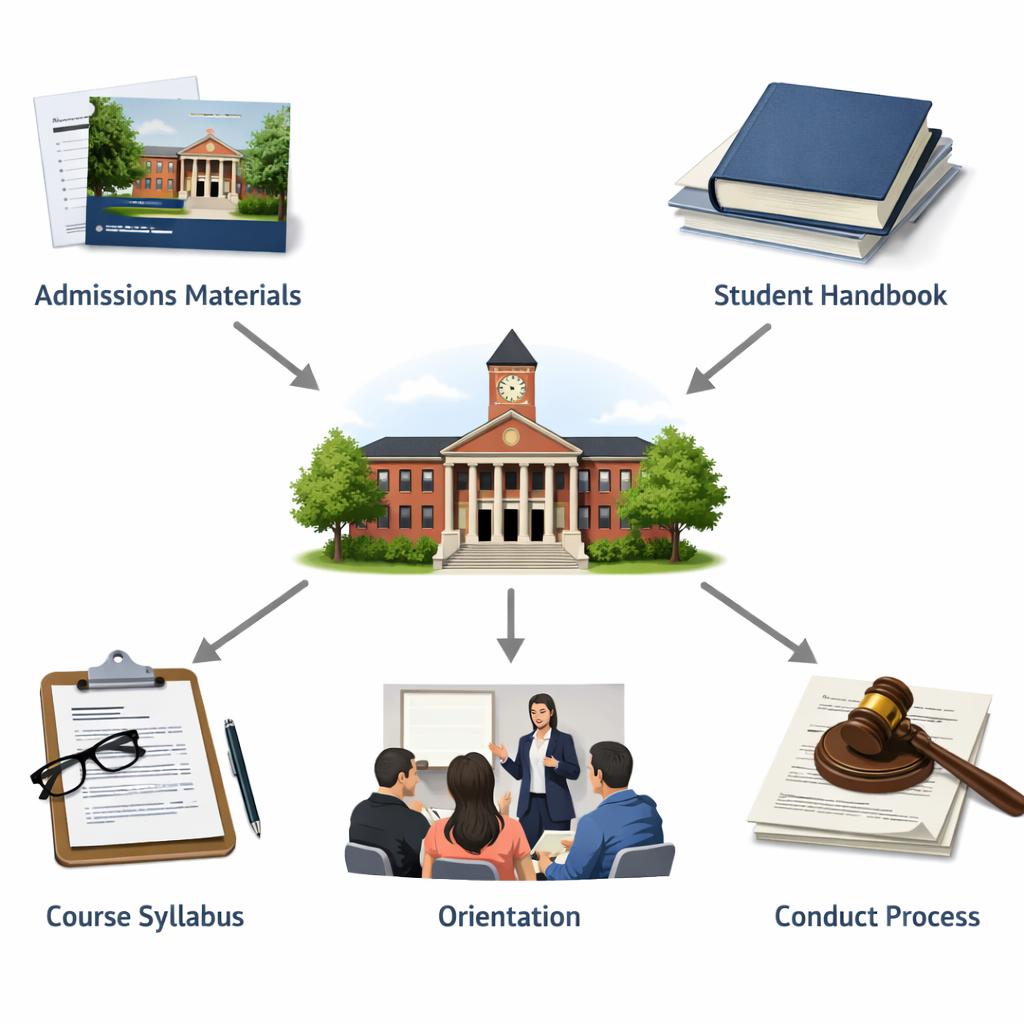
Implementation works best when the same baseline message appears in admissions materials, the student handbook, orientation resources, conduct pages, and course syllabi. Start with one institutional statement, then allow instructors to add assignment-level rules using plain labels such as “allowed,” “allowed with disclosure,” or “not allowed.” Linking to practical resources such as syllabus policy examples can help departments keep wording consistent and reduce mixed messages.
A simple workflow can also make the policy easier to follow: the handbook explains university-wide rules, the syllabus gives course-level rules, the assignment sheet sets task-specific instructions, and conduct procedures address alleged misuse. Students should not have to guess which rule applies in a given class. Compact, repeated wording is often more effective than long, legal-style explanations.
To reduce confusion further, train faculty and student-facing offices on common questions, documentation practices, and how to distinguish poor judgment from deliberate misconduct. Consequences should remain proportional and should fit within current academic integrity and student conduct processes instead of creating a separate enforcement system. Before launch, test the policy with students for readability and accessibility. In practice, the best smart policy for students example for universities is the one students can understand quickly: what they may do, what they must disclose, and what happens if they violate the rules.

Conclusion
The best smart policy for students example for universities is not a long legal document. It is a practical student use policy that defines acceptable use, requires disclosure when appropriate, protects privacy, and fits within existing academic integrity and conduct structures. Universities should aim for one campus-wide baseline with room for local variation by course or program, especially in higher-risk or professionally regulated settings.
Use the sample in this article as a starting point, then adapt terminology, approval paths, and enforcement details to fit your institution. Most important, have the final version reviewed by university counsel, privacy, accessibility, and academic affairs teams before adoption. A clear policy helps students make better decisions and helps instructors apply expectations more consistently.
FAQ
What should a university student use policy include?
It should include scope, approved and prohibited uses, disclosure expectations, privacy restrictions, instructor authority, and consequences for misuse. It should also explain how course-level rules interact with campus-wide rules so students understand which standard applies.
In most cases, the strongest policies also remind students that they remain responsible for the final work they submit, even when outside tools are allowed for limited support.
How is a student use policy different from an academic integrity policy?
A student use policy explains when and how generative tools may be used in coursework. An academic integrity policy addresses broader misconduct, such as plagiarism, unauthorized assistance, fabrication, and misrepresentation. The two should work together, with the student use policy providing practical guidance and the integrity policy supplying the enforcement framework.
This distinction matters because students often need clear use rules long before a misconduct issue arises.
Should every course use the same rules?
No. A campus baseline is helpful, but different disciplines may need stricter or more detailed expectations. Writing seminars, labs, clinical programs, and exam-based courses often need assignment-level restrictions because the risks and learning goals are different.
Universities should keep the institutional standard simple while allowing instructors to apply narrower rules when needed for safety, professional standards, or learning outcomes.
How should students disclose tool use?
Universities can require a short disclosure note in the assignment, an appendix describing material assistance, or a project log showing how the tool was used. The method should be simple, consistent, and easy for instructors to review.
The best disclosure process is one students will actually follow: brief, predictable, and clearly described in the syllabus or assignment instructions.


