
Responsible smart use in education examples are most helpful when schools need clear, practical ways to support learning without weakening trust, fairness, or assignment expectations. In practice, responsible use means digital tools can help people plan, revise, organize, or access material, while the student still completes the real academic work and follows course rules. Strong academic integrity guidelines set expectations early by explaining what is allowed, what must be disclosed, and what counts as misconduct. The goal is not total permission or total bans. It is a policy-based approach that protects privacy, keeps human judgment at the center, and makes classroom expectations easier to understand for students, teachers, and support staff.

What responsible use in education looks like
Responsible use starts with purpose, not convenience. A tool is being used responsibly when it supports a learning goal, does not replace the thinking an assignment is meant to measure, and fits school or course rules. In many classes, that means students may use digital help to brainstorm topics, build study questions, improve readability, or check grammar, but not submit copied text as their own work. For educators, appropriate use often includes drafting lesson ideas, creating discussion prompts, or adapting materials for different reading levels while still reviewing every draft for accuracy and classroom fit.
Clear boundaries matter just as much as useful tools. Students should know when disclosure is required, when citation is expected, and when independent work is mandatory. Teachers should explain whether use is allowed for planning, outlining, revision, translation support, or accessibility needs. Responsible practice also protects privacy by avoiding the entry of sensitive student information into outside systems unless district or campus rules explicitly allow it. When expectations are concrete, schools can uphold academic integrity more consistently and avoid confusion across classrooms.
Core principles: transparency, citation, privacy, and human judgment
Four principles make responsible use easier to apply across grade levels and subjects. First, transparency: if a student or teacher used a digital tool in a meaningful way, they should say so whenever class rules require it. Second, citation: if wording, ideas, media, or code from a tool significantly shaped the final work, schools should explain how that contribution must be acknowledged. Third, privacy: personal, medical, discipline, and confidential academic information should not be entered into outside systems unless approved by school policy. Fourth, human judgment: every output should be checked for mistakes, bias, missing context, and fit with the assignment or lesson.
These principles work because they are flexible without being vague. A fifth grader using reading support, a college student revising for clarity, and an instructor preparing examples can all follow the same logic: disclose when required, cite when needed, protect private information, and make sure a person decides what is accurate and appropriate. That kind of consistency helps schools create fair expectations instead of a patchwork of exceptions.
Responsible use in education examples for students and teachers
Many of the strongest responsible smart use in education examples focus on support rather than substitution. A student might ask a digital tool to suggest possible research questions, then choose one and build an original outline with their own evidence. Another student may turn lecture notes into a practice quiz, translate directions for comprehension, or get feedback on sentence variety before revising in their own voice. Accessibility is another valid use case. Tools can read text aloud, simplify directions, or help multilingual learners understand unfamiliar vocabulary. In each case, the student remains responsible for the ideas, analysis, evidence, and final submission.
For educators, responsible use can save time without reducing professional judgment. Teachers may draft rubric language, generate sample discussion starters, create differentiated practice prompts, or outline a parent newsletter. Instructional designers might compare course sequence options or test clearer module labels. Academic support staff can build study guides, tutoring prompts, or reflection questions more efficiently. These examples remain responsible because the adult reviews the material, removes weak suggestions, checks facts, and aligns the final version to standards, student needs, and local policy rather than accepting a draft automatically.
Examples that support brainstorming, feedback, accessibility, and lesson planning
- Brainstorming: Students generate possible essay angles, then select and refine one with their own reasoning and source support.
- Feedback: Writers get comments on clarity, organization, or transitions, then revise independently instead of pasting in replacement text.
- Accessibility: Learners use reading supports, summaries, captions, or translation aids to access content while still doing the required thinking.
- Study support: Class notes are turned into flashcards, self-check questions, or review outlines for test preparation.
- Lesson planning: Teachers draft warm-ups, examples, or exit tickets and then edit them for accuracy, tone, and classroom fit.
- Communication: Staff prepare first drafts of family updates or student reminders, then carefully review details and remove sensitive information.

Conclusion
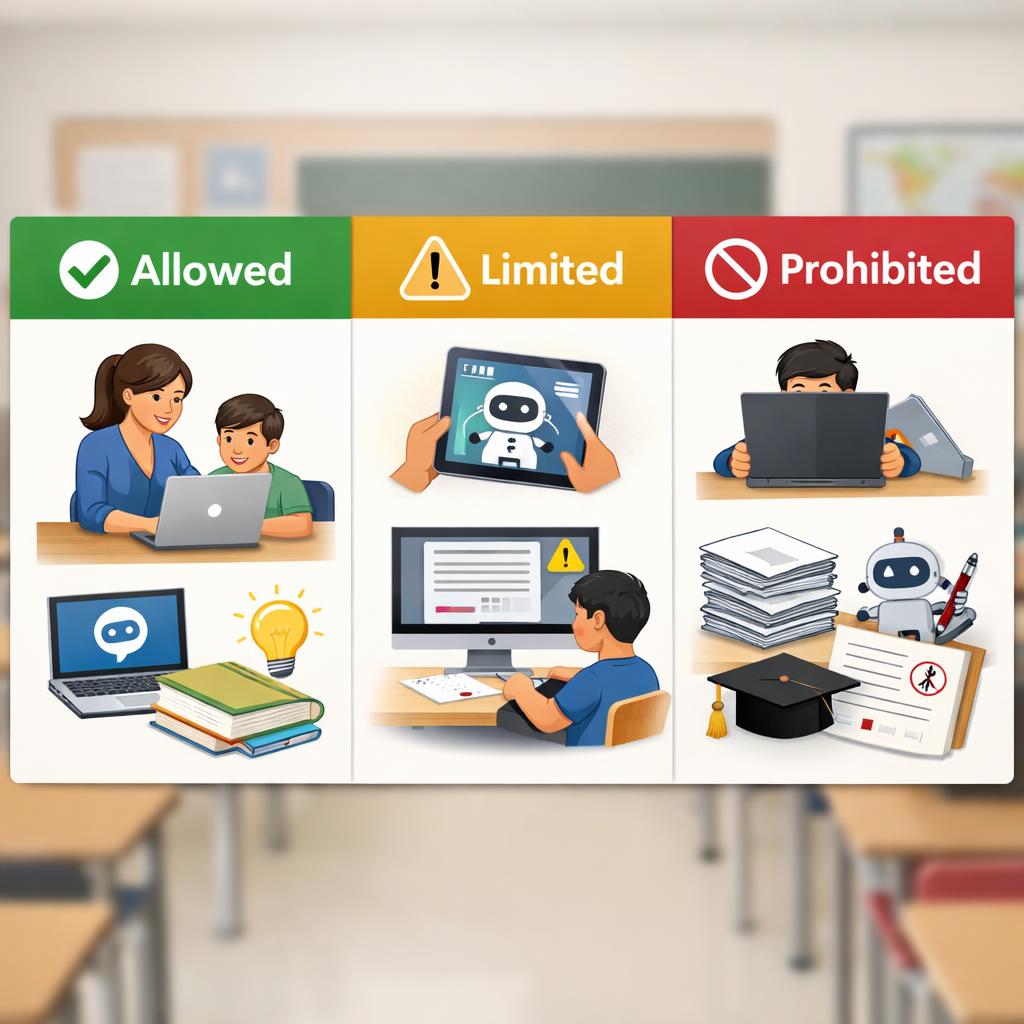
Responsible smart use in education examples are most useful when they show both permission and limits. Schools do not need vague rules that leave students guessing. They need practical expectations that help students learn, help teachers work efficiently, and protect fairness, privacy, and trust. The clearest approach is to allow supportive uses such as brainstorming, accessibility help, study materials, and lesson preparation while requiring human review, disclosure when assigned, and original academic effort. Schools can strengthen that approach with a simple acceptable use and disclosure policy that explains what is allowed, what is limited, and what is prohibited. When expectations are specific and consistent, responsible use becomes easier to teach, easier to follow, and easier to enforce.
FAQ
What are examples of responsible use in education?
Common examples include using digital tools to brainstorm topics, create study questions from notes, improve grammar, translate directions, support accessibility, or draft lesson materials that a teacher later reviews and edits. The key is that the tool supports learning or preparation rather than replacing the student’s required thinking or the teacher’s professional judgment.
How can teachers allow responsible use without increasing cheating?
Teachers can define allowed, limited, and prohibited uses in the syllabus or assignment instructions, require short disclosure statements, and design assessments that include drafts, in-class writing, oral check-ins, or reflections on process. These steps make expectations visible and reduce the chance that students will treat outside help as a substitute for original work.
Do students always need to disclose tool use?
Not always. Disclosure depends on course, instructor, and school policy. However, if a tool substantially shaped wording, structure, ideas, or other parts of the final submission, disclosure is often the safest and most transparent choice. Clear school rules should explain when disclosure is required and what format students should use.
What should schools include in responsible use policies?
Policies should define allowed, limited, and prohibited uses; explain disclosure and citation expectations; protect student privacy; and require human review of any generated material. Strong policies should also connect rules to assignment design so expectations are practical across classrooms, grade levels, and subject areas.


