

The short answer is yes, there are real claude smart detector vs chatgpt detector differences, but they usually show up in detector behavior rather than in any guaranteed winner. Most tools vary in the writing traits they are tuned to spot, how they react after human editing, and whether their scores are useful inside an actual publishing process. For SEO teams, that makes the decision less about brand labels and more about workflow fit, false-positive tolerance, and how much manual review still happens after a draft is flagged. If you need a wider category view, see best smart detection tools for SEO publishers.

In practice, a detector built around Claude-like writing may focus on different patterns than one tuned for ChatGPT-like writing. That can matter when you are screening text that is still close to its original form. It matters less once the content has been rewritten, localized, merged with notes, or polished by editors. So for most publishers, the biggest difference is not absolute accuracy. It is whether the detector helps your team make faster, more consistent review decisions.
Direct answer: how Claude and ChatGPT detectors differ
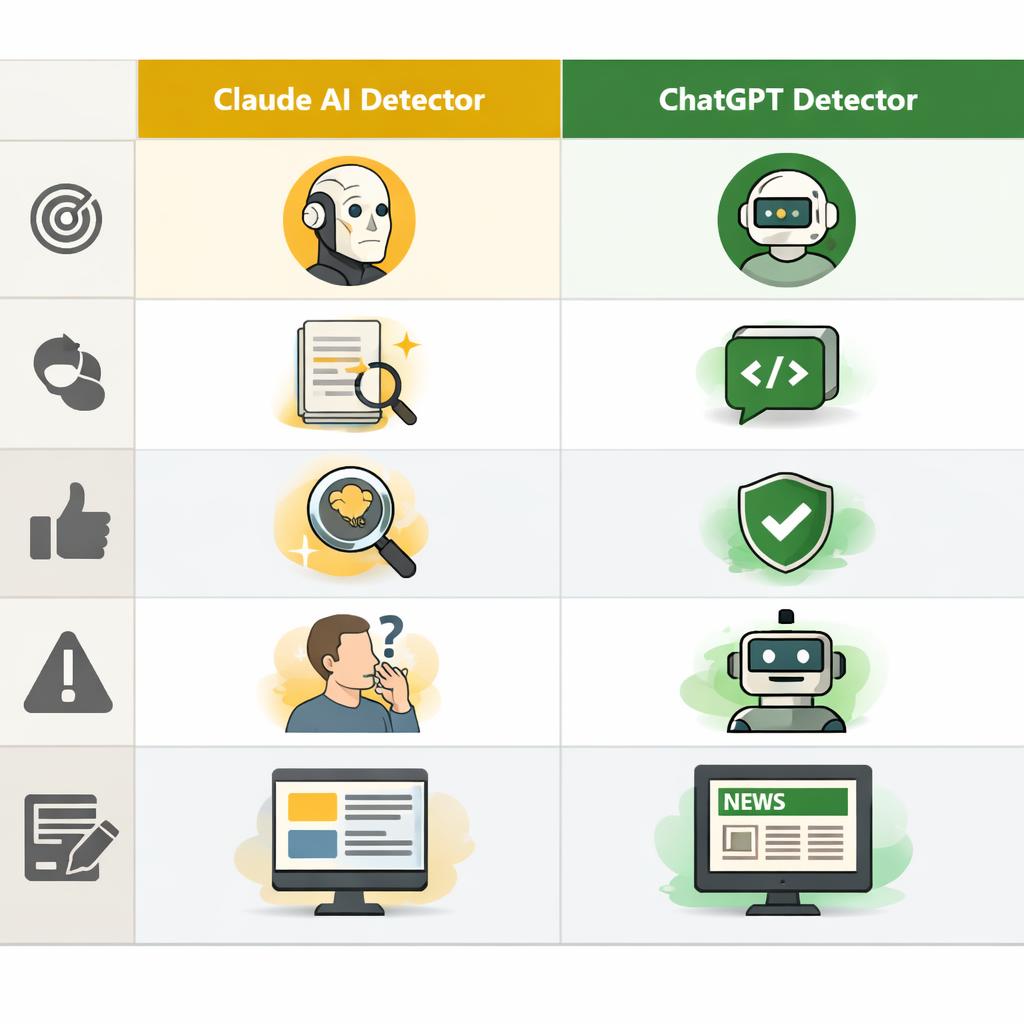
The clearest difference is tuning. A Claude-focused detector usually tries to identify traits often associated with polished, explanatory long-form writing, while a ChatGPT-focused detector may be more sensitive to conversational structure, prompt-shaped formatting, or predictable response patterns. Those are tendencies, not rules, but they influence what gets flagged and what slips through.
Another difference is score design. Some tools try to label text as matching a specific source family, while others output a broader likelihood score for machine-written text. For editorial teams, broader scoring can be easier to apply across mixed drafts. Source-family labels can be useful when your policy question is narrower, such as checking whether a submission resembles one known writing source more than another. In either case, the score is a signal for review, not proof of authorship or intent.
What each detector is usually tuned to catch
A Claude-focused detector may react more strongly to smooth transitions, balanced explanations, and structured reasoning across longer passages. A ChatGPT-focused detector may be more likely to notice familiar prompt-response pacing, list-heavy organization, repetitive framing, or conclusion patterns that feel formulaic. That does not mean each detector only works on one source. In reality, many tools still rely on broader regularities such as sentence predictability, repeated phrasing, or low variation in syntax.
That overlap is why results can get messy. A Claude-focused tool may still flag text that resembles ChatGPT output, and the reverse is also true. Both can become less reliable on short passages, heavily edited articles, translated pages, or content intentionally rewritten to sound more distinctive. For publishers, the practical takeaway is simple: detector categories may differ, but their limits often overlap too.
Which detector fits your SEO publishing workflow
If your team needs a quick first-pass screen on contributor submissions, a general detector or a flexible model-specific option may be enough. If you already know the likely source family and need targeted policy checks, comparing Claude-focused and ChatGPT-focused detectors is worth your time because the tuning may better match the question you are asking. The real issue is whether your workflow asks, “Does this look machine-written at all?” or “Does this look like it came from this type of source?”
Content type also matters. Product roundups, location pages, affiliate comparisons, and templated support content often trigger more false signals because they naturally repeat structure and phrasing. Expert commentary, opinion pieces, and original reporting may produce cleaner review signals. Mixed-author pages are especially difficult because they combine styles, revisions, and editorial cleanup. In those cases, model-specific detection may lose value fast, and a stable review process becomes more important than narrow labeling.
When model-specific detection helps and when it does not
Model-specific detection helps most when text is still fairly raw, the likely source matters to your policy, and your editors want targeted triage before deeper review. It can be useful for outsourced submissions, early draft screening, or controlled tests where you are comparing text that has not been substantially rewritten. In those situations, a detector tuned to one source family may provide a clearer signal than a broad classifier.
It helps less when articles have gone through several editing rounds, combine research with human commentary, or have been refreshed over time by multiple contributors. At that point, a score may only tell you that some automated writing patterns remain. It does not tell you whether the page is useful, original, accurate, or likely to perform well in search. That is why these tools are worth comparing for publishers who need faster screening, but not as replacements for editorial standards, fact checks, or quality review.

How to compare detectors without overtrusting scores
The best way to compare tools is to test them on your own sample set instead of relying on vendor messaging or isolated demos. Include untouched generated drafts, heavily edited versions, published pages, rewritten sections, and mixed-author articles. Then compare not just headline scores, but consistency, false positives, and whether the output actually changes what an editor does next. This is also where detector testing should connect with your broader content review workflow.
A simple fit matrix can help:
- Best fit: raw submissions, source-known drafts, narrow policy checks
- Possible fit: lightly edited commercial pages, outsourced content review, pre-publication triage
- Weak fit: mixed-author updates, translated articles, heavily rewritten posts
- Do not rely on alone: final quality approval, originality judgments, ranking predictions
When reviewing results, separate what your test actually supports from what it does not. Primary findings are behaviors clearly useful in your workflow, such as stable scoring after light edits or fewer false positives on your page types. Secondary findings are helpful but less decisive, such as source-family labeling. Exploratory findings are patterns worth watching, not reasons to roll out a tool across the whole team.
Simple test criteria for publishers before rollout
Keep the pilot small and practical. Test each detector on your real formats, check whether results stay usable after human edits, and note how often a flagged score leads to a meaningful editorial action. Include edge cases like short intros, quoted passages, comparison copy rewritten into prose, and refreshed pages with older sections left intact. A tool that only looks strong on untouched drafts may not survive real publishing conditions.
Look for practical reliability over perfect classification. Strong candidates explain scores clearly, support repeatable review rules, and help editors decide what to inspect next. Weak candidates create noise, change dramatically after minor rewrites, or encourage overconfidence. If you are comparing a first-party or branded detector in this space, it is only worth considering when it reduces upfront process friction, fits the amount of editing your team actually does, and gives results your reviewers can apply consistently. Before you choose, compare score stability, false-positive rates, mixed-author behavior, and documentation clarity against your own sample set.

Conclusion
The core judgment is that claude smart detector vs chatgpt detector differences matter most when your workflow depends on source-family pattern matching, and they matter less when content is heavily edited, blended, or reviewed mainly for broader machine-written signals. In other words, it depends on your use case. If you need narrow source checks, model-specific tuning may help. If you need dependable editorial triage across many page types, score stability and usability usually matter more.
Before rollout, run a small comparison using your published pages, raw drafts, rewritten samples, and mixed-author content. Check which tool gives the most usable signal, which one creates the fewest false alarms, and how each score holds up after editing. Then review the official product details and your internal review rules before expanding use. If you want to compare broader categories next, visit best smart detection tools for SEO publishers.
FAQ
Are Claude detectors more accurate than ChatGPT detectors?
Sometimes, but only when the text still resembles the source family the detector was tuned to identify. Once a draft has been deeply edited, merged with human writing, or translated, that advantage can shrink quickly. Accuracy also depends on your content mix, review thresholds, and whether your team prefers fewer false positives or more aggressive flagging.
Do SEO publishers need a model-specific detector or a general detector?
It depends on the use case. A model-specific detector can be useful for narrow policy checks or source-focused screening. A general detector may fit better when you need broad editorial triage across many draft types. For mixed-author workflows, usability and score consistency are often more valuable than a very specific label.
What is the difference between Claude and ChatGPT content detection in edited articles?
In edited articles, the gap often becomes smaller. Both detector types may still notice machine-written patterns, but neither can reliably identify a specific source family after substantial rewrites. That is why edited content should be reviewed with detector output plus manual checks for originality, factual support, voice consistency, and reader usefulness.
When is best smart detection tools for SEO publishers a logical next resource?
It is the right next step when you have finished a head-to-head comparison and need a wider view of detector categories, workflow fit, and rollout criteria. It is useful for teams building a review process or narrowing a shortlist. If you still have not defined your policy goal, sample set, or acceptance criteria, do that first, then use best smart detection tools for SEO publishers to compare broader options.


