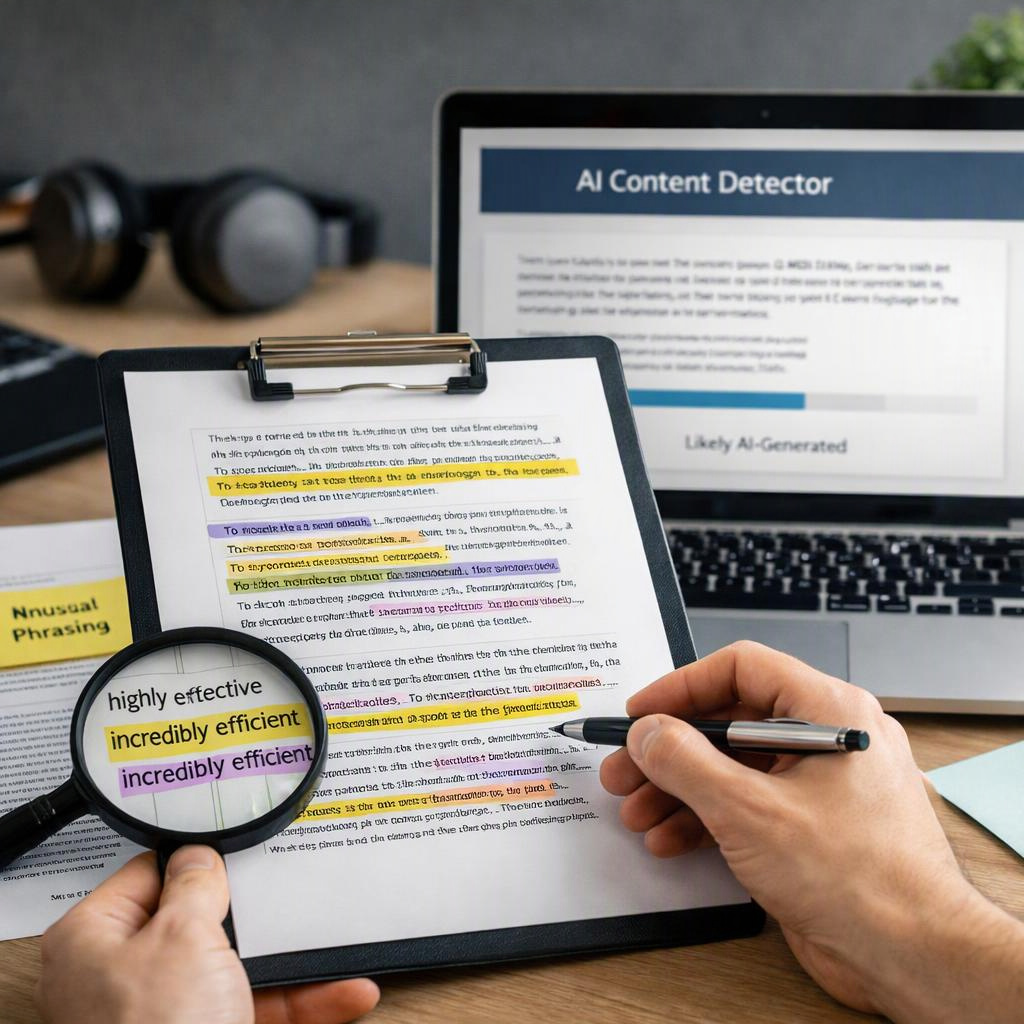

If you’re wondering how to tell if something is written by smart, the answer is: no phrase, writing style, or detector score proves authorship. The strongest approach combines close reading, cautious screening, and evidence of the writer’s process. Even then, you may need to leave the question unresolved.

Use the checklist below to decide what needs verification. A text detector is worth evaluating when you need a supplementary screening signal, but only if its documented capabilities fit your material. Before uploading text, check authorization, privacy terms, and how submissions are stored or shared.
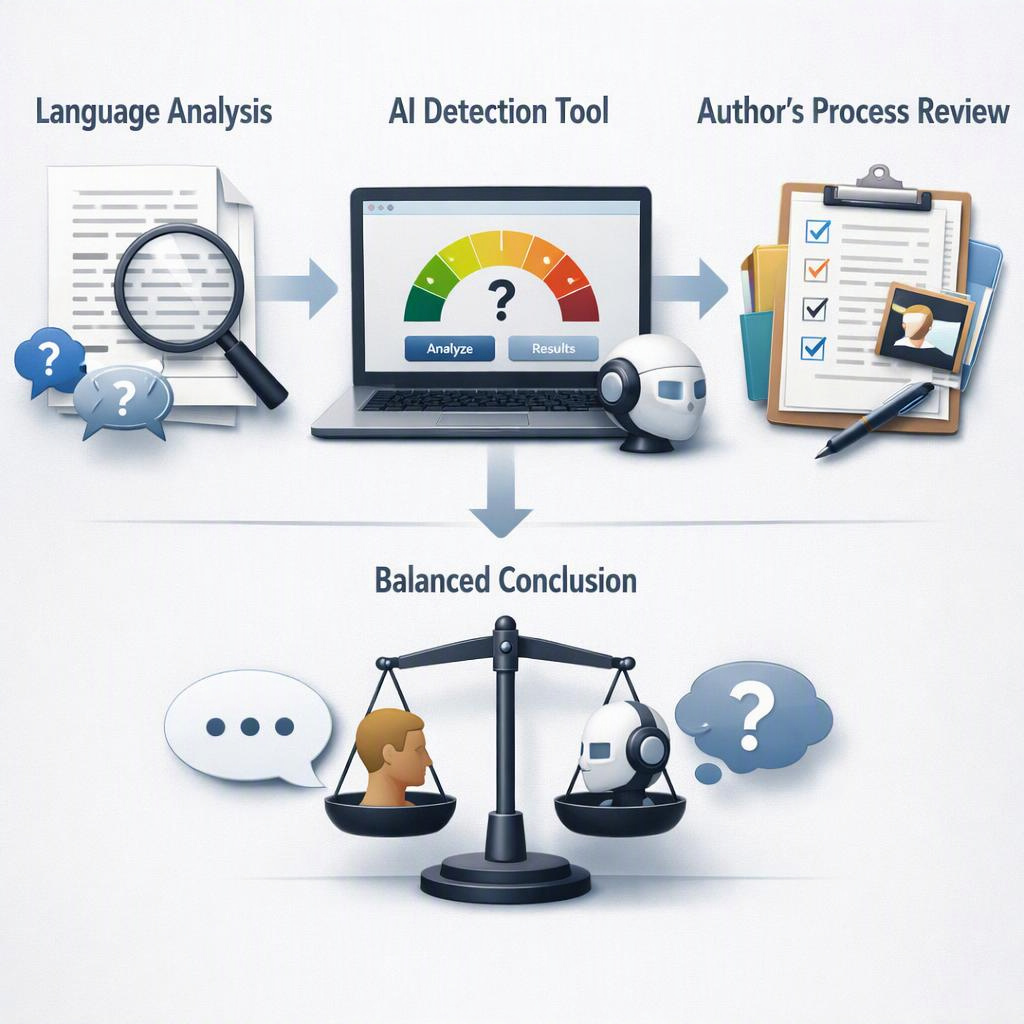
- Inspect language: Flag passages that need factual checks or clearer reasoning.
- Consider screening: Treat the result as a review prompt, not a verdict.
- Review the process: Examine sources, voluntarily shared drafts, and the writer’s explanation.
- Make a qualified judgment: Separate supported findings from unresolved questions.
First, define your concern. Are you checking factual accuracy, undisclosed assistance, or compliance with a writing policy? These require different evidence. Accurate writing can have uncertain origins, and entirely human-written work can still contain serious mistakes.
Step 1: Flag Language Patterns Without Treating Them as Proof
Read the whole passage before singling out phrases. Repetition, broad claims, predictable transitions, and sudden changes in detail can warrant closer review. None identifies machine authorship. Templates, translation, assignment instructions, and editing can all make human writing sound standardized.
Replace “this sounds generated” with a specific, testable observation. For example, ask whether a statistic has a source or whether two paragraphs make the same point. If you compare earlier work, choose a similar genre and audience. A polished report and an informal email are not useful style benchmarks for each other.
- Repetition: Does each paragraph add evidence or reasoning, rather than rephrase an earlier point?
- Generic claims: Are statements such as “research shows” tied to identifiable research?
- Formulaic transitions: Do words such as “therefore” connect a conclusion to supporting evidence?
- Uneven specificity: Are names, dates, and numbers explained and consistent throughout?
- Source integrity: Open references and confirm that they exist, support the claim, and contain any quoted wording.
Keep notes neutral. “The cited page does not support this number” identifies a fixable problem. “This number proves machine authorship” goes beyond the evidence. Correct factual errors regardless of who or what produced the draft.
Step 2: Use a Detector as a Signal, Not a Verdict
Automated screening may help you decide where to look more closely, but it cannot independently establish authorship. A false positive flags human writing; a false negative misses generated writing. Be especially cautious with short, translated, heavily edited, or mixed-origin passages, where a result may not resolve the question.
Check the tool’s documentation before interpreting a percentage. The number might represent a classification score, a share of flagged text, or another measure. It is not automatically the probability that the writer used a generator. Avoid universal cutoffs for accepting work or alleging a policy violation.
- Check suitability: Compare the passage’s language, length, and format with documented requirements and limitations.
- Check submission terms: Review retention, access, and privacy provisions. Do not upload sensitive material without appropriate authorization.
- Preserve context: Record the submitted version, review date, result, and relevant limitations without collecting unnecessary personal information.
- Avoid score shopping: Matching results do not establish independent confirmation. Conflicting results do not settle authorship either.
- Choose the next check: Investigate specific flagged passages alongside sources and process evidence. If submission is unsafe or unsuitable, skip screening.
For routine editorial review, direct source checking may be more useful than another score. A detector cannot tell you whether a quotation is accurate or whether a conclusion follows from the cited research.
Step 3: Review Drafts, Sources, and the Author’s Process
Invite the writer to share relevant outlines, drafts, revision history, or source notes voluntarily. Ask how the argument developed and why particular examples were chosen. Keep the conversation neutral: the goal is to understand the process, not demand that someone prove innocence.
These materials add context, not certainty. Missing drafts do not establish misconduct; some writers overwrite files or work in tools without revision history. Request only information relevant to the review, not access to personal accounts, devices, or unrelated documents.
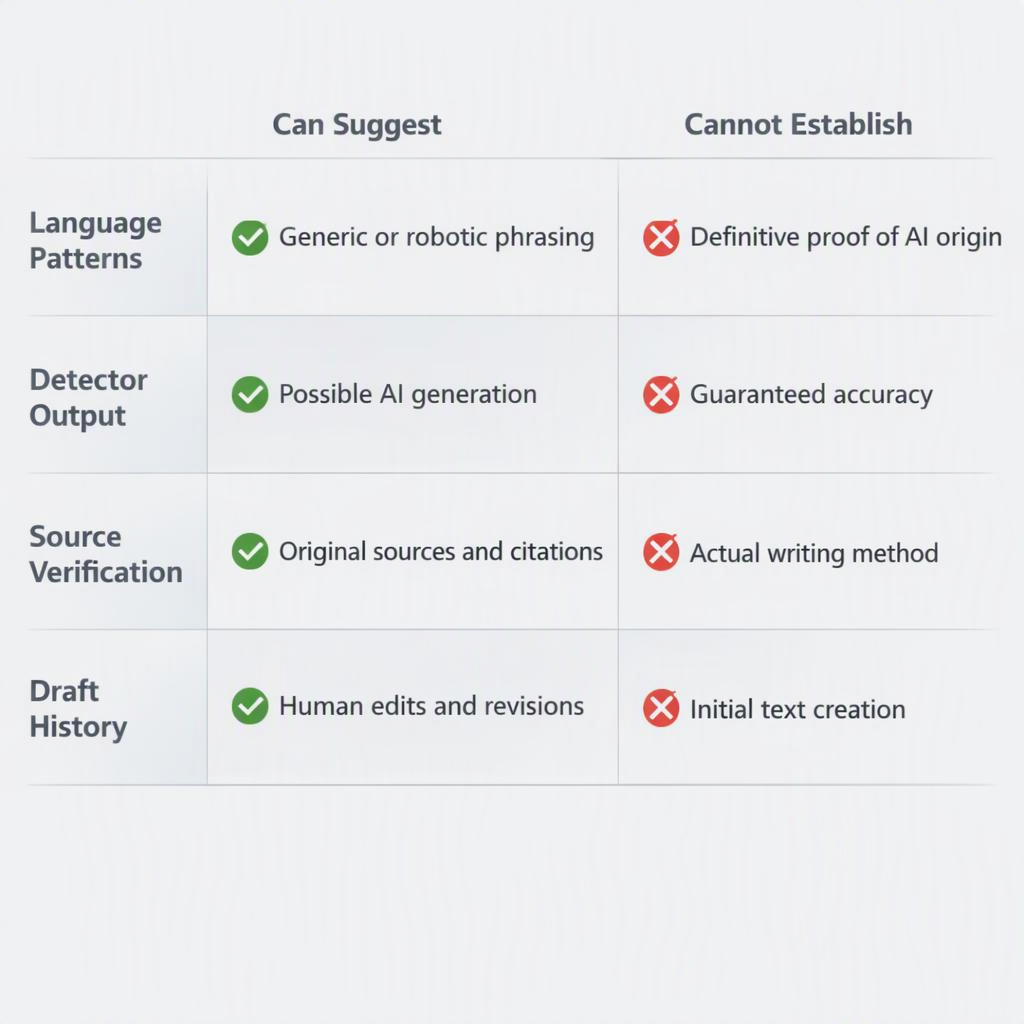
- Language patterns: Identify passages worth examining; do not establish who wrote them.
- Detector output: Supplies a screening signal; does not independently prove origin or a policy breach.
- Source verification: Tests factual support; does not identify authorship on its own.
- Draft history: May show development; cannot certify every contribution, and its absence proves little.
- Routine screening: Focus on factual corrections, clearer reasoning, and proportionate follow-up rather than labeling the writer.
- Mixed-origin text: Clarify what assistance was used, which parts it affected, and whether the applicable policy requires disclosure.
- High-stakes review: Involve qualified human reviewers, allow a fair response, and follow institutional procedures before consequential decisions. Explain both the supporting evidence and its limits.
Several weak signals do not automatically become strong proof when combined. Look for corroboration that addresses the actual concern, especially when a grade, job, or publication decision is involved.
Conclusion: Base Your Judgment on Corroborating Evidence
You cannot reliably determine authorship from style or a score alone. Close reading identifies questions, screening adds a limited signal, and process evidence supplies context. Keep accuracy, permitted assistance, and disclosure requirements separate so that uncertainty does not become an accusation.
A useful review note records the concern, evidence checked, writer’s response, and remaining uncertainty. If the evidence is inconclusive, say so. You can still ask for stronger sourcing or clearer explanations without claiming to know how every sentence was produced.
For an authorized passage that needs supplementary screening, review the detector’s suitability and submission terms. Compare supported languages, input length, score definitions, and privacy provisions first; then verify any flagged passages against sources and available drafts.
FAQ
Can you reliably identify machine-written text just by reading it?
No. Reading can reveal unsupported claims or repetitive structure, but human writing has those features too. Treat them as reasons to investigate specific passages, not proof of origin. Polished prose is not evidence of undisclosed assistance.
Can human-written text receive a suspicious detector result?
Yes. False positives are possible, and generated text can go unflagged. Interpret results within documented limitations. A suspicious score should prompt proportionate review, not an automatic penalty, rejection, or public accusation.
What if the author has no drafts or revision history?
That leaves an evidence gap, not proof of wrongdoing. Ask about source selection and writing choices without turning the discussion into a memory test. Consider available notes and applicable policy requirements, and acknowledge what remains unknown.
When is a text detector a logical option?
It may suit supplementary screening of authorized, nonconfidential material when its documented requirements match the passage. It is not suitable as sole evidence for consequential decisions. For your text, verify language support, length requirements, score meaning, and submission privacy before deciding whether screening adds useful context.