

If you’re searching for how to humanize smart text for college essays, the most effective approach is to treat any machine-written draft as raw material, not a final product. Use it to gather ideas or organize a structure, then rewrite it so the essay sounds like a real student with a distinct point of view. That means bringing in your own memories, priorities, phrasing, and reflection instead of leaning on polished but generic language. If your broader goal is to lower detection score on an essay, honest revision matters far more than cosmetic edits.

College admissions readers want writing that feels personal, credible, and clearly connected to the prompt. A generated draft can help with brainstorming, but it often smooths out emotion, overexplains obvious points, and uses language that could apply to almost anyone. The goal is not to disguise anything or make up experiences. The goal is to revise until the essay clearly sounds like you, using details only you would choose and a voice that fits your age, background, and purpose.
Why college essays need a personal, believable voice
Admissions essays are not judged the same way as a standard class paper. Readers are looking for self-awareness, judgment, and a sense of who you are beyond your grades and activities. When a draft sounds too polished, vague, or strangely formal, it can weaken trust. That is why students wondering how to make college essay text sound more human should start with credibility. A believable essay includes small specifics, natural pacing, and reflection that feels earned instead of inserted to sound impressive.
Personal voice also makes an essay easier to follow. Instead of broad lines such as “I learned the value of perseverance,” a stronger version shows what happened, why it mattered, and how your thinking changed. That approach helps you revise for natural flow while keeping the writing honest. In the broader How To Lower smart Detection Score On An Essay cluster, the same principle applies: the more your essay reflects your own choices and lived perspective, the more authentic and readable it becomes.
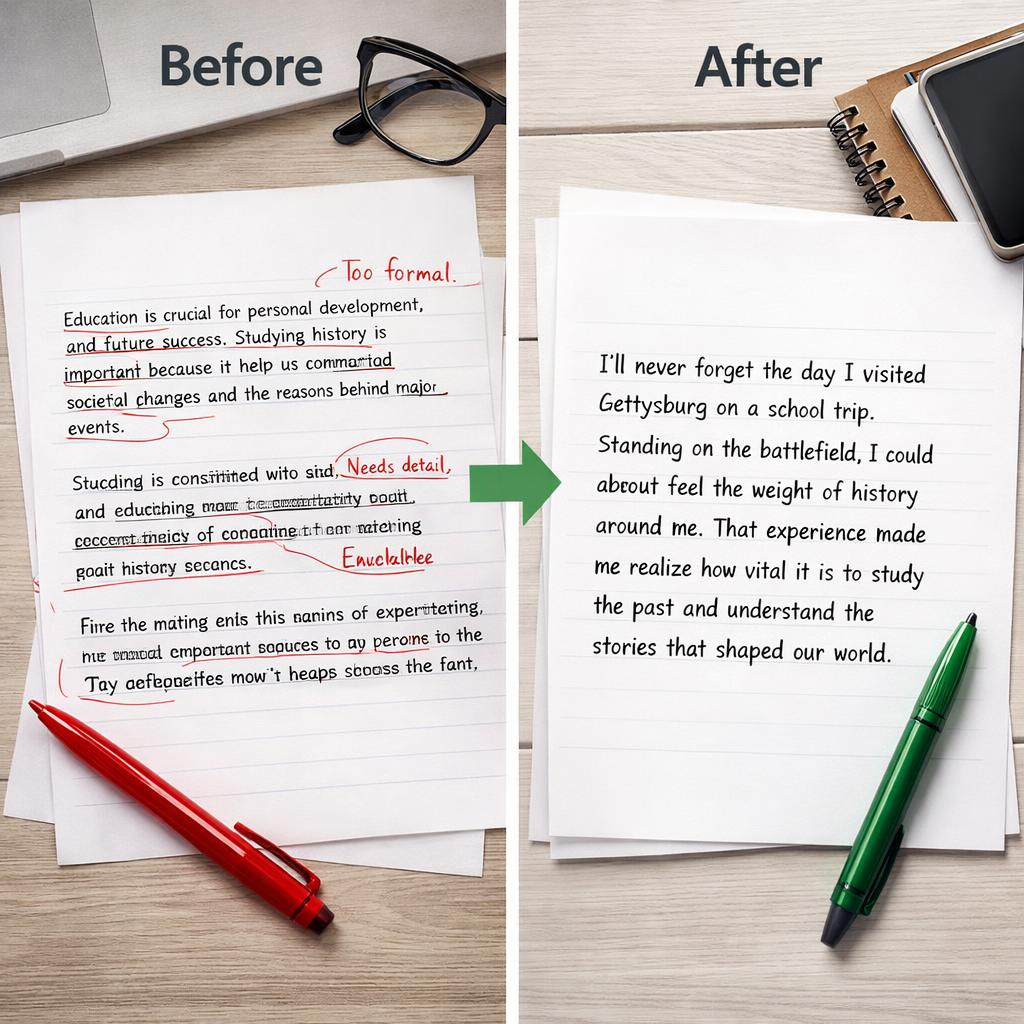
How to rewrite generic draft text into your own style
Start by highlighting lines that sound interchangeable, especially the introduction, transitions, and conclusion. Phrases like “through this experience, I discovered” or “it shaped me into the person I am today” often feel borrowed because they summarize emotion without proving it. Replace them with concrete moments, plainspoken wording, and reactions you would actually use. If you want to know how to rewrite generated essay text in your own voice, ask yourself: Would I really say this? Does this detail belong specifically to my life? Is this sentence too tidy to feel true?
A useful method is to keep the core idea but rebuild each sentence from memory. Change the rhythm, shorten obvious topic sentences, and allow one or two lines to feel a little less polished if that sounds more natural. Students trying to learn how to edit robotic essay wording for students often improve quickly when they read the draft aloud and cut anything that sounds staged. Strong college writing does not need to sound casual, but it should sound lived-in.
Add specific experiences, natural phrasing, and varied rhythm
Specificity is what turns a generic draft into a real essay. Name the bus route, the lab table, the debate round, the smell in the kitchen, or the comment your brother made before your interview. Those details create texture and make reflection believable. Natural phrasing matters too. Instead of reaching for the most elevated word, choose the one that feels exact. A sentence can still be sharp and memorable without sounding inflated. This is one of the most reliable ways to make an essay sound natural for college applications.
Sentence flow matters just as much. Real writing mixes short and long sentences, direct statements and reflective ones. Every line should not have the same shape. You can also keep a few rough edges if they sound like you, as long as meaning stays clear. Think about the difference between saying leadership taught you resilience and showing yourself missing a key instruction before a volunteer event, feeling embarrassed, adjusting the plan, and noticing how your team reacted. The second version feels more human because it carries experience instead of summary.

Conclusion
Learning how to humanize smart text for college essays is really about revision with integrity. A machine-written draft may offer structure, but a strong college essay comes from your own experience, your own wording, and your own reflection. When you replace generic phrases with concrete moments, vary sentence flow, and keep the tone believable, the essay becomes more convincing to a reader and more accurate to who you are.
The safest and most effective path is not to decorate a generic draft. It is to reshape it until the writing carries your perspective clearly. That same advice also helps anyone trying to lower detection risk on an essay: make the work personal, specific, and honest. If a sentence could describe almost any student, revise it. If it captures something only you noticed, keep building from there. For extra support, you can strengthen your personal voice before you submit.

FAQ
How can I make draft essay text sound more like my own voice?
Read it aloud and underline anything you would never naturally say. Then replace those lines with simpler wording, clearer reactions, and details from your own life. Your voice shows up most clearly in the examples you choose, the phrases you repeat naturally, and the way you interpret what happened.
What kinds of edits make a college essay feel less robotic?
Cut clichés, shorten overly formal sentences, and add concrete moments. Robotic writing usually leans on summary instead of scene, broad claims instead of evidence, and transitions that sound polished but generic. Specific details often fix all three problems at once because they make the essay sound grounded and believable.
Should I keep some imperfections in my essay?
Yes, if they reflect your natural style and do not hurt clarity. Not every sentence needs to sound perfectly balanced. A little variation in rhythm can make the essay feel more genuine, as long as grammar, meaning, and prompt fit remain strong.


