
The public evidence cited here does not establish that ordinary ChatGPT text universally contains a deployed watermark. The developer’s August 4, 2024 research update describes text-watermarking methods and questions surrounding their release. Research progress is not confirmation that every response carries a watermark. This assessment reflects those dated sources, not a live check of current deployment.

If you are investigating a chatgpt watermark, first clarify what you have found: an unusual character, a pattern in the wording, or information about how a file was created. These are different kinds of evidence. An invisible space, familiar writing style, or detector score cannot independently verify a watermark. A finding in one copied passage also cannot establish how every ChatGPT model, interface, or export behaves. The useful next step is to match your question to a check that can actually answer it.
What Public Evidence Establishes About ChatGPT Text Watermarks
The August 2024 developer update discusses watermarking, text classifiers, and metadata as separate approaches to identifying content origins. It reports watermarking research and explains limitations and release considerations. That supports a narrow conclusion: a method was researched and evaluated. It does not, by itself, document universal deployment in ChatGPT. A research proposal, a test result, an announced plan, and a released feature are not interchangeable. Older documentation should not be treated as a guarantee about today’s outputs.
For a concrete example, Kirchenbauer and colleagues’ 2023 technical paper describes a scheme that nudges generation toward selected token groups, then checks for the resulting statistical pattern. Tokens are units used to represent text, not necessarily whole words. The paper explains one published method; it does not establish that ChatGPT uses it. For any deployment claim, look for documentation identifying the product, covered outputs, release date, and verification requirements. A text detector is worth comparing when your question concerns likely generation, provided its documented scope fits your input. It is not automatically suitable for verifying a particular watermark.
Why Invisible Characters Are Not Proof of a Watermark
Invisible Unicode characters are actual characters in a text string, not proof of its origin. Some affect spacing, joining, or display without looking like ordinary printed symbols. The Unicode Standard, Version 16.0, published in September 2024, documents these behaviors. Such characters can appear through document formatting and copying workflows. A statistical watermark, by contrast, can use token-selection patterns without inserting invisible characters. Polished phrasing, repeated transitions, and distinctive punctuation are also insufficient to verify a hidden signal.
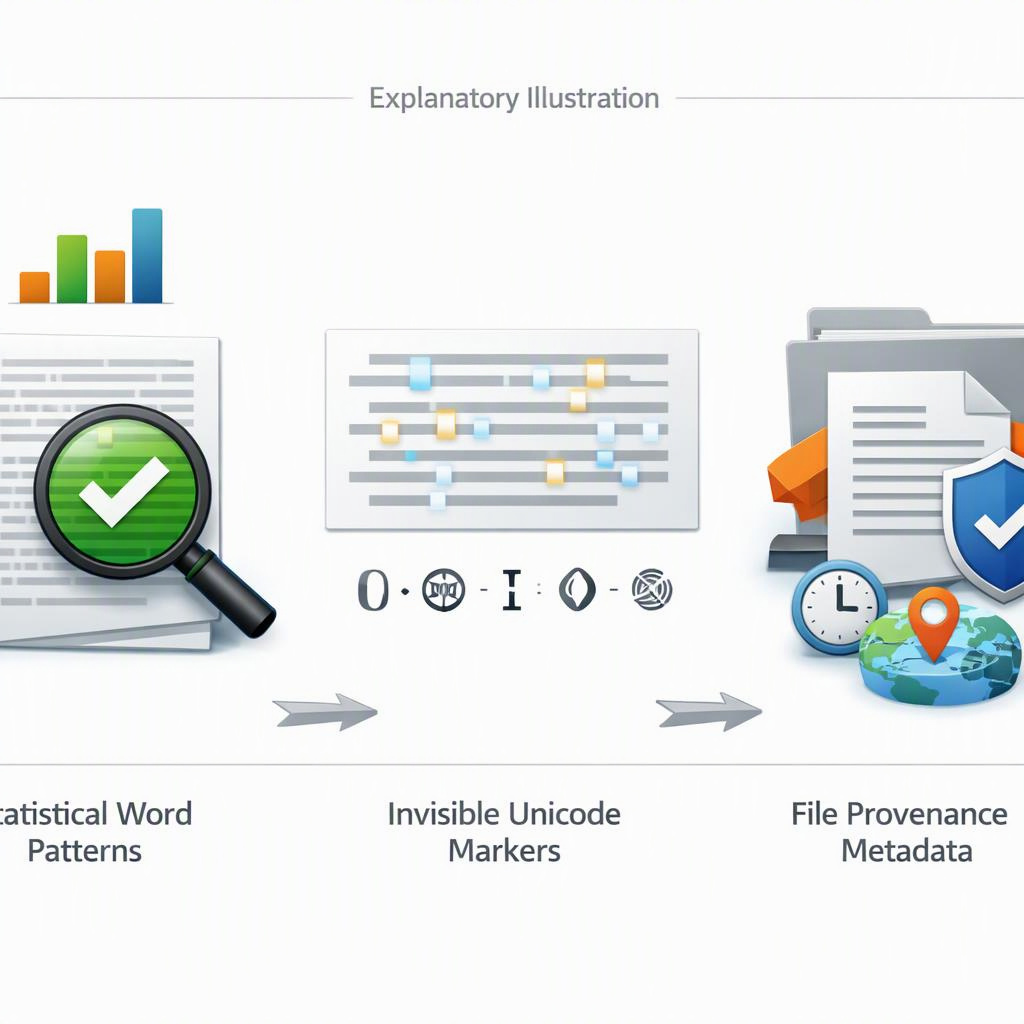
Keep these three layers separate when inspecting a passage. They describe different mechanisms, not confirmed features of ChatGPT text. Evidence at one layer does not establish what happened at another. For example, copying words out of a document may leave the document’s metadata behind.
- Statistical word-choice patterns: verification requires a named scheme and a procedure designed to detect its signal.
- Unicode characters: inspection can identify character values and explain formatting, but cannot establish who created the text.
- File-level provenance metadata: records associated with a file are separate from its plain-text wording and should not be confused with image provenance.
Which Checks Help—and What Their Results Cannot Prove
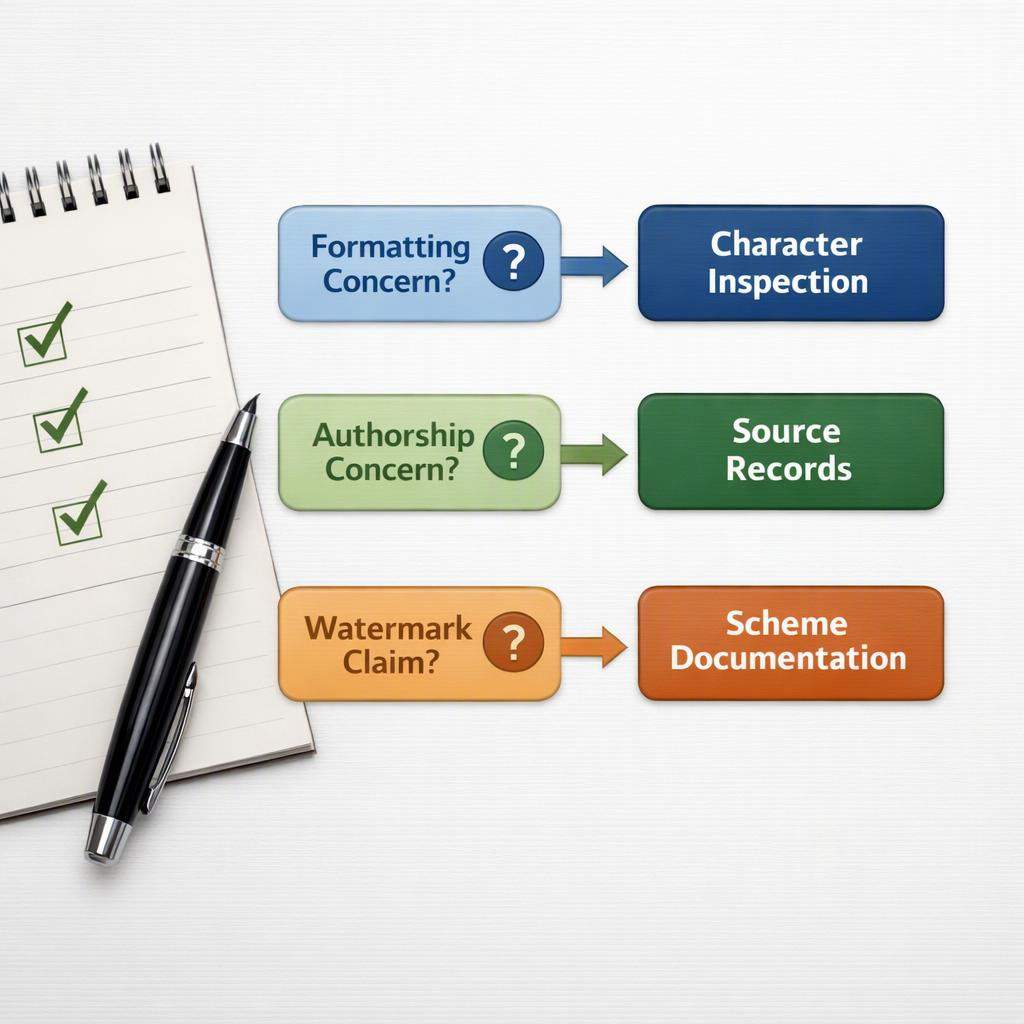
Choose your check according to the problem: broken formatting, uncertain authorship, or a specific watermark allegation. Do not rely on the strongest-sounding tool label. Depending on the scheme, verification may require a designated verifier, enough text, access to a key, or particular statistical assumptions. A general-purpose classifier does not necessarily meet those requirements.
- Unexpected formatting: inspect character values in a trusted editor. This can reveal an unusual space or joining character, but it cannot establish the character’s origin or verify a statistical watermark.
- Uncertain authorship: review drafts, version history, and available source records. These can help reconstruct the writing process, although gaps may leave some questions unresolved.
- A named watermark claim: follow that scheme’s documented verification procedure. Interpret the result within its stated conditions, rather than extending it to all generated text.
- A question about likely generation: consider classification only within the tool’s documented scope. Its output is an assessment, not proof of authorship or confirmation of watermark status.
For grading, publication disputes, or disciplinary decisions, seek corroborating evidence and let the writer explain their process. Record what was checked and what remains unknown. A preliminary result should not become a definitive attribution simply because it includes a score.
Conclusion
A ChatGPT watermark claim needs evidence of both a specific mechanism and its deployment. The August 2024 update cited here documents research and release considerations; it does not establish that every current ChatGPT passage is watermarked. It also does not justify an unconditional claim that no watermark could exist. Invisible characters and recognizable prose habits cannot settle that question.
If pasted text looks wrong, start with character inspection. If authorship is disputed, compare drafts and source records. If someone claims a watermark is present, request the scheme’s documentation and applicable verifier. For preliminary classification, review the detector’s stated scope before submitting text: compare supported inputs, published limitations, and data-handling terms with your needs. Those checks help you choose a relevant method while avoiding conclusions the result cannot support.
FAQ
Does a chatgpt watermark remover actually remove a verified watermark?
The label alone proves nothing. A credible claim must identify the scheme, demonstrate that its signal was present, and provide an applicable verification result afterward. Changing spacing or wording does not independently show that a verified watermark existed or was removed.
Can copying, reformatting, or rewriting remove generated-text watermarks?
It depends on the mechanism. Copying can affect characters or metadata; rewriting changes token sequences. Neither action alone establishes what happened to a statistical signal. The cited 2023 paper examines robustness for its own scheme, not an independently documented ChatGPT deployment.
Does a negative check prove that a passage came from a person?
No. A watermark check tests one scheme under specified conditions. A negative result does not prove human authorship. Likewise, a classification result cannot certify that an unrelated watermark is absent. The conclusion must stay within the test’s documented scope.
When is a text detector a logical option?
It may help with preliminary classification when its documented purpose matches your question. It cannot replace character inspection or scheme-specific watermark verification. Before using one for an authorship review, compare its supported inputs, evidence limits, and privacy terms, then check drafts and source records before making a consequential judgment.


