
Yes, essay drafting support can be used responsibly in education, but only when the student remains the real author, the assignment or course policy allows that level of help, and any required disclosure, citation, and source checks are completed before submission. In practical terms, responsible smart use in education for essay drafting is less about the tool and more about authorship, transparency, and whether the support strengthens learning instead of replacing it.

For most students and educators, the safest approach is to use generative writing support for planning, structure, and revision rather than as a substitute for original thinking. That lines up with the policy concerns behind academic integrity rules for classroom writing tools: each school, instructor, and assignment may set different limits, so acceptable use depends on the context.
It also helps to stay realistic about what policy guidance can and cannot tell you. It may show common recommendations and likely risk areas, but it does not prove that every school permits the same practices, that every generated source is trustworthy, or that authorship can be judged by a detector alone. Students still need to verify facts, follow local rules, and make sure the final work reflects their own understanding.
When essay drafting help is responsible in education
Acceptable uses: brainstorming, outlining, and revision support
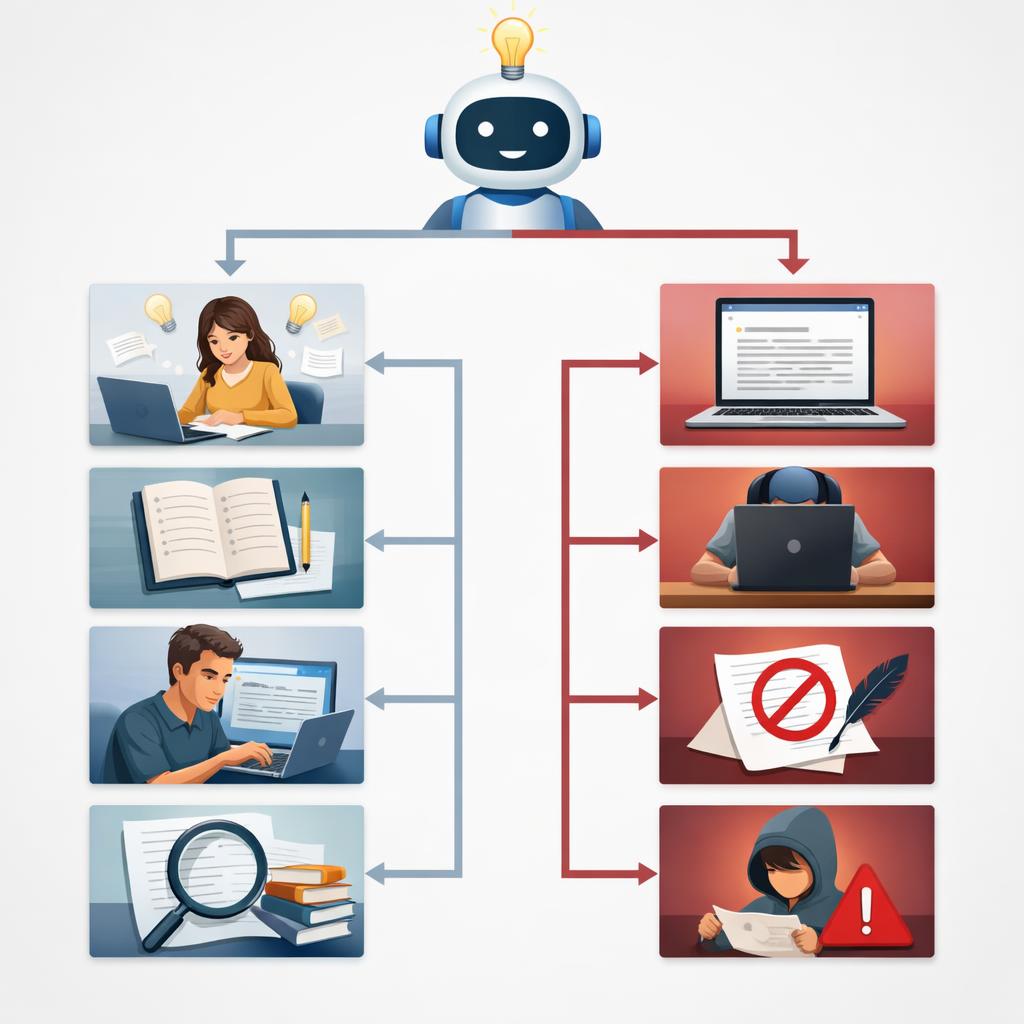
Responsible use usually starts where the student still does the real thinking. That can include generating topic ideas, testing thesis options, building a rough outline, improving awkward phrasing, or asking for feedback on clarity, organization, and tone. In those cases, the student still selects the argument, checks the evidence, writes the analysis, and decides what belongs in the final paper.
This is the clearest answer to whether generative support can fit school writing: yes, but usually only when help stays limited and the student remains accountable for the final submission. A student might ask for sample outline formats, transitions between paragraphs, or sentence-level edits. An instructor might allow planning help but ban generated body paragraphs. Those distinctions matter because they preserve the skills the assignment is supposed to measure, including reasoning, evidence use, and critical reading.
Unacceptable uses: hidden ghostwriting and source fabrication
Use becomes much harder to defend when the system does the intellectual work the assignment is meant to assess. That includes submitting generated paragraphs as if they were student-written, asking for a full essay and lightly rewording it, or using invented citations, quotations, or page numbers without checking them. Even polished language does not make hidden ghostwriting acceptable.
The biggest risks are often not style-related but evidence-related. Generative systems can produce confident but unsupported claims, misread sources, or create references that look real but do not exist. That is why students need clear boundaries: do not submit generated analysis as your own, do not rely on unverified citations, and do not assume that fluent wording means the content is accurate or allowed under course rules.
A simple decision framework for students and educators
Check authorship, disclosure, citation, and course policy before use
A simple framework can make decisions more consistent. First, ask what the assignment is actually measuring: idea generation, close reading, drafting skill, revision, or independent argument. If the support would replace the exact skill being assessed, it is probably the wrong fit. Second, ask whether the student can still honestly say, “I am the author of this work.” Third, check whether the instructor, department, or school requires disclosure of drafting assistance. Fourth, verify every fact, quotation, and source before submission.
This framework also helps separate what is strongly supported from what is more conditional. Primary recommendations include preserving student authorship, following assignment rules, and checking all sources manually. Secondary recommendations may include saving prompts, keeping draft history, or writing a brief process note if an instructor wants more transparency. Exploratory options might include class-specific reflection statements or local disclosure forms. What the evidence does not support is a universal rule that applies everywhere.
For the evidence step, students should review how to verify sources before submitting an essay so quotations, citations, and factual claims are checked against reliable materials.
- Good fit: brainstorming, outlining, revision suggestions, readability checks, and comparing possible directions.
- Poor fit: hidden full-draft generation, fabricated sources, invented quotes, and assignment-specific analysis produced for the student.
- Always verify: course policy, authorship, disclosure expectations, privacy limits, and every cited source.

Conclusion
Responsible smart use in education for essay drafting is possible, but only within clear limits. The student must remain the author, any required disclosure should be made, and all facts, quotations, and references need to be checked against dependable sources. In most cases, the most defensible uses are brainstorming, outlining, and revision support, while hidden ghostwriting and fabricated citations create the greatest academic integrity risks.
If you are deciding whether a specific approach is appropriate, compare the assignment goal, your course or school policy, the level of drafting help involved, and the verification steps you can realistically complete. It is also worth comparing guidance such as a classroom policy template for generative writing support if you need a practical framework for authorship, disclosure, and source checking rather than a shortcut to produce essays. Before you submit or approve any draft, check policy fit, disclosure requirements, source accuracy, and whether the final paper still reflects genuine student work.

FAQ
Is it ever acceptable to use generative tools for essay drafting in school?
Yes, but only in some settings. It depends on the instructor, the assignment, and whether the student still does the core intellectual work. Planning, brainstorming, and revision help may be allowed more often than full-draft generation. The safest step is to check the course rules before using any support.
What parts of the essay process can students use generative tools for responsibly?
In many cases, prewriting and editing are easier to justify than analysis or final drafting. Students may use support for topic narrowing, outline creation, sentence-level clarity, or feedback on organization. They should be much more cautious with thesis development, textual interpretation, quotations, citations, and factual claims, because those areas usually require direct authorship and careful verification.
How should a student disclose drafting support if a class allows it?
The right method depends on the policy. Some instructors want a short note explaining what kind of help was used, such as outline support or revision suggestions. Others may ask for saved drafts, prompt records, or a reflection memo. If the policy is unclear, the student should ask before submitting so there is no confusion about authorship.
When is the Responsible smart Use In Education For Essay Drafting cluster guidance a logical option to compare?
It makes sense to compare that guidance when a student, teacher, parent, or writing center needs a policy-and-process framework rather than a way to generate essays quickly. It is most useful when the goal is to clarify authorship, disclosure, source verification, and assignment fit. It is not a good fit for anyone looking to bypass course rules or replace original student writing. Before relying on any framework, verify school policy, assignment expectations, privacy considerations, and source-checking requirements.


