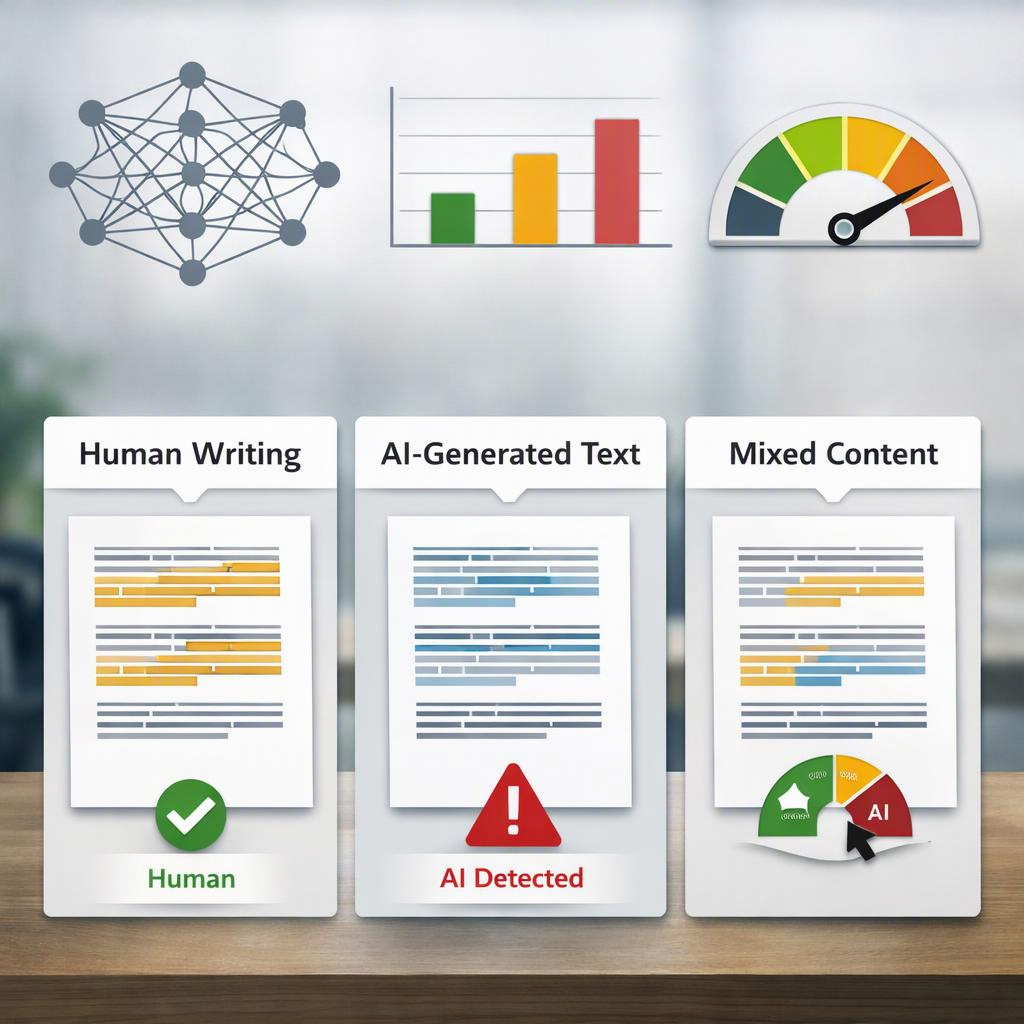

The short answer to “how do smart detectors work” is that they look for patterns associated with machine-generated writing. Some use trained classifiers; others examine statistical signals, such as word predictability. They estimate how text resembles examples, not who wrote it. A percentage from one tool may also mean something different in another.

For educators, editors, and writers, the useful question is whether a detector can support the review at hand. You can review the text detector as a candidate for preliminary screening because it may offer another signal alongside drafts and source checks. However, its supported inputs, scoring, privacy practices, and performance have not been verified here.
This guide explains the methods, score meanings, and checks that matter before using a result. The sample framework is illustrative, not a product test: it contains no measured outputs, accuracy figures, or rankings. Use it to organize a comparison, not predict how a passage will be labeled.
How Detectors Turn Writing Patterns into Classifications
A trained classifier learns from examples labeled as human-written or generated, then applies those learned patterns to unfamiliar passages. Statistical methods instead, or additionally, examine how likely a sequence of words is under a reference language model. One measure is perplexity: lower perplexity means the model finds the wording less surprising. That does not make predictable writing proof of machine authorship.
Some methods examine variation across sentences; others take a different approach. The research paper DetectGPT, for example, investigates how a model’s assigned probabilities change after small alterations to a passage. It is worth comparing at the method level when assessing research approaches, but it does not describe every commercial service. Performance depends on the writing domains and generators represented in testing.
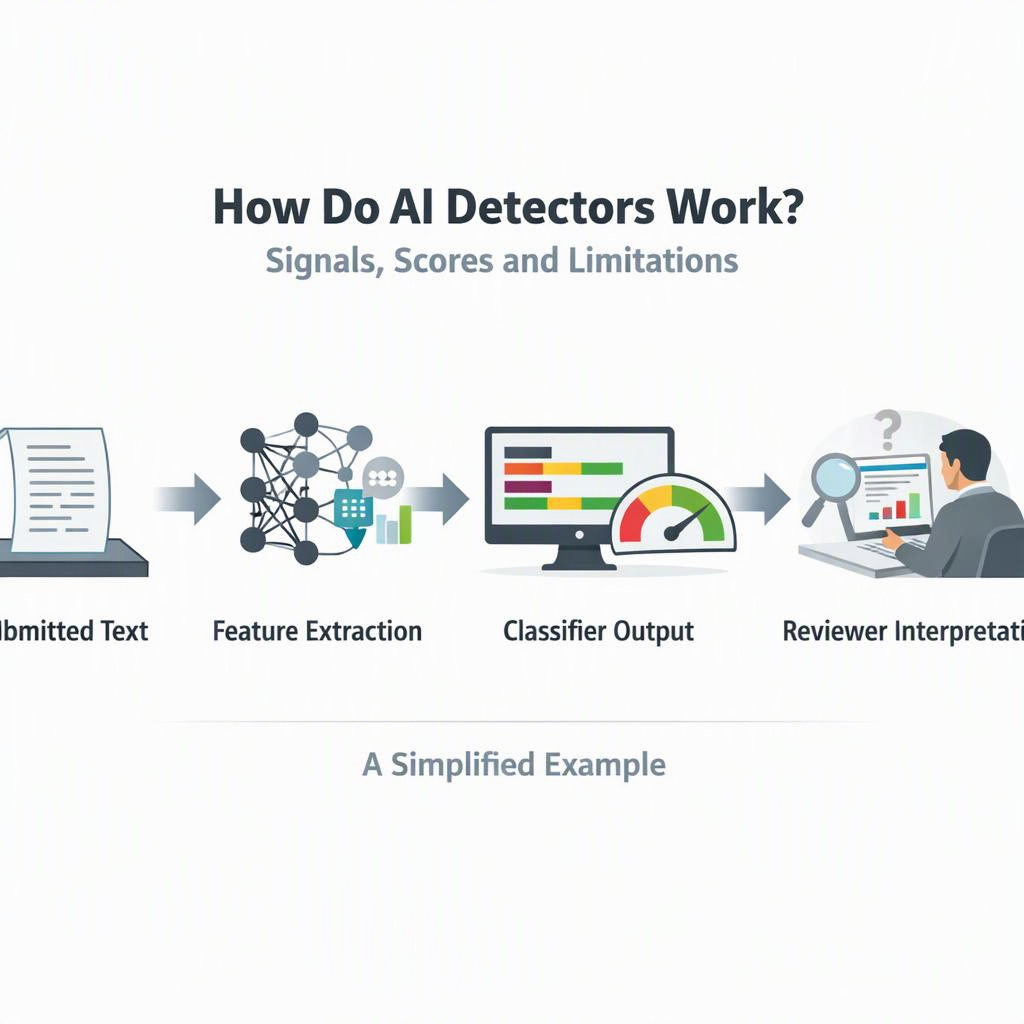
- Simplified workflow: Submitted text → extracted features or learned representations → classification output → reviewer interpretation. The details vary by tool.
- Authorship classification: Estimates whether writing resembles labeled examples; it does not reconstruct the drafting process.
- Plagiarism matching: Searches for overlap with accessible sources. Copied text and generated text are different concerns.
- Provenance evidence: Draft history or documented generation logs provides evidence about production, rather than style alone.
How to Read Scores Across Human, Generated, and Mixed Text
Before interpreting a percentage, check what it measures. A classification score indicates the strength of a model output. A flagged-text proportion describes how much eligible text was marked. A calibrated probability needs validation showing that predictions match observed frequencies under specified conditions. None automatically means “the probability this writer used generation tools.” Look for the score definition, denominator, and decision threshold.
A false positive flags human writing; a false negative misses generated writing. Precision measures how many flagged examples are actually generated, while recall measures how many generated examples are caught. Changing a threshold can trade one kind of error for another. Reported accuracy also depends on language, passage length, dataset composition, and the balance between human and generated examples.
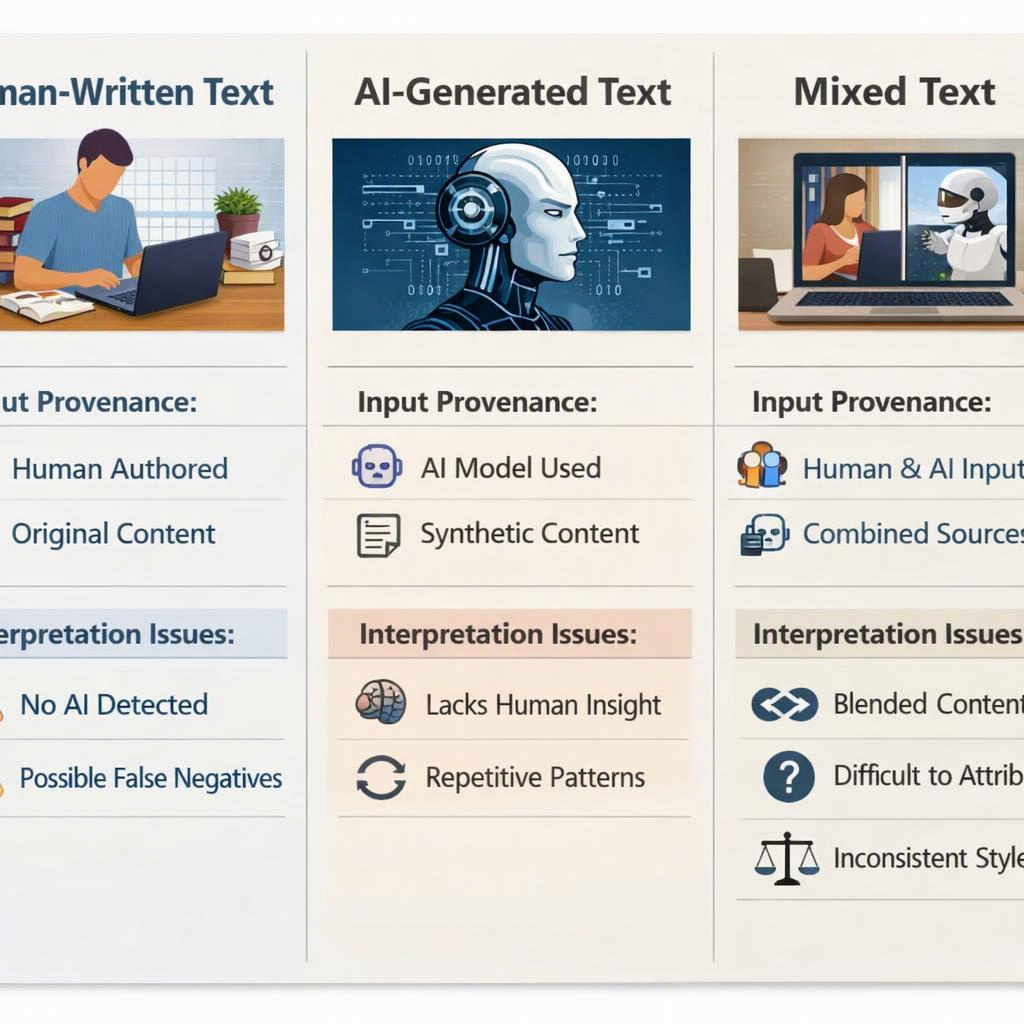
- Illustrative human sample: Choose consented or appropriately licensed writing with documented authorship. A generated-text label would call for investigation, not automatic acceptance.
- Illustrative generated sample: Save the prompt, generator version, and unedited output. A human-text label would not override that record.
- Illustrative mixed sample: Document generated portions and human revisions. A whole-document score may hide differences between passages.
- Record for each sample: Note provenance, word count, detector version, test date, original label, and interpretation. These examples are untested; actual results may overlap.
When Detection Software Helps—and When to Check Other Evidence
Detection software is best treated as an optional screening aid. Start by defining the concern: unauthorized writing assistance, copied passages, inaccurate claims, or something else. Each requires different evidence. A detector cannot settle all these questions, and a polished or formulaic style is not a reliable substitute for checking how the work was produced.
- Preliminary editorial screening: May help prioritize closer reading, provided a flag is treated as a prompt for review rather than a finding.
- Short, translated, heavily edited, or mixed passages: Need extra caution and evidence that the tool has been evaluated on comparable inputs.
- Disciplinary or other consequential decisions: Need corroborating evidence, transparent procedures, and a fair opportunity for the writer to respond.
- Software comparison: Check supported languages, minimum length, evaluation datasets, false-positive rates, score definitions, and retention, deletion, and sharing practices.
Favor documented testing over rankings without supporting evidence. Ask whether evaluations include writing like yours and generators relevant to your workflow. Compare flags with draft history, verified sources, and a neutral discussion with the writer. Missing drafts alone prove little because records can be incomplete. Check citations and factual claims directly: these checks can reveal substantive problems regardless of how a passage was composed.
Conclusion: Treat Detection as a Signal, Not Proof
Machine-written text detectors classify patterns; they do not establish authorship. They can support preliminary review, but only when the inputs, score meanings, and evaluation evidence fit the task. Human, generated, and mixed writing can receive overlapping classifications, so a confident label should not replace independent evidence.
If you review submissions or manuscripts, check the detector’s suitability before submitting text. Compare its supported languages, minimum passage length, score definitions, and relevant error rates with your workflow. Check retention and sharing policies before using a permitted, non-sensitive sample. If those details are unavailable, request clarification first.
Then compare the output with drafts, verified sources, and the writer’s explanation. Record unresolved questions rather than turning a percentage into an accusation. This keeps the tool in a supporting role and the decision grounded in the applicable writing rules.
FAQ
Can a detector establish who wrote a passage?
No. It classifies text using learned patterns or statistical measures; it does not identify an author. Even a confident label needs context. Draft records and documented generation logs can provide independent evidence, although each record still needs careful interpretation.
Why can human-written text receive a generated-text label?
Human and generated writing share patterns. Formulaic wording, constrained assignments, or material unlike the tool’s evaluation data can complicate classification. Review the documented limitations and supporting evidence rather than assuming misconduct from the label.
How should mixed human and generated text be evaluated?
Record generated portions and subsequent edits where possible. Check whether the tool supports mixed text and reports passage-level or whole-document results. A flagged proportion is not a verified breakdown of what each contributor wrote.
When is the linked text detector a logical option?
It may suit preliminary, low-stakes screening if its documentation matches your material; it is not sole evidence for consequential decisions. Before testing a permitted sample, compare supported inputs, score meanings, relevant error rates, and privacy terms to decide whether its results would usefully inform your review.